
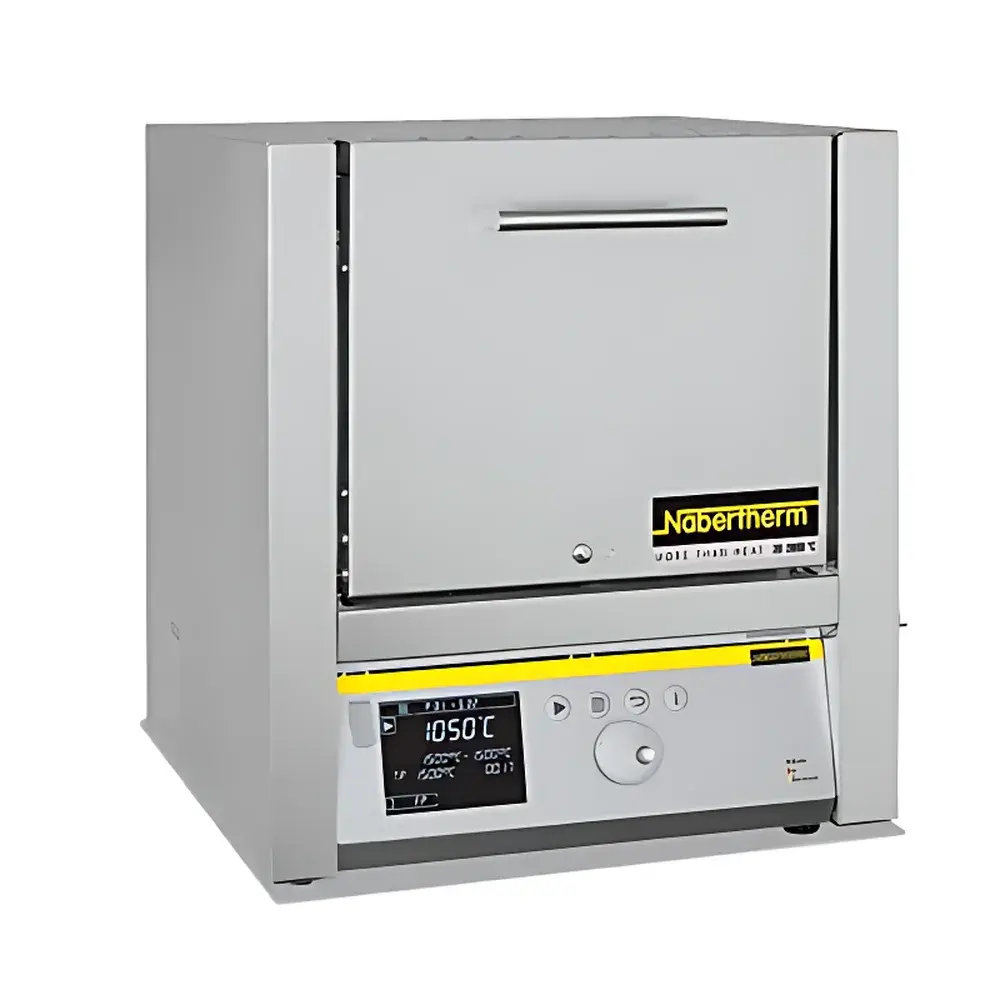
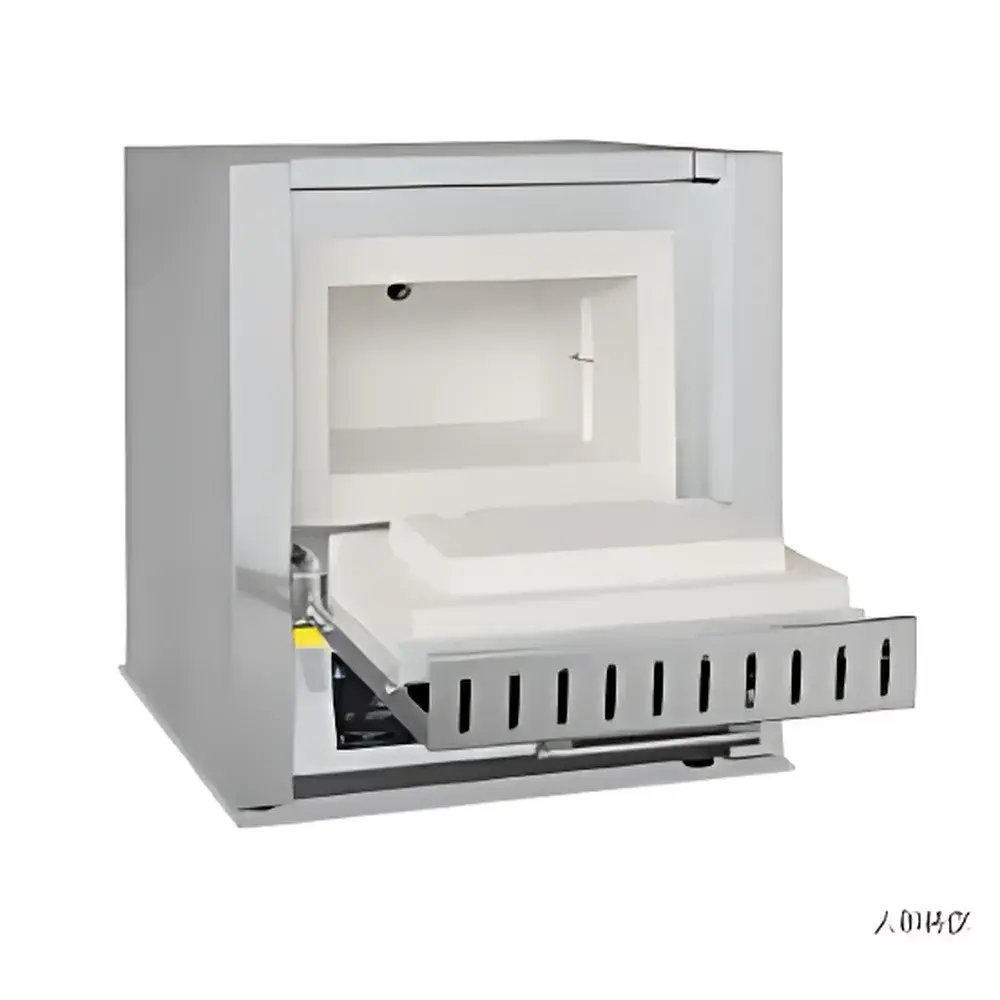
Nabertherm L15/11/B410 Benchtop Muffle Furnace
| Brand | Nabertherm |
|---|---|
| Origin | Germany |
| Model | L15/11/B410 |
| Type | Box-Type Muffle Furnace |
| Max. Temperature | 1100 °C |
| Temperature Uniformity | ±3 °C |
| Rated Power | 3.5 kW |
| Heating Time to Max. Temp. | 90 min |
| Internal Dimensions (W×D×H) | 230 × 340 × 170 mm |
| Chamber Volume | 9 L |
| Heating Method | Electric (Dual-Sided Ceramic Heating Panels with Embedded Resistance Wire) |
| Construction | Double-Walled Stainless Steel Housing (Brushed Finish), Ceramic Fiber Insulation, Safety-Grade Refractory Liner |
Overview
The Nabertherm L15/11/B410 is a precision-engineered benchtop muffle furnace designed for routine thermal processing in academic, pharmaceutical, and industrial R&D laboratories. Operating on the principle of radiant heat transfer within an electrically heated, fully insulated chamber, it isolates samples from direct contact with heating elements—ensuring contamination-free thermal treatment essential for ashing, calcination, sintering, and heat-treatment protocols. Its dual-sided ceramic heating panels integrate high-stability resistance wire and are recessed behind protective ceramic layers, minimizing exposure to volatiles or splashes while enabling rapid thermal response and long-term element integrity. The furnace conforms to EN 60519-2 for electrical safety in industrial heating equipment and incorporates Class 2 thermal protection with independent overtemperature cutoff—critical for unattended operation under GLP/GMP-aligned workflows.
Key Features
- Robust double-walled stainless steel housing (brushed finish) with optimized air-gap insulation—reducing external surface temperature to <50 °C at maximum operating conditions.
- Ceramic fiber insulation system rated for continuous service up to 1100 °C; non-combustible, low thermal conductivity, and compliant with EU REACH and RoHS directives.
- Four-segment programmable controller (B410) with ramp-soak functionality, real-time process visualization, and USB-based data logging via NTLog software (supports CSV export for traceability).
- Integrated adjustable air inlet on door and rear-mounted exhaust port—enabling controlled atmosphere conditioning using inert or reactive gases (e.g., N₂, Ar, forming gas) via optional gas interface kit.
- Low-noise solid-state relay (SSR) switching ensures stable power delivery and eliminates mechanical relay wear, supporting >100,000 operational cycles under laboratory duty cycles.
- Optional external door hinge (L-type configuration) facilitates horizontal loading of fragile or oversized samples without vertical lifting constraints.
Sample Compatibility & Compliance
The L15/11/B410 accommodates standard crucibles (alumina, platinum, quartz), ceramic boats, and metal trays up to 230 mm wide × 340 mm deep × 170 mm high. It supports ASTM E1529 (fire-test-response standards), ISO 1171 (ash content determination in fuels), USP (residue on ignition), and AOAC 942.05 (food ash analysis). All internal refractory components meet DIN 51066 for thermal shock resistance and are certified free of asbestos and heavy-metal binders. Optional catalytic exhaust units comply with VDI 3870 for organic vapor abatement, while flue-gas torch systems meet EN 746-2 for post-combustion safety in solvent-rich applications.
Software & Data Management
NTLog software enables full process documentation—including time-stamped temperature profiles, setpoint deviations, SSR status, and alarm logs—exportable in CSV format for audit-ready reporting. When paired with VCD (Virtual Control Device) software, users gain remote monitoring and multi-furnace synchronization capabilities via Ethernet or USB. All logged data include digital signatures and immutable timestamps, satisfying FDA 21 CFR Part 11 requirements for electronic records when deployed with validated user access controls and audit trail activation. Firmware updates are delivered via secure HTTPS channel and verified via SHA-256 checksum.
Applications
- Pharmaceutical QA/QC: Residue-on-ignition testing per USP , loss-on-drying validation, catalyst recovery.
- Food & Agriculture Labs: Total ash quantification (AOAC 942.05), mineral content analysis, feedstock characterization.
- Materials Science: Pre-sintering of oxide ceramics, binder burnout in green bodies, glass transition studies.
- Metallurgy & Foundry R&D: Heat treatment of small alloy specimens, flux residue removal, oxidation behavior assessment.
- Environmental Testing: Soil/sediment ash correction, filter media conditioning prior to ICP-MS digestion.
FAQ
What is the recommended maintenance interval for the ceramic heating panels?
Annual visual inspection and resistance verification are advised; replacement is only required if measured resistance deviates by >10% from factory specification or physical damage is observed.
Can the furnace be operated under vacuum or reduced pressure?
No—the L15/11/B410 is not rated for vacuum service. It is designed exclusively for ambient-pressure or positive-pressure inert gas environments.
Is the B410 controller compatible with third-party SCADA systems?
Yes—via optional RS485 Modbus RTU interface (requires separate communication module, part no. 631000810), enabling integration into LabVantage, DeltaV, or Siemens Desigo CC platforms.
Does the unit ship with calibration documentation?
Each furnace includes a factory-issued temperature uniformity report (measured at 900 °C and 1100 °C per DIN EN 60519-2 Annex D) and NIST-traceable thermocouple calibration certificate.
What safety certifications does this model hold?
CE-marked per Machinery Directive 2006/42/EC and Low Voltage Directive 2014/35/EU; additionally certified to UL 61010-1:2012 and CSA C22.2 No. 61010-1-12 for North American deployment.



