
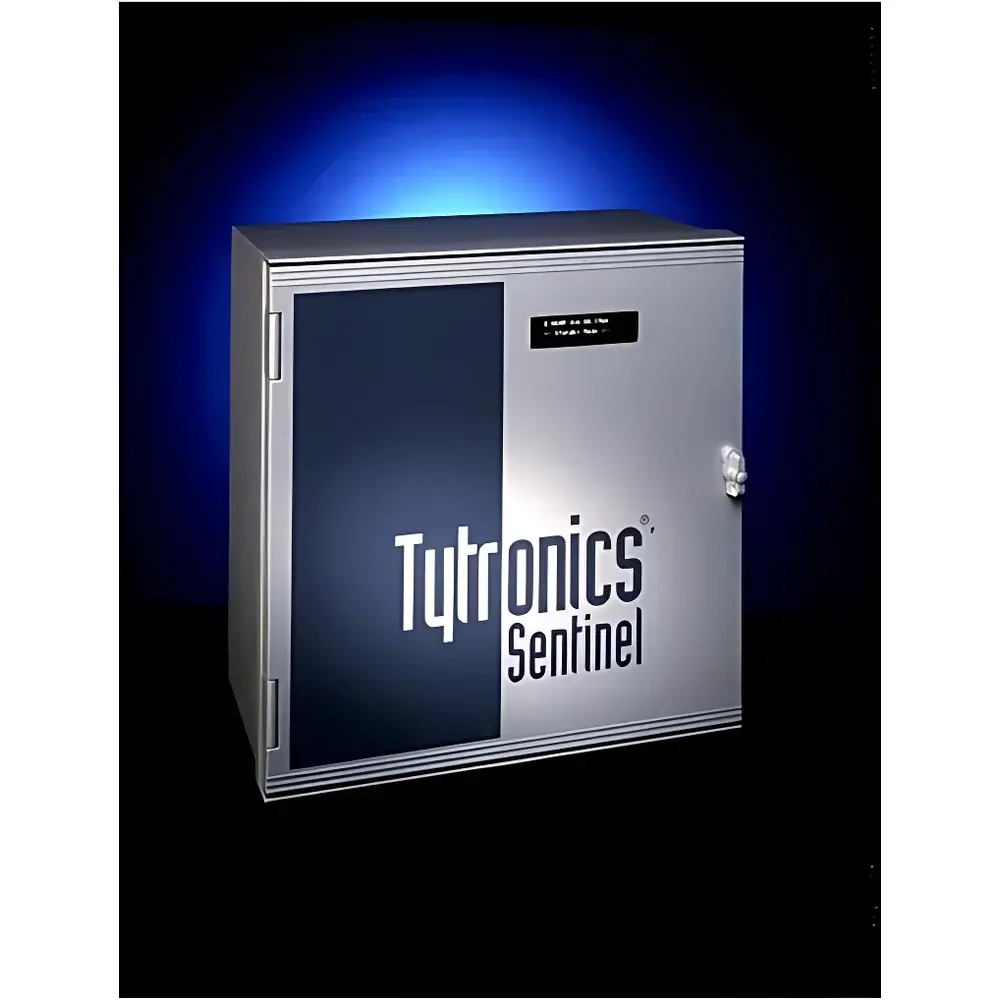
Tytronics Sentinel Cu Ion Online Monitor
| Origin | USA |
|---|---|
| Manufacturer Type | Authorized Distributor |
| Origin Category | Imported |
| Model | Sentinel Cu Ion Online Monitor |
| Instrument Type | Multi-Ion Analyzer |
| Measurement Principle | Colorimetric Spectrophotometry (Bathocuproine or Neocuproine Method) |
| Range | 0–10 ppm (Low), 0–20 ppm (High) |
| Accuracy | ±2% of reading or full scale |
| Resolution | 0.001 ppm |
| Repeatability | ±2% of reading or full scale |
| Cycle Time | 5–15 minutes |
| Sample Flow Rate | 50–900 mL/min |
| Sample Temperature | 5–70 °C |
| Max Suspended Solids | 2% w/w, particle size ≤1.27 mm |
| Sample Pressure | 0–50 psig |
| Sample Interface | 1/4" compression fitting |
| Waste Outlet | 3/4" NPT male, atmospheric discharge |
| Analog Output | 4–20 mA, user-configurable |
| Alarm Outputs | Programmable digital relays |
| Power Supply | 100–240 VAC, 50/60 Hz |
| Enclosure Rating | NEMA 4X (IP65) |
| Mounting | Wall-mounted with integrated hardware |
| Dimensions (W×H×D) | 387 × 406 × 210 mm |
| Weight | ~36 kg |
Overview
The Tytronics® Sentinel Cu Ion Online Monitor is a fully automated, laboratory-grade colorimetric spectrophotometer engineered for continuous, real-time quantification of total dissolved copper (Cu²⁺) in aqueous streams. It operates on the well-established principle of selective reduction and complexometric color development: Cu²⁺ is first reduced to Cu⁺ by hydroxylamine hydrochloride in acidic citrate buffer; the resulting cuprous ion forms a stable, intensely colored chelate with either bathocuproine (λmax = 500 nm) or neocuproine (λmax = 450 nm). A dual-wavelength optical system—measuring at both analytical and reference wavelengths (810 nm)—compensates for turbidity-induced absorbance interference, ensuring robust performance in challenging matrices such as wastewater effluent, industrial process water, and boiler feedwater. Designed for unattended operation over extended intervals, the Sentinel Cu integrates fluidic control, thermal stabilization, photometric detection, and embedded intelligence into a single NEMA 4X-rated enclosure compliant with industrial environmental requirements.
Key Features
- Automated reagent delivery, sample aspiration, reaction timing, optical measurement, and system cleaning—eliminating manual intervention between calibration cycles
- Dual-wavelength photometry (analytical + reference) for automatic compensation of suspended solids and color interferences
- Fiber-optic probe architecture minimizes optical path contamination and reduces maintenance frequency
- Patented large-bore fluidic manifold (≥1.27 mm internal diameter) resists clogging from particulate-laden samples up to 2% w/w solids
- Configurable measurement cycle (5–15 min) optimized for regulatory reporting intervals or process control responsiveness
- Up to 10 programmable analysis methods and 3 independent calibration protocols stored onboard
- Self-diagnostic monitoring of reagent levels, sample flow integrity, optical path cleanliness, and temperature stability
- User-defined alarm thresholds with relay outputs for process shutdown, maintenance alerts, or data logging triggers
Sample Compatibility & Compliance
The Sentinel Cu accepts raw, unfiltered water samples across a broad operational envelope: temperature (5–70 °C), pressure (0–50 psig), and particulate loading (≤2% w/w, max particle size 1.27 mm). Its tolerance for turbid and chemically complex matrices aligns with ASTM D1688 (Copper in Water), ISO 8694 (Water Quality – Determination of Copper), and USP elemental impurities guidance. The instrument supports audit-ready data handling per FDA 21 CFR Part 11 when integrated with compliant SCADA or LIMS platforms. All wetted components—including tubing, valves, and reaction coil—are constructed from chemically inert materials (e.g., PTFE, PVDF, borosilicate glass) to prevent leaching or adsorption artifacts. NEMA 4X (IP65) rating ensures reliable outdoor or harsh indoor deployment without external enclosures.
Software & Data Management
The embedded controller features a graphical LCD interface with intuitive menu navigation and real-time trend visualization. All configuration parameters—including method selection, calibration curves (linear or polynomial), alarm logic, and analog output scaling—are managed via front-panel keypad or optional Ethernet/RS-485 connectivity. Raw absorbance values, calculated concentrations, diagnostic flags, and timestamped event logs are stored internally for ≥30 days. Data export is supported via Modbus TCP/RTU or ASCII serial protocol for integration into plant-wide DCS, MES, or cloud-based analytics platforms. Firmware updates are performed via USB drive, and configuration backups can be exported/imported to ensure rapid recovery or fleet-wide consistency. Audit trails record all operator actions, calibration events, and parameter changes—supporting GLP/GMP traceability requirements.
Applications
- Drinking water treatment plants: compliance monitoring of copper leaching from distribution piping per EPA Lead and Copper Rule (LCR)
- Industrial wastewater discharge: real-time verification of Cu removal efficiency in electroplating, PCB manufacturing, and metal finishing facilities
- Power generation: boiler feedwater and condensate monitoring to prevent copper oxide deposition in high-pressure steam cycles
- Chemical process streams: closed-loop control of copper catalyst concentration or corrosion inhibitor dosing
- Surface water surveillance: early detection of anthropogenic copper inputs near mining or agricultural runoff zones
- Research and education labs: automated long-term copper speciation studies under controlled flow and pH conditions
FAQ
What copper species does the Sentinel Cu measure?
It measures total soluble copper (Cu²⁺ and Cu⁺), reported as elemental Cu (ppm), following standardized reduction and complexation protocols. It does not distinguish between oxidation states or organic complexes without prior digestion.
Can the instrument be configured for multi-analyte monitoring?
Yes—the Sentinel platform supports expansion to up to six independent sample streams via optional multiplexer modules; however, Cu-specific reagents and optics remain dedicated per channel.
Is field calibration required after installation?
A two-point calibration using NIST-traceable Cu standards is recommended at commissioning and at least quarterly thereafter; drift correction is supported via built-in zero/span checks.
How is reagent consumption minimized?
Precise metering pumps deliver microliter-scale reagent volumes per analysis cycle, extending typical reagent bottle life to 30–60 days at 10-minute intervals.
Does the system meet cybersecurity requirements for OT networks?
The base unit operates in standalone mode with no default network services; optional Ethernet communication supports TLS 1.2 encryption and role-based access control when deployed behind enterprise firewalls.
Related Products







