
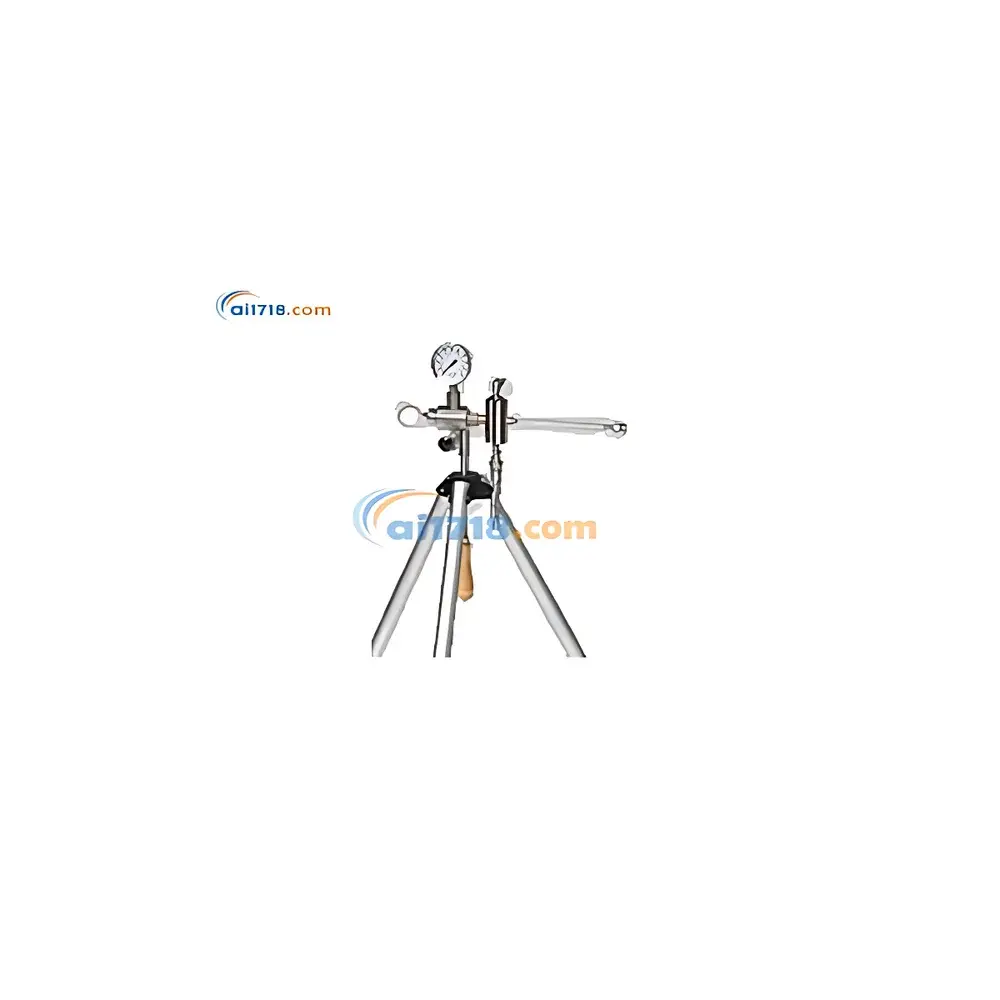
Standard Bureau of Mines Dew Point Analyzer by AMETEK MOCON
| Brand | AMETEK MOCON |
|---|---|
| Origin | USA |
| Manufacturer Type | Authorized Distributor |
| Origin Category | Imported |
| Model | Standard Bureau of Mines (Model 13 / Chanscope II) |
| Pricing | Available Upon Request |
Overview
The Standard Bureau of Mines Dew Point Analyzer—manufactured by AMETEK MOCON and rooted in the legacy of the U.S. Bureau of Mines—is a primary-standard, chilled-mirror hygrometer engineered for trace-level dew point measurement of water vapor and hydrocarbon condensables in industrial gases. Unlike electronic sensors that rely on polymer or aluminum oxide capacitive elements, this instrument operates on the fundamental thermodynamic principle of phase transition: it cools a highly polished mirror surface in direct contact with the sample gas until condensation (dew formation) is optically detected. This cold-mirror method provides absolute, calibration-free measurement traceable to first principles—making it the metrological reference against which all secondary dew point analyzers (e.g., tunable diode laser, quartz crystal microbalance, or capacitance-based systems) are validated. Designed for field and laboratory use in high-integrity environments, the analyzer delivers NIST-traceable reproducibility without electrical power, relying solely on controlled gas expansion and cryogenic cooling media (e.g., liquid nitrogen or dry ice/acetone slurry).
Key Features
- Primary-standard chilled-mirror technology compliant with ASTM D1142–“Standard Test Method for Water Vapor Content of Gaseous Fuels by Measurement of Dew-Point Temperature”
- No calibration required: measurement validity derived from physical condensation threshold, not sensor drift compensation
- Simultaneous capability for water dew point (WDP) and hydrocarbon dew point (HCDP) determination using identical optical detection methodology
- Portable, ruggedized stainless-steel construction suitable for field deployment in pipeline pigging stations, compressor skids, and offshore platforms
- Integrated RTD temperature sensor (Chanscope II variant) certified to NIST-traceable standards for mirror surface temperature measurement
- Zero-power operation: requires only process gas supply and external coolant—no batteries, AC mains, or signal conditioning electronics
- Optical viewing port with magnified eyepiece enables unambiguous visual confirmation of dew formation onset
Sample Compatibility & Compliance
The analyzer accommodates a broad range of pressurized and ambient-pressure gas streams—including natural gas (including acid gas variants containing H₂S and CO₂), refinery off-gas, syngas, nitrogen blanketing gas, hydrogen, argon, and helium. It is routinely deployed in custody transfer points where compliance with ISO 8503-2 (surface roughness), AGA Report No. 8 (compressibility), and GPA 2172 (hydrocarbon dew point specification) is mandated. Its adherence to ASTM D1142 ensures compatibility with regulatory frameworks governing pipeline quality (e.g., PHMSA 49 CFR Part 192), LNG specifications (ISO 8503), and GMP-compliant gas purity validation in pharmaceutical inerting applications.
Software & Data Management
While the core measurement is analog and self-contained, the included moisture content calculation software accepts user-inputted dew point temperature and system pressure to compute volumetric water concentration (ppmv) in accordance with the Magnus formula and IAPWS-97 steam tables. The software supports batch logging, CSV export, and integration into LIMS environments via manual data entry. For auditability in regulated industries, raw observation timestamps, pressure readings, and operator identifiers may be documented per GLP/GMP record-keeping requirements—though the instrument itself does not generate electronic audit trails (it is inherently non-digital and exempt from FDA 21 CFR Part 11 compliance obligations).
Applications
- Natural gas transmission: verification of pipeline moisture limits (< 7 lb/MMscf) prior to compressor stations and metering stations
- Custody transfer at city gate stations and LNG liquefaction terminals
- Hydrocarbon dew point monitoring in NGL fractionation and stabilization units
- Quality assurance of instrument air, purge gas, and blanketing nitrogen in petrochemical reactors
- Validation of online TDLAS or capacitive dew point transmitters during commissioning and periodic verification
- Thermal processing atmosphere control in heat-treating furnaces (e.g., carburizing, nitriding)
- Acid gas service applications where H₂S tolerance and corrosion-resistant wetted materials (316SS, Hastelloy C-276 mirror mount) are critical
FAQ
Does this instrument require periodic calibration?
No. As a primary-standard chilled-mirror device, it relies on thermodynamic phase-change physics—not empirical calibration curves—and therefore does not require scheduled recalibration.
Can it measure hydrocarbon dew point in sour gas containing H₂S?
Yes. The mirror surface and gas path are constructed from corrosion-resistant alloys compatible with acidic gas environments up to 25% H₂S by volume.
Is electrical power needed for operation?
No. The analyzer functions entirely passively—only requiring sample gas flow, pressure regulation, and external coolant (e.g., liquid nitrogen or dry ice/acetone mixture).
What pressure range is supported?
Typical operating range: 0–1,500 psia; optional high-pressure configurations available up to 10,000 psia for subsea wellhead applications.
How is traceability to NIST ensured?
The integrated RTD sensor (Chanscope II model) is supplied with a NIST-traceable calibration certificate; mirror temperature uncertainty is ±0.1 °C at −40 °C and ±0.2 °C at −70 °C.





