
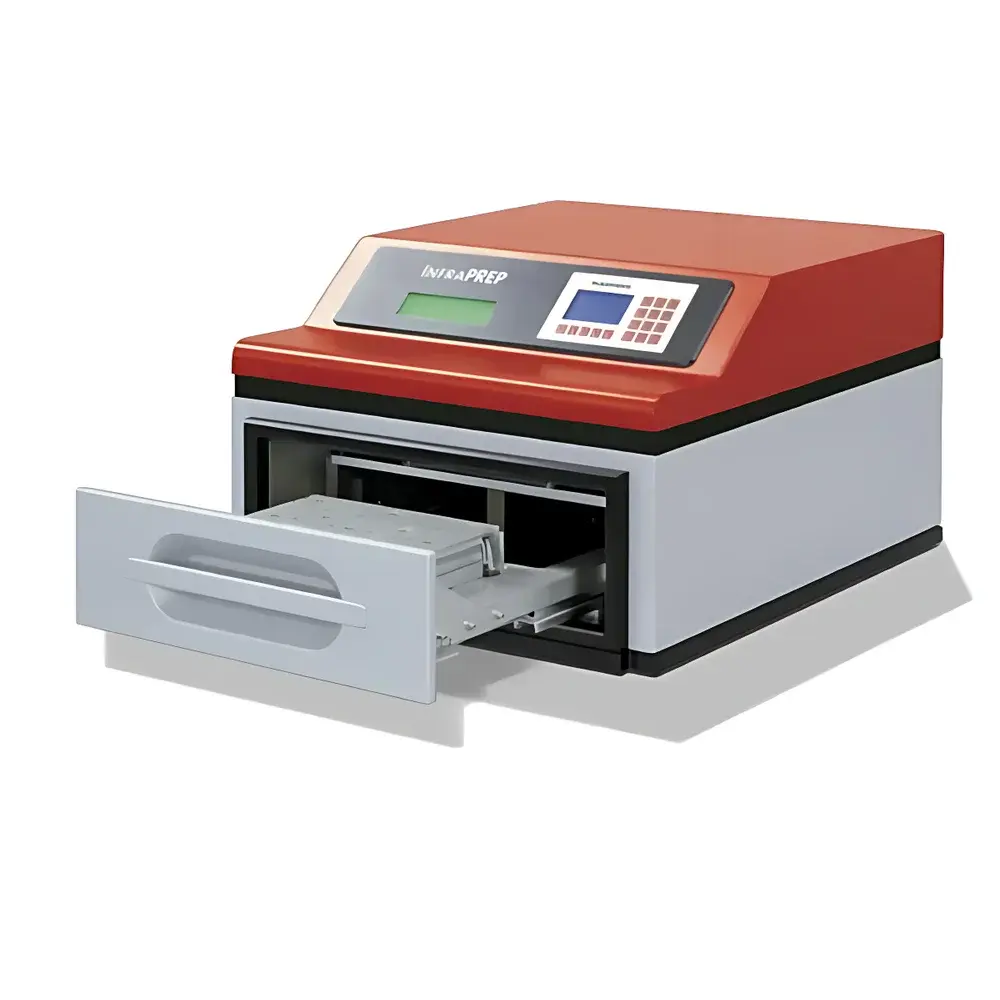
RuboLab Infrasorb High-Throughput Multi-Sample Rapid Adsorption Capacity Analyzer
| Brand | RuboLab |
|---|---|
| Origin | Germany |
| Model | Infrasorb |
| Instrument Type | Specific Surface Area and Pore Size Analyzer |
| Principle | Dynamic (Flow) Method |
| Number of Analysis Stations | 12 |
| Pressure Range | Ambient (1 bar) |
| Measurement Gas | n-Butane, CO₂ (optional: NH₃, H₂S, VOCs e.g., methanol, ethanol) |
| Sample Volume | 0.1 mL or ≤30 mg |
| Gas Flow Rate | up to 500 mL/min (N₂-equivalent) |
| Analysis Time | <5 min (typ. 3 min) |
| Temperature | 298 K |
| Detection Method | Non-contact, disturbance-free infrared thermography |
| Repeatability | High (validated per ISO 9277 and ASTM D3663 protocols for comparative adsorption screening) |
Overview
The RuboLab Infrasorb High-Throughput Multi-Sample Rapid Adsorption Capacity Analyzer is an engineered solution for quantitative, comparative assessment of adsorption capacity across diverse porous materials—without requiring full isotherm acquisition. Unlike conventional static volumetric or gravimetric gas sorption analyzers, the Infrasorb operates on the principle of dynamic flow calorimetry: it monitors transient thermal signatures induced by exothermic gas adsorption in real time using high-sensitivity, non-contact infrared thermography. As a carrier gas (e.g., n-butane or CO₂) flows continuously over a sample bed at ambient pressure (1 bar), adsorption events generate localized temperature rises proportional to adsorption enthalpy and accessible surface area. The shape and amplitude of the resulting thermal transient curve correlate directly with both total adsorption capacity and kinetic accessibility of pore networks. This physics-based correlation has been empirically validated against BET surface area measurements (ISO 9277) and Dubinin–Astakhov micropore analysis (ISO 15901-2), enabling robust, calibration-free ranking of materials within ≤3 minutes per sample.
Key Features
- 12 independent analysis stations enable true parallel throughput—ideal for formulation screening, catalyst batch qualification, or quality control labs processing >100 samples/week.
- Ambient-pressure operation eliminates high-vacuum requirements, reducing system complexity, maintenance overhead, and safety certification burdens associated with pressurized gas handling.
- Infrared thermographic detection provides non-invasive, spatially resolved thermal profiling—no embedded thermocouples or physical contact that could perturb adsorption kinetics or introduce thermal lag.
- Gas flexibility: pre-configured for n-butane and CO₂; optional corrosion-resistant gas pathways support NH₃, H₂S, and polar VOCs (e.g., methanol, ethanol) with material-compatible wetted components (Hastelloy C-276, fused silica, PTFE).
- Integrated sample activation module supports static heating under inert purge (N₂ or Ar) up to 400 °C, ensuring reproducible degassing prior to dynamic adsorption testing.
- Modular architecture allows field-upgradable options: high-pressure CO₂ extension (up to 20 bar) for ultra-micropore characterization (0.3–0.7 nm), and advanced kinetic modeling add-ons compliant with IUPAC recommendations for transient adsorption analysis.
Sample Compatibility & Compliance
The Infrasorb accommodates powders, granules, extrudates, monoliths, and coated filters—samples ranging from 0.1 mL volume to 30 mg mass. Its flow geometry minimizes channeling and ensures uniform gas–solid contact across heterogeneous morphologies. All hardware and firmware comply with CE marking requirements (2014/30/EU EMC Directive, 2014/35/EU LVD). Data integrity meets GLP and GMP audit readiness standards: software enforces user role-based access control, electronic signatures (21 CFR Part 11 compliant), and immutable audit trails for all method parameters, raw thermal traces, and derived metrics (e.g., ΔTmax, t½, integrated heat response). Validation documentation includes IQ/OQ protocols aligned with ASTM E2500-13 and ISO/IEC 17025:2017 for comparative adsorption instrumentation.
Software & Data Management
Infrasorb Control Suite v4.2 provides intuitive workflow-driven operation—from method setup (gas selection, flow rate, activation profile) to real-time thermal curve visualization and automated comparative reporting. Raw IR data are stored in HDF5 format with embedded metadata (timestamp, operator ID, instrument serial, environmental logs). Batch analysis tools generate ranked lists based on normalized thermal response amplitudes, enabling rapid pass/fail decisions against specification limits. Export modules support CSV, PDF, and .xlsx formats; API integration (RESTful JSON) enables direct ingestion into LIMS or MES platforms. Optional Advanced Kinetics Module applies numerical deconvolution to resolve multi-step adsorption processes (e.g., physisorption vs. chemisorption contributions) using first-order and diffusion-limited models.
Applications
- Rapid QC screening of activated carbons, zeolites, MOFs, and silica gels for pharmaceutical excipient or environmental filter qualification.
- Catalyst挤出物 (extrudate) evaluation: quantifying binder-induced pore blockage or thermal degradation effects on active surface availability.
- Adsorbent lifetime monitoring via repeated adsorption/desorption cycling under controlled humidity or trace contaminant exposure.
- Structure–property correlation studies linking thermal transient profiles to nitrogen BET surface area, CO₂ uptake at 0.15 bar, or mercury intrusion porosimetry data.
- Process development support: optimizing impregnation, calcination, or steam activation parameters using adsorption response as a surrogate metric.
FAQ
How does Infrasorb differ from traditional BET surface area analyzers?
It does not measure absolute surface area via gas adsorption isotherms. Instead, it delivers a highly reproducible, relative adsorption capacity index correlated to BET surface area—optimized for speed and throughput rather than absolute metrology.
Can it quantify micropore volume?
Not directly. However, the CO₂-enabled high-pressure option (up to 20 bar) supports Dubinin–Radushkevich analysis for ultra-micropores when combined with dedicated isotherm acquisition mode.
Is calibration required before each run?
No. System stability is verified daily via reference material (certified activated carbon) and built-in thermal drift compensation algorithms.
What safety provisions exist for flammable gases like n-butane?
Integrated gas cabinet with explosion-proof ventilation, automatic shutoff valves, and catalytic bead sensors meeting ATEX Zone 2 / Class I Div 2 requirements.
Does the software support multi-user environments with audit trails?
Yes. Full 21 CFR Part 11 compliance includes electronic signatures, session locking, and tamper-evident audit logs archived for ≥15 years.



