
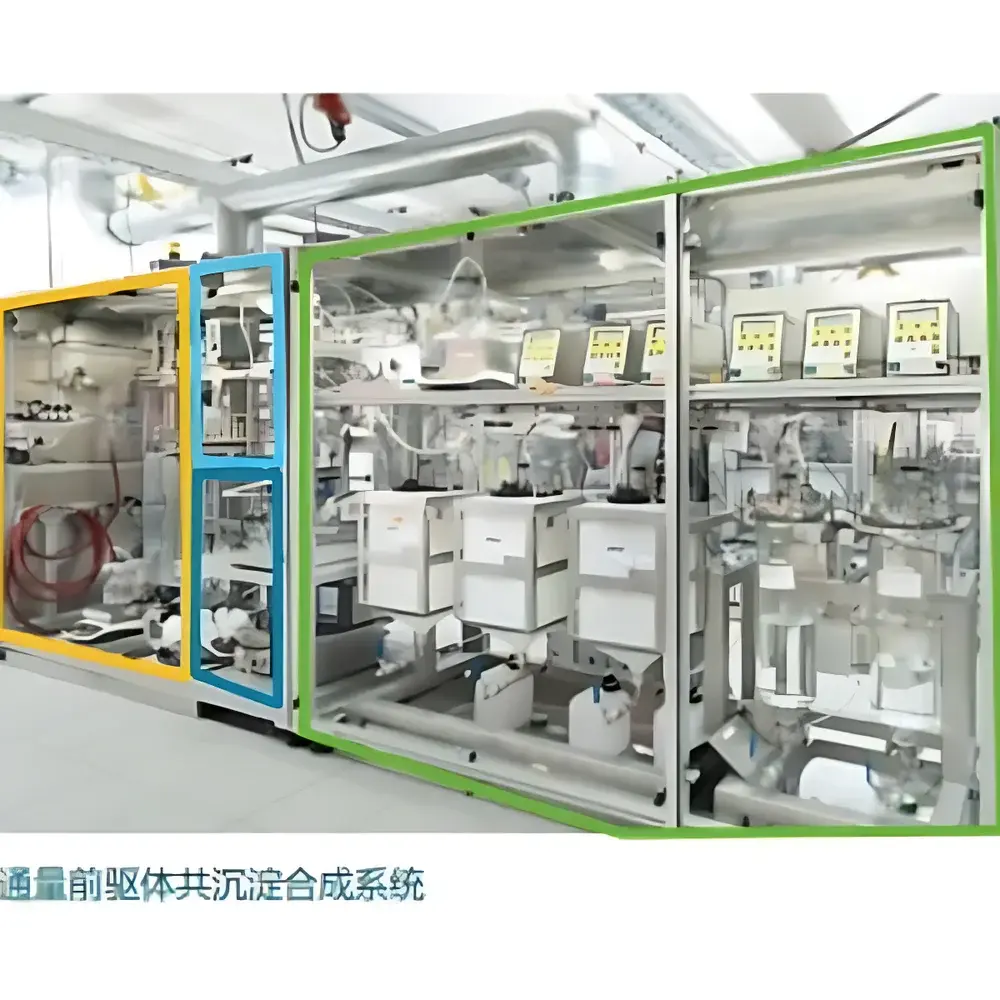
HTE HTS-CP Battery Cathode Precursor Co-Precipitation Synthesis System
| Brand | HTE |
|---|---|
| Origin | Germany |
| Type | High-Throughput Co-Precipitation Reactor System for Battery Cathode Precursor Synthesis |
| Reactor Volume | 2 L or 10 L (customizable) |
| Operation Modes | Continuous, Batch with Concentrator, Heavy-Duty Batch with Concentrator |
| Max Operating Temperature | 70 °C at Ambient Pressure |
| Feed Types | Aqueous Metal Salt Solutions, Precipitants, Dopants, Dry Powders |
| Integrated Sensors | Real-time pH Monitoring, In-line Particle Size Measurement (e.g., laser diffraction), Automated Liquid Sampling |
| Software Suite | hteControl (experiment automation & data acquisition), Custom GUI, GLP-compliant audit trail |
| Compliance | Designed for ISO/IEC 17025-aligned R&D environments |
| Safety | Lab-in-Lab containment architecture with redundant safety sensors, 24/7 unattended operation certified |
| Material Output per Run | 1–5 kg of precursor (e.g., NMC, LFP, Prussian Blue analogues) |
| Scalability | Process parameters validated from lab-scale to pilot-scale with <±5% deviation in PSD and stoichiometry |
Overview
The HTE HTS-CP Battery Cathode Precursor Co-Precipitation Synthesis System is an engineered high-throughput platform designed specifically for the reproducible, parameter-controlled synthesis of transition metal hydroxide or carbonate precursors used in lithium-ion and sodium-ion battery cathodes. It operates on the principle of controlled co-precipitation—where metal cations (e.g., Ni²⁺, Co²⁺, Mn²⁺, Fe²⁺, Na⁺) are simultaneously precipitated from aqueous solutions under precisely regulated pH, temperature, residence time, and mixing hydrodynamics. This system bridges the gap between exploratory materials discovery and scalable process development by enabling statistically robust experimental design (DoE) across multiple variables—including feed concentration gradients, pH ramp profiles, aging duration, and nucleation kinetics—while maintaining strict compositional homogeneity and particle size distribution (PSD) control. Its architecture is purpose-built for R&D labs targeting NMC (LiNiₓMnᵧCo_zO₂), LFP (LiFePO₄), sodium-based Prussian blue analogues, and next-generation solid-state cathode precursors.
Key Features
- Modular reactor configurations supporting 2 L and 10 L working volumes—with full geometric and dynamic similarity for seamless scale-up validation.
- Triple-mode operation: continuous flow, batch with integrated concentrator, and heavy-duty batch with recirculation—enabling direct comparison of kinetic vs. thermodynamic growth regimes.
- Real-time, closed-loop pH control with sub-0.05-unit resolution via automated titrant dosing, critical for stabilizing metastable intermediate phases during layered oxide precursor formation.
- In-line particle size monitoring using laser diffraction (e.g., Malvern Mastersizer-compatible interface), allowing immediate feedback adjustment of agitation speed or supersaturation rate.
- Automated liquid sampling with quenching capability for offline ICP-OES, XRD, and SEM validation—synchronized with timestamped process metadata.
- Lab-in-Lab safety enclosure with pressure relief, leak detection, thermal runaway sensors, and emergency shutdown protocols compliant with DIN EN 61000-6-4 EMC standards.
- hteControl software suite providing experiment scheduling, parameter scripting, hardware synchronization, and raw data export in HDF5 or CSV formats with embedded metadata (ISO/IEC 17025 traceability).
Sample Compatibility & Compliance
The HTS-CP system accommodates a broad spectrum of feedstocks relevant to modern battery material development: aqueous solutions of sulfate/nitrate/chloride salts (Ni, Co, Mn, Fe, Al, Ti), ammonium hydroxide or sodium hydroxide precipitants, chelating agents (e.g., NH₃), dopant solutions (e.g., Zr⁴⁺, Nb⁵⁺), and dry powder additives introduced via gravimetric feeders. It supports synthesis of spherical, dense, radially aligned NMC precursors (D50 = 8–12 µm, CV < 8%), plate-like LFP precursors, and nanostructured Prussian blue frameworks. All systems are delivered with CE marking, comply with EU Machinery Directive 2006/42/EC, and support integration into GMP/GLP environments through optional 21 CFR Part 11–compliant electronic signatures and audit trail modules.
Software & Data Management
hteControl serves as the central orchestration layer, enabling fully autonomous execution of multi-step co-precipitation protocols—including pre-mixing, nucleation induction, growth phase, aging, and washing cycles. Each experiment generates structured datasets containing >200 synchronized time-series channels (pH, T, rpm, flow rates, turbidity, PSD moments). Data is stored with FAIR principles (Findable, Accessible, Interoperable, Reusable) and can be exported to third-party platforms such as MATLAB, Python (Pandas/NumPy), or enterprise LIMS. Optional hteAnalytics modules provide PCA-driven correlation mapping between process parameters and final precursor properties (e.g., tap density, BET surface area, cation mixing ratio), accelerating DOE iteration cycles.
Applications
- High-fidelity screening of NMC-622, NMC-811, and NCA precursor synthesis under varying [OH⁻]/[NH₃] ratios and supersaturation indices.
- Rapid optimization of LFP precursor morphology for improved carbon coating uniformity and reduced sintering temperature.
- Development of doped or gradient-structured precursors (e.g., Ni-rich core / Mn-rich shell) via sequential feed modulation.
- Process qualification for semi-solid and sulfide-based solid-state battery cathode precursors requiring strict moisture/oxygen exclusion.
- Supporting DOE studies for DOE-defined ASTM D7984-22 (Standard Guide for High-Throughput Experimentation in Energy Materials).
FAQ
Can the HTS-CP system synthesize precursors under inert atmosphere?
Yes—optional glovebox-integrated versions with O₂/H₂O < 0.1 ppm are available for air-sensitive chemistries such as Mn³⁺-rich or low-valence cobalt systems.
Is reactor cleaning and cross-contamination prevention addressed?
All wetted parts use electropolished 316L SS or PFA-lined components; CIP (Clean-in-Place) protocols with nitric acid or citric acid washes are programmable within hteControl.
How does the system ensure stoichiometric accuracy across high-throughput runs?
Integrated gravimetric feeders with ±0.1% repeatability and real-time conductivity/pH feedback enable dynamic correction of metal ion concentration drifts prior to precipitation onset.
What level of support is provided for method transfer to pilot plants?
HTE provides full dimensional, thermal, and hydrodynamic scaling reports—including Reynolds, Damköhler, and Péclet number correlations—validated against industrial-scale reactors up to 1 m³ volume.
Are regulatory documentation packages available for audit readiness?
Yes—IQ/OQ documentation, calibration certificates, risk assessments (FMEA), and 21 CFR Part 11 validation packages are deliverable upon request.






