
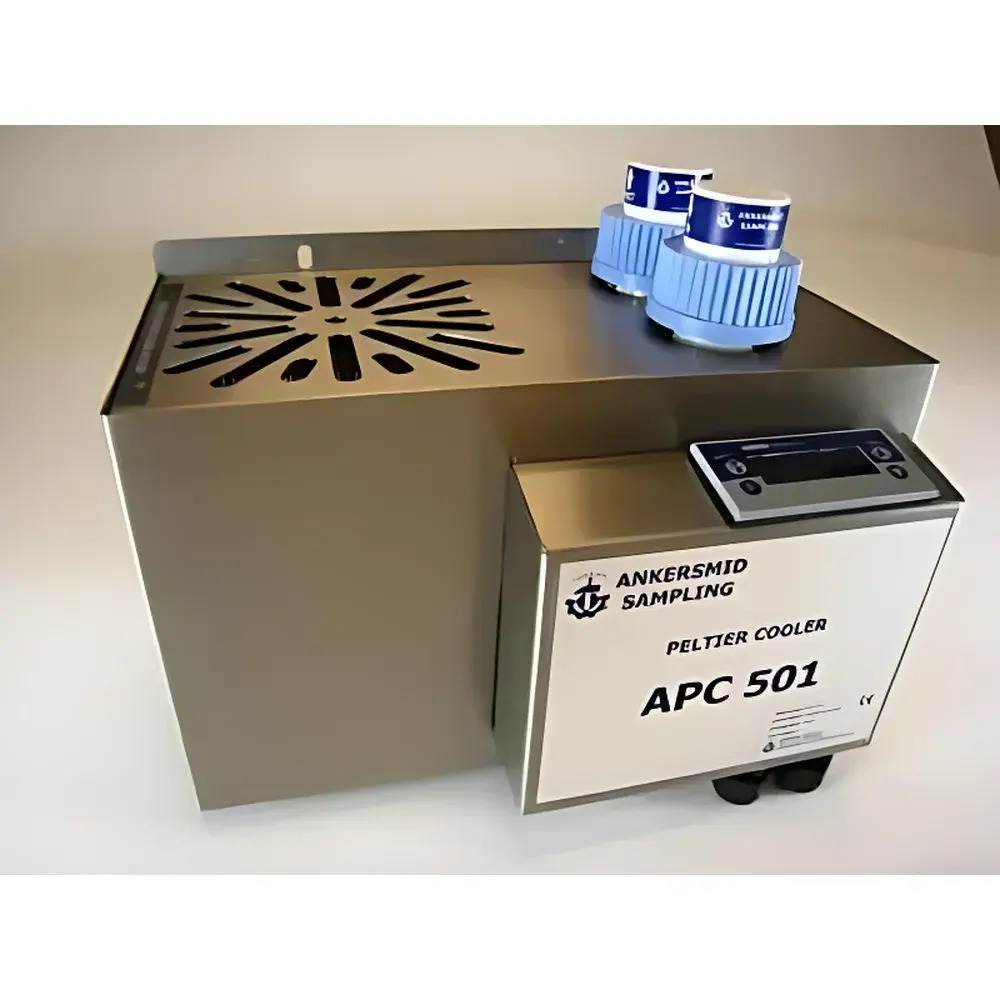
APC Peltier & Compressor-Based Gas Cooler
| Origin | Netherlands |
|---|---|
| Manufacturer Type | Distributor |
| Origin Category | Imported |
| Model | APC Peltier & Compressor-Based Gas Cooler |
| Pricing | Upon Request |
Overview
The APC Peltier & Compressor-Based Gas Cooler is a dual-mode, precision-engineered condensate removal system designed for demanding continuous gas sampling applications in environmental monitoring, emissions compliance, and industrial process analysis. It operates on two complementary thermoelectric principles: solid-state Peltier cooling for fine temperature control and high-efficiency compressor-based cooling for rapid thermal load handling—enabling stable, low-temperature dew point conditioning across variable ambient and sample conditions. The system cools moist gas streams below their dew point to separate water vapor and condensable interferents prior to delivery to analyzers such as FTIR, NDIR, chemiluminescence, or electrochemical sensors. By maintaining a tightly regulated dew point—adjustable between 1 °C and 15 °C with nominal stability at 5 °C—the APC minimizes water-induced cross-sensitivity, volumetric expansion errors, and optical path contamination, thereby preserving analytical integrity and long-term calibration stability.
Key Features
- Dual-cooling architecture: Integrated Peltier modules for precise setpoint control + scroll-type refrigerant compressor for high thermal capacity and fast cooldown response
- Adjustable dew point regulation: Digital controller with ±0.3 °C stability over the full 1–15 °C range; factory-calibrated at 5 °C nominal operation
- Modular heat exchanger design: Three material options available—borosilicate glass (for ultra-high chemical inertness), PVDF (for halogenated and acidic gas compatibility), and 316 stainless steel (for high-pressure, high-flow, or particulate-laden streams)
- Tool-free serviceability: Heat exchanger, condensate drain lines, and filter housings are fully removable without disassembly tools—enabling routine cleaning, validation, and traceability maintenance per ISO/IEC 17025 requirements
- Integrated condensate management: Compatible with peristaltic pump (ACP), automatic liquid drain (ALD), or collection vessel (ACV) configurations; optional liquid-level alarm sensor with relay output
- Gas-conditioning flexibility: Optional humidification head for calibration gas streams—patented design ensures matched thermal and humidity states between calibrant and sample, eliminating dilution- and density-related volume errors
Sample Compatibility & Compliance
The APC cooler supports gas matrices containing SO₂, NOₓ, CO, CO₂, NH₃, HCl, HF, VOCs, and volatile organic acids—provided material selection aligns with chemical compatibility charts (e.g., PVDF for chlorine species, glass for oxidizing halogens). It meets EN 15267-3 and EPA Method 9 requirements for certified continuous emission monitoring systems (CEMS), and its digital controller includes configurable alarm outputs compliant with SIL 2 functional safety architecture. All wetted parts conform to USP Class VI and FDA 21 CFR Part 11–ready data logging when paired with optional RS485 interface. Design adheres to IEC 61000-6-2 (EMC immunity) and IEC 60529 IP54 enclosure rating for field-deployable robustness.
Software & Data Management
The standard digital controller provides local setpoint adjustment, real-time dew point display, and status indicators (cooling active, condensate full, sensor fault). With the optional RS485 Modbus RTU interface, the APC integrates into centralized SCADA or LIMS platforms for remote parameter configuration, trend logging of dew point deviation, and audit-trail generation. Data timestamps, operator IDs, and configuration changes are recorded in accordance with GLP/GMP documentation standards. Firmware supports firmware-over-the-air (FOTA) updates via secure authenticated protocols—ensuring long-term regulatory alignment without hardware replacement.
Applications
- Continuous stack gas monitoring (CEMS) for power plants, incinerators, and cement kilns
- Calibration gas conditioning in reference laboratories performing ISO 17025-accredited gas analysis
- Pre-concentration systems for online GC or PTR-MS where moisture suppression is critical to column lifetime and detector sensitivity
- Mobile emissions testing units requiring vibration-resistant, low-power cooling solutions
- Indoor air quality (IAQ) networks deploying multi-gas sensor arrays sensitive to humidity drift
- Research-grade atmospheric simulation chambers requiring repeatable, sub-ambient gas conditioning
FAQ
What is the maximum allowable gas flow rate for the APC cooler?
The system is rated for up to 500 normal liters per hour (500 Nl/h) at standard temperature and pressure (0 °C, 101.325 kPa), with optimal dew point stability achieved between 50–400 Nl/h depending on inlet humidity and temperature.
Can the APC handle corrosive or reactive gases?
Yes—material selection determines compatibility: PVDF heat exchangers resist strong acids (e.g., HCl, HF) and halogens; borosilicate glass is recommended for oxidizers (e.g., ClO₂, O₃); 316 stainless steel suits neutral or mildly acidic dry streams under pressure.
Is the dew point controller validated per ISO/IEC 17025?
The controller’s temperature sensor is traceably calibrated to NIST standards; full system dew point validation—including heat exchanger thermal lag and sensor placement—is performed during installation commissioning per ISO 5725-2 guidelines.
How does the optional calibration gas humidification head function?
It introduces controlled water vapor upstream of the heat exchanger using a saturator column with temperature-stabilized Peltier elements—ensuring calibration gas and sample share identical dew point, temperature, and pressure profiles before analyzer inlet, eliminating volumetric correction factors.
What maintenance intervals are recommended for field operation?
Heat exchanger cleaning every 3 months (or after 500 operating hours); condensate pump tubing replacement every 6 months; annual verification of dew point sensor accuracy against chilled-mirror hygrometer reference.







