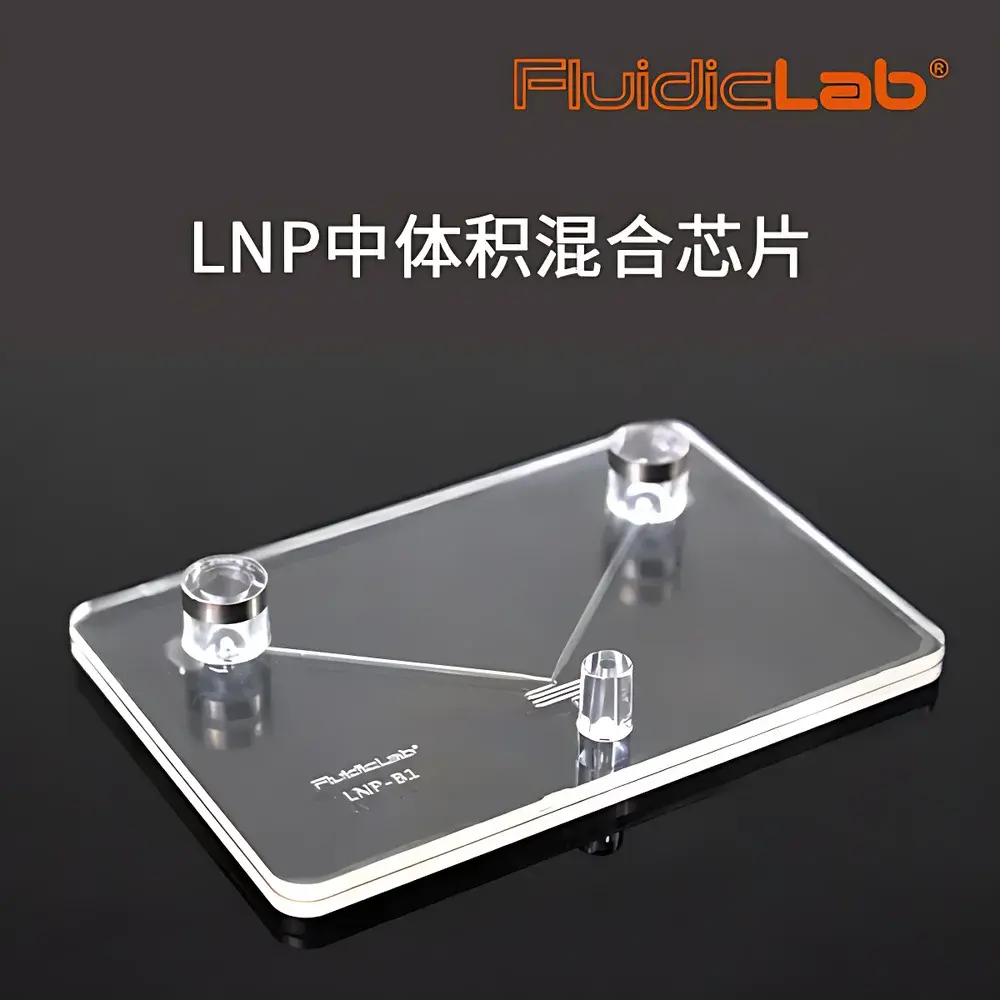
FluidicLab LNP-B1 COC Microfluidic Droplet Chip with Luer Fitting
| Brand | FluidicLab |
|---|---|
| Origin | Shanghai, China |
| Manufacturer Type | OEM Producer |
| Region of Origin | Domestic (China) |
| Model | LNP-B1 (with Luer Fitting) |
| Chip Material | Cyclic Olefin Copolymer (COC) |
| Chip Type | Droplet-Generation Microfluidic Chip |
| Dimensions (mm) | 62.2 × 41.3 |
| Channel Width | 350–700 µm |
| Max Operating Pressure | 50 bar |
| Total Fill Volume | 8.22 µL |
| Mixing Structure Volume | 2.09 µL |
| Recommended Total Flow Rate | 16 mL/min |
| Maximum Total Flow Rate | 40 mL/min |
| Compatible Instruments | FluidicLab LNP-S1 & LNP-S2 Intelligent Lipid Nanoparticle Synthesizers |
| Application Range | Total Synthesis Volume 0.4–40 mL |
| Flow Regime | Medium-volume, medium-flow-rate LNP formulation |
Overview
The FluidicLab LNP-B1 COC Microfluidic Droplet Chip is an engineered microfluidic component designed for reproducible, scalable synthesis of lipid nanoparticle (LNP) formulations under controlled hydrodynamic conditions. It operates on the principle of passive chaotic advection within a precisely fabricated herringbone-mixing architecture, enabling rapid and uniform mixing of aqueous and organic phases at laminar flow regimes typical of continuous-flow LNP production. The chip is optimized for integration with the FluidicLab LNP-S1 and LNP-S2 intelligent synthesizers, supporting total synthesis volumes from 0.4 mL to 40 mL and aggregate flow rates between 4 and 40 mL/min — positioning it within the critical mid-scale development window bridging benchtop screening and preclinical batch preparation. Its monolithic cyclic olefin copolymer (COC) construction eliminates adhesive interfaces, ensuring chemical inertness, optical clarity, and compliance with material safety requirements for pharmaceutical process development.
Key Features
- Monolithic COC substrate: Single-material construction with no bonding adhesives, eliminating leachables and interfacial delamination risks under high-pressure operation.
- Herringbone mixing architecture: 18 identical mixing modules arranged in series; each module comprises six symmetric herringbone grooves, yielding 108 total mixing elements for enhanced fluid stretching and folding.
- High-pressure capability: Rated for continuous operation up to 50 bar, supporting robust performance under elevated backpressure scenarios common in viscous lipid-phase handling or narrow-channel configurations.
- Luer-compatible interface: Integrated Luer male fittings enable rapid, leak-tight connection to standard syringe pumps, peristaltic drivers, and fluidic manifolds without custom adapters.
- Reusability & cleanability: Demonstrated stability across multiple cleaning cycles (e.g., 70% ethanol, isopropanol, or 0.1 M NaOH), with no measurable degradation in mixing efficiency or channel integrity after ≥5 uses under validated protocols.
- Precision microfabrication: Channel widths defined between 350 µm and 700 µm, balancing diffusion-limited mixing kinetics with pressure drop constraints across the operational flow range.
Sample Compatibility & Compliance
The LNP-B1 chip is compatible with standard LNP formulation solvents including ethanol, isopropanol, and chloroform, as well as aqueous buffers (e.g., citrate, acetate, Tris-HCl) across pH 3–9. Its COC composition meets the material biocompatibility and extractables profile stipulated in the Good Manufacturing Practice for Pharmaceutical Products (2010 Revision) and aligns with the national standard GB/T 20173602-T-469 (“Guidelines for Material Selection of Pharmaceutical Machinery”). While not classified as GMP-certified equipment per se, the chip’s design supports GLP-compliant process documentation when used within validated instrument platforms (e.g., LNP-S2 with audit-trail-enabled firmware). It is intended for research-use-only (RUO) applications in formulation development, stability studies, and analytical method transfer—not for direct clinical manufacturing without additional qualification per ICH Q5A(R2) and Q5D.
Software & Data Management
As a passive hardware component, the LNP-B1 chip does not incorporate embedded electronics or firmware. However, its performance is fully traceable when operated via FluidicLab’s LNP-S1/S2 synthesizers, which support time-stamped flow parameter logging (flow rate, temperature, pressure), automated protocol execution, and CSV-exportable synthesis metadata. When integrated into a validated environment, the system supports 21 CFR Part 11–compliant electronic records through optional secure user authentication, electronic signatures, and immutable audit trails—enabling alignment with regulatory expectations for early-phase formulation data integrity.
Applications
- Systematic optimization of LNP encapsulation efficiency, polydispersity index (PDI), and particle size distribution (e.g., 50–150 nm target range) via parametric variation of flow ratio, total flow rate, and temperature.
- Rapid screening of novel ionizable lipids, PEG-lipids, and helper lipids under consistent shear history and residence time control.
- Scalable generation of reference standards for orthogonal characterization techniques including DLS, NTA, TEM, and cryo-EM sample preparation.
- Process analytical technology (PAT) integration: Paired with inline UV-Vis or dynamic light scattering probes for real-time monitoring of nanoparticle formation kinetics.
- Education and training in microfluidic-based nanomedicine manufacturing principles, emphasizing deterministic mixing physics over stochastic emulsification.
FAQ
Is the LNP-B1 chip compatible with non-FluidicLab pumping systems?
Yes — provided the external pump delivers stable, pulseless flow within the specified range (4–40 mL/min total) and interfaces via standardized Luer connections. Backpressure must remain below 50 bar.
Can this chip be sterilized using autoclaving?
No — COC softens above 120 °C and is incompatible with steam sterilization. Recommended sanitization methods include solvent rinsing (ethanol/IPA), alkaline wash (0.1 M NaOH), or low-temperature plasma treatment.
What is the expected lifetime under routine use?
Under validated cleaning and handling protocols, ≥5 reuses without performance drift have been confirmed. Lifetime depends on solvent aggressiveness, particulate load, and mechanical handling during installation.
Does the chip support asymmetric flow ratios (e.g., 3:1 aqueous:organic)?
Yes — the herringbone geometry maintains mixing efficacy across flow ratios from 1:1 to 5:1, though optimal LNP characteristics are typically achieved between 2:1 and 4:1 depending on lipid composition.
How is residence time controlled in this chip?
Residence time is determined by total flow rate and the fixed internal volume (8.22 µL); at 16 mL/min, mean residence time is ~30 ms — sufficient for complete mixing and initial nucleation under typical LNP formulation conditions.