
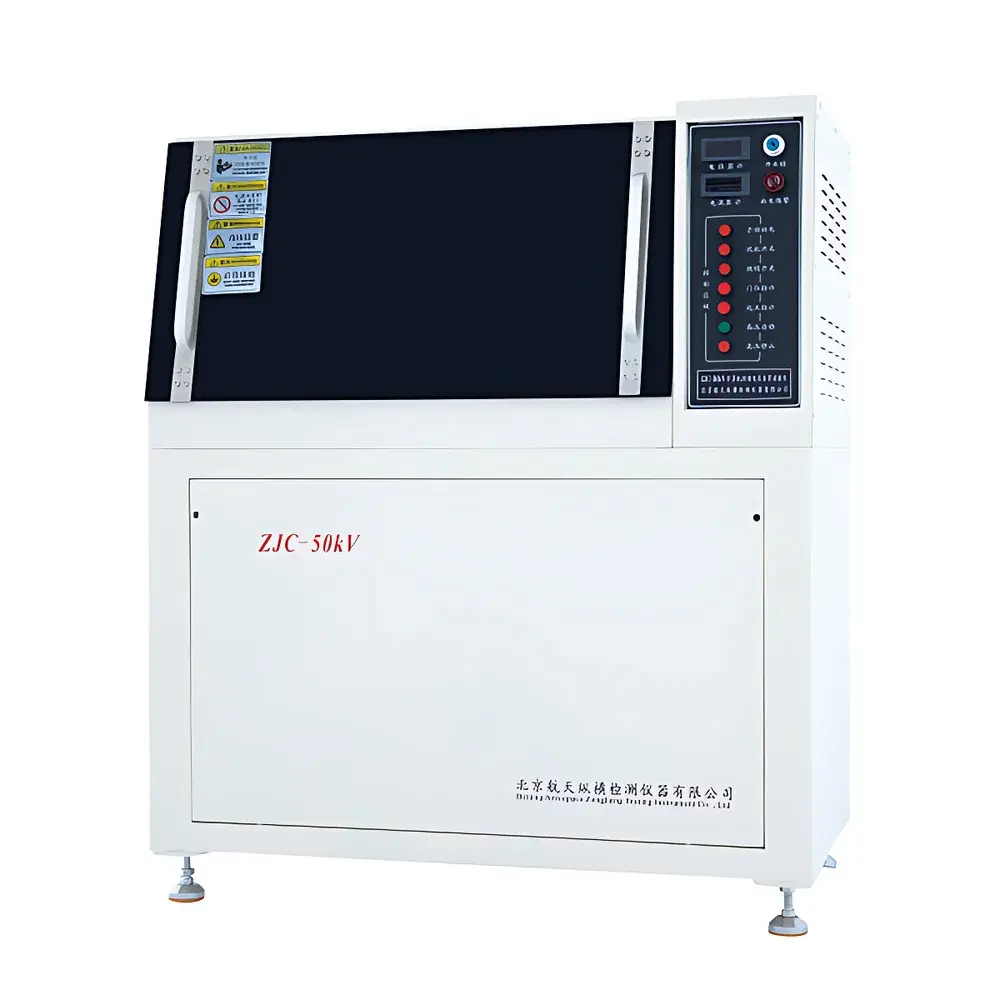
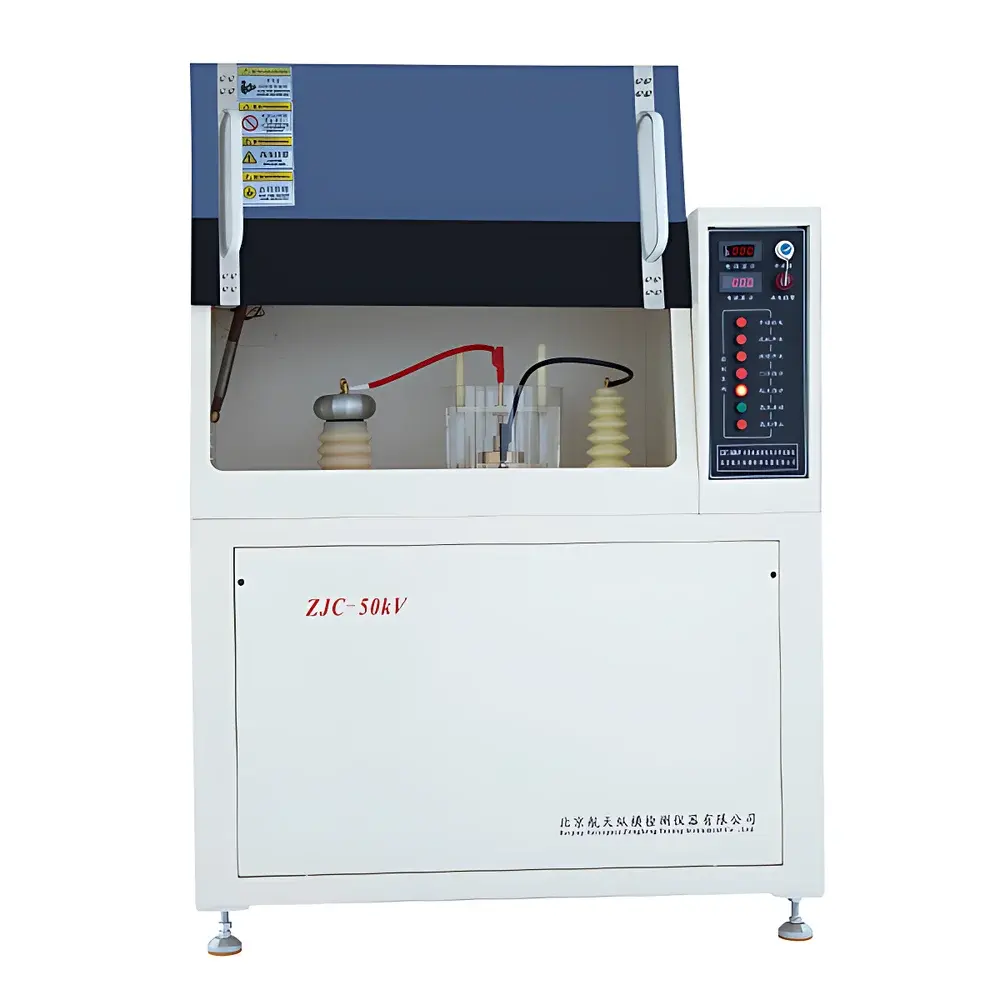
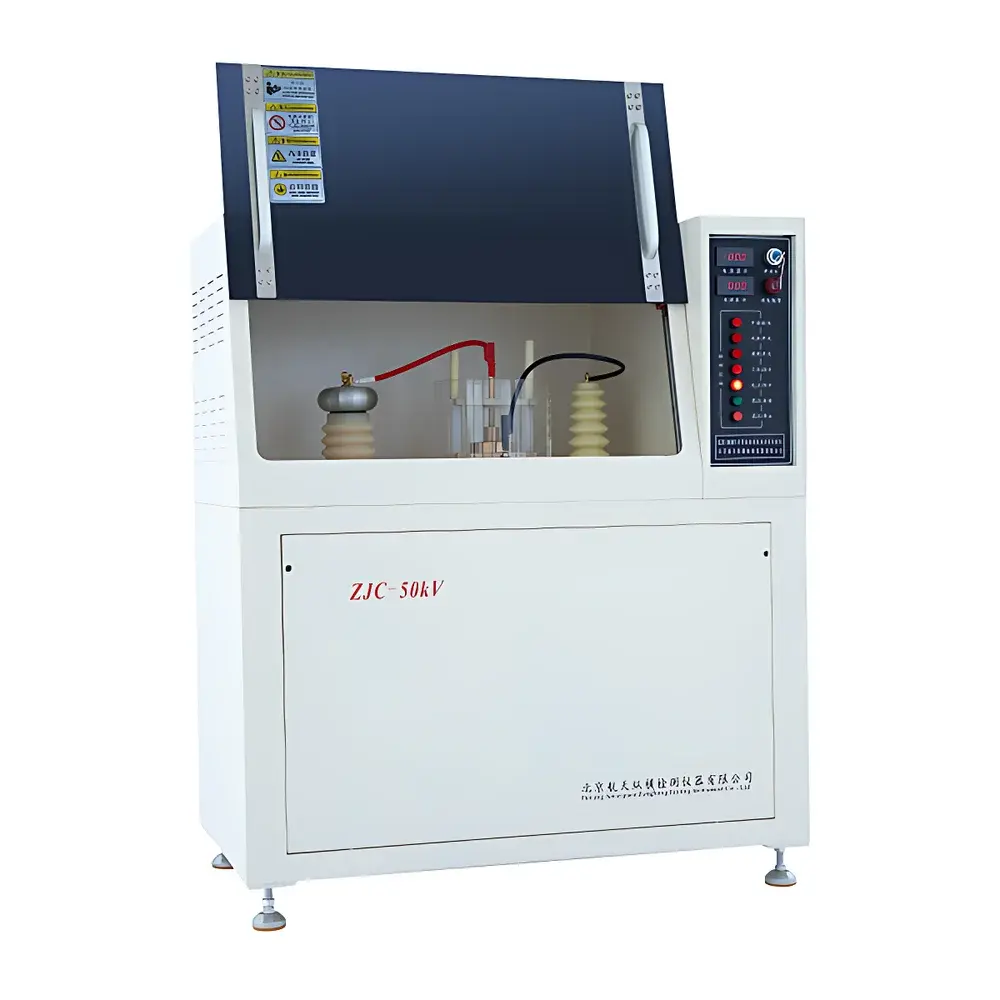
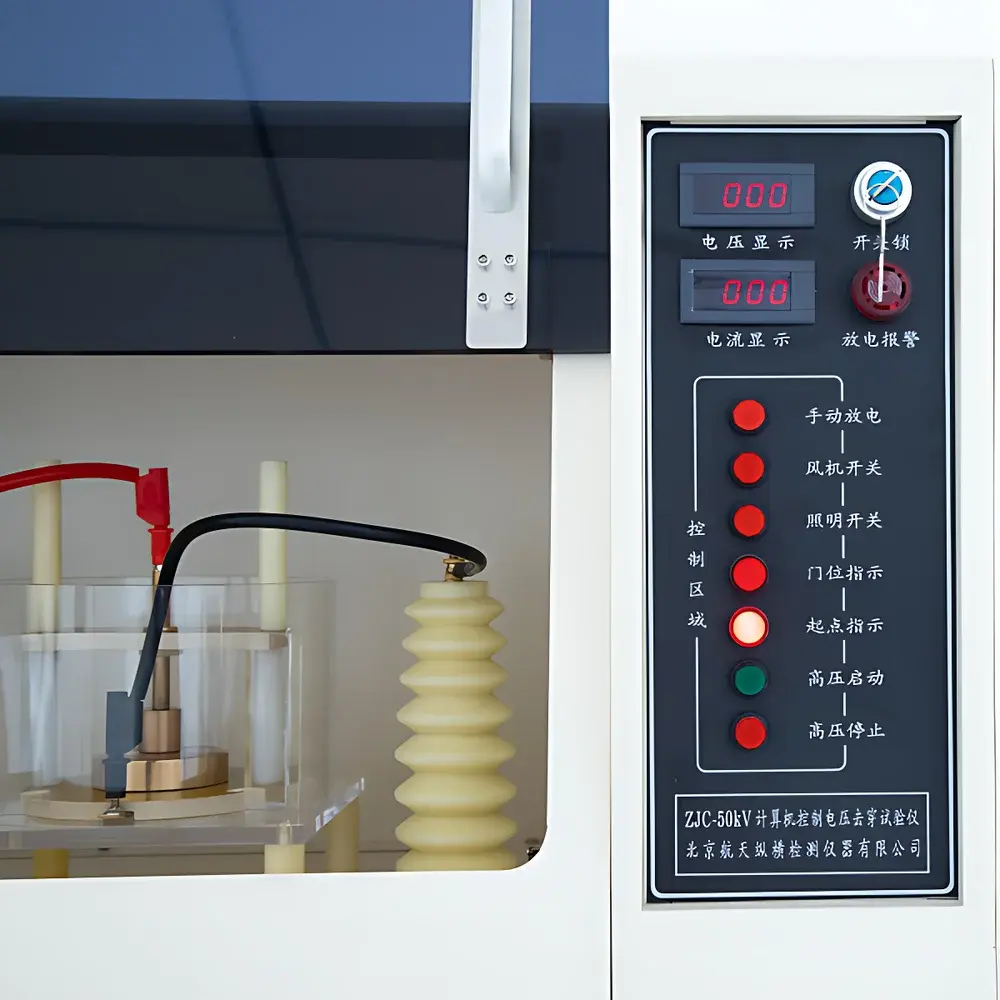
Aerospace ZH-50KV Dielectric Breakdown Strength Tester
| Brand | Aerospace |
|---|---|
| Origin | Beijing, China |
| Manufacturer Type | Authorized Distributor |
| Country of Origin | China |
| Model | ZH-50KV |
| Breakdown Voltage Range | 0–50 kV (AC/DC/Impulse) |
| Output Capacity | ≥10 kVA (compliant with GB/T 1408.1) |
| Voltage Accuracy | ≤1.5% FS (standard), optional ≤0.5% FS |
| Ramp Rate | 0.1–5 kV/s (adjustable), optional 0.01–10 kV/s (stepless) |
| Breakdown Detection Sensitivity | 0.1 mA (standard), optional 0.01 mA |
| Data Storage | 100 test records (standard), optional 1000+ with cloud backup |
| Safety Compliance | Triple Interlock Protection (door interlock, overcurrent cutoff ≤0.1 s, emergency stop), grounding resistance ≤4 Ω, discharge rod included |
| Environmental Options | Ambient (15–40 °C, RH ≤70%), optional high-temp chamber (RT to 200 °C, ±1 °C), optional low-temp chamber (−70 °C), oil-immersion testing (25# transformer oil, oil bath available) |
Overview
The Aerospace ZH-50KV Dielectric Breakdown Strength Tester is an engineered solution for precise measurement of electrical insulation integrity under controlled AC, DC, or impulse voltage stress. Based on the fundamental principle of dielectric breakdown—where insulating materials undergo irreversible conduction when subjected to electric fields exceeding their intrinsic withstand threshold—the instrument quantifies the critical voltage at which catastrophic failure occurs. Designed in strict alignment with international and national standards—including IEC 60243-1, ASTM D149, GB/T 1408.1 (for solid insulating materials), and GB/T 1695 (for vulcanized rubber)—the system delivers traceable, repeatable results essential for quality assurance, R&D validation, and regulatory compliance in high-reliability sectors.
Key Features
- Multi-Mode High-Voltage Generation: Configurable output architecture supporting sinusoidal AC (50/60 Hz), steady-state DC, and standard lightning impulse waveforms (1.2/50 µs). Output range spans 0–50 kV with selectable capacity ≥10 kVA, ensuring stable voltage delivery per GB/T 1408.1 requirements.
- Modular Electrode System: Standard electrode set includes brass disc electrodes (Φ25 mm and Φ75 mm), stainless steel spherical electrodes (R = 2 mm), and cylindrical electrodes for tubular specimens. Optional gold-plated contacts minimize contact resistance for ultra-low-current detection scenarios.
- Programmable Ramp Control: Linear and stepwise voltage ramp profiles with adjustable rate (0.1–5 kV/s standard; 0.01–10 kV/s optional). Enables implementation of short-time, slow-rate, or graded-voltage protocols per ASTM D149 Method A/B/C and IEC 60243-1 Annex B.
- Triple-Layer Safety Architecture: Integrated mechanical door interlock, electronic overcurrent protection (<0.1 s response), and redundant emergency stop circuitry. All high-voltage terminals are shielded, grounded (≤4 Ω), and equipped with manual discharge rods conforming to IEC 61010-1 safety guidelines.
- Environmental Flexibility: Supports ambient-air testing as default; optional oil-immersion configuration (with 25# transformer oil bath) mitigates surface tracking in hygroscopic or porous samples. High-temperature test chamber (RT to 200 °C, ±1 °C) and cryogenic options (−70 °C) available for thermal-stress coupling studies.
Sample Compatibility & Compliance
The ZH-50KV accommodates a broad spectrum of insulating materials—including polymer films, epoxy laminates, ceramic substrates, rubber composites, battery separator membranes, and photovoltaic backsheet films. Its electrode geometry and voltage profile adaptability ensure compliance with material-specific test configurations: flat electrodes for sheet-like specimens per GB/T 1408.1 Clause 6.2; spherical electrodes to minimize edge-field distortion in brittle solids per IEC 60243-1 Section 4.3; and custom fixtures for non-standard geometries (e.g., cable jackets, bushings).
All operational modes meet electromagnetic compatibility (EMC) requirements per EN 61326-1 and carry CE marking. The system supports audit-ready documentation workflows compliant with GLP and GMP environments, including user-accessible calibration logs, operator ID tagging, and timestamped test records—fully compatible with FDA 21 CFR Part 11–enabled software upgrades.
Software & Data Management
Bundled control software provides real-time voltage/current waveform visualization, automatic breakdown event capture, and post-test Weibull statistical analysis for breakdown strength distribution modeling. Each test record stores full parameter metadata (ramp rate, electrode type, ambient T/RH, medium), enabling cross-lot comparison and trend monitoring. Standard USB/RS485 interfaces allow integration into lab-wide LIMS platforms. Optional cloud-sync module enables remote data archiving, role-based access control, and automated PDF report generation with customizable templates aligned to ISO/IEC 17025 reporting conventions.
Applications
- Power Systems: Insulating oil qualification (per ASTM D877/D1816), cable termination and splice validation (up to 110 kV class), and bushing dielectric screening.
- Electronics Manufacturing: PCB substrate withstand verification (IPC-TM-650 2.5.1), semiconductor encapsulant evaluation, and flexible printed circuit (FPC) insulation layer testing.
- Energy Storage & Renewables: Lithium-ion battery separator puncture voltage assessment (≥500 V), EV battery pack module insulation integrity under thermal soak (60 °C), and PV module backsheet DC withstand (1000 Vdc, IEC 61215-2 MQ12).
- Advanced Materials R&D: Structure–property correlation studies on nanocomposite dielectrics, thermal–electrical coupling under simultaneous temperature–voltage stress, and partial discharge-informed breakdown mode classification (e.g., treeing vs. thermal runaway).
FAQ
What electrode configuration should I use for thin polymer films?
For films <100 µm thick, Φ75 mm disc electrodes are recommended to reduce edge-field enhancement and improve statistical reliability—consistent with ASTM D149 Method A and GB/T 1408.1 Annex C.
Is oil-immersion testing mandatory for all materials?
No. Oil immersion is required only when air testing yields premature surface flashover (e.g., on epoxy or silicone surfaces), or when mandated by standards such as ASTM D149 Clause 7.3. Oil baths mitigate creepage and enable bulk-dielectric-dominated failure modes.
How does this system compare to imported alternatives in metrological performance?
The ZH-50KV achieves ≤1.5% FS voltage accuracy (calibrated per JJG 315–2023), with optional ≤0.5% FS upgrade using NIST-traceable resistive dividers. While premium European systems offer marginally tighter long-term stability, the ZH-50KV’s annual recalibration interval, documented uncertainty budget, and third-party certificate support (CNAS-accredited labs) fulfill ISO/IEC 17025 technical requirements for accredited testing laboratories.
Can the system perform withstand (hold-time) tests?
Yes. Programmable hold-mode allows application of fixed voltage for durations up to 60 minutes at any level within the 0–50 kV range, fully compliant with IEC 60270 and GB/T 16927.1 for routine dielectric withstand verification.
What maintenance is required to sustain measurement integrity?
Routine tasks include quarterly electrode polishing (brass/stainless), biannual transformer oil replacement (if used), annual verification of grounding resistance and interlock functionality, and biennial full-system calibration against certified reference standards. Aerospace provides documented maintenance schedules and spare-part kits with extended warranty coverage.



