
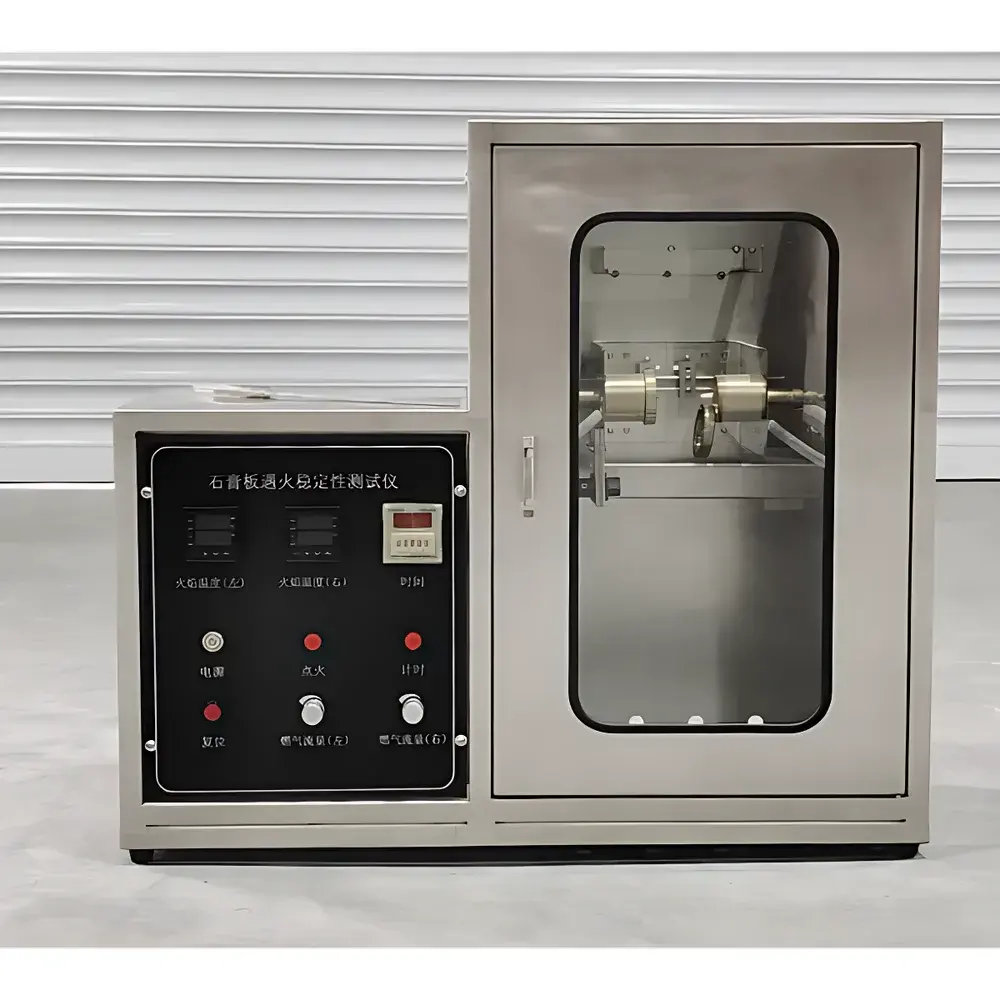
Aerospace GBFS-1 Fire Stability Tester for Gypsum Board
| Brand | Aerospace |
|---|---|
| Origin | Beijing, China |
| Model | GBFS-1 |
| Supply Voltage | 220 V ±10%, 50 Hz |
| Power Consumption | 180 W |
| Temperature Range | 800 ±30 °C (max 900 °C, Class 1 accuracy) |
| Temperature Stabilization Time | <3 min |
| Flame Source | Dual LPG burners (inner diameter Φ9.5 ±0.5 mm, length ~100 mm |
| Gas Flow Control | 100–1000 mL/min |
| Load Application | 7, 10, 12, 15, 17, or 20 N (equivalent to 0.75–2.04 kgf) |
| Specimen Dimensions | 300 mm × 50 mm, with two 25-mm-offset suspension holes |
| Test Duration Resolution | 0.1 s |
| Repeatability Error | ±0.1 min |
| Ignition | Automatic electronic ignition |
| Temperature Monitoring | Dual thermocouples positioned 5 mm from specimen surface |
| Data Display | Digital real-time readout of temperature and elapsed time |
| Compliance Standard | GB/T 9775–2008 (identical to ISO 6308:1980) |
| Enclosure Dimensions | 700 × 300 × 600 mm (W×D×H) |
| Weight | ~30 kg |
| Ventilation Requirement | Mandatory fume extraction via ducted hood or integrated smoke treatment system |
Overview
The Aerospace GBFS-1 Fire Stability Tester for Gypsum Board is a precision-engineered benchtop combustion test apparatus designed to evaluate the structural integrity of fire-resistant gypsum board under controlled thermal loading, in strict accordance with GB/T 9775–2008 (equivalent to ISO 6308:1980). It implements a standardized vertical flame exposure protocol wherein two calibrated LPG-fueled burners apply symmetrical thermal flux to the center region of a suspended specimen. The instrument measures the time-to-failure—defined as the moment of mechanical rupture or complete loss of load-bearing capacity—under defined static tensile loads. This endpoint reflects the material’s ability to maintain dimensional stability, prevent collapse, and retain barrier function during early-stage fire exposure. Unlike generic flammability screening tools, the GBFS-1 focuses exclusively on *fire stability*, a critical performance parameter for passive fire protection systems in commercial and residential construction.
Key Features
- Dual independently regulated LPG burners with air-adjustable nozzles (Φ9.5 ±0.5 mm), enabling precise flame geometry control and reproducible thermal flux distribution.
- Automated digital temperature regulation system maintaining 800 ±30 °C at 5 mm from specimen surface within <3 minutes, verified per Class 1 thermocouple accuracy requirements.
- Integrated dual-K-type thermocouple monitoring with real-time digital display of both temperature and elapsed time, synchronized to event-triggered recording.
- Programmable load application via six discrete tension settings (7–20 N), corresponding to standardized dead-weight configurations per GB/T 9775–2008 Annex B.
- Automatic failure detection: optical or mechanical interruption sensing triggers immediate timestamp capture upon specimen fracture or detachment.
- Full digital timing resolution of 0.1 s, supporting traceable data logging compliant with internal QA protocols and third-party audit requirements.
- Robust stainless-steel and refractory-lined chamber architecture optimized for thermal cycling durability and low particulate generation.
Sample Compatibility & Compliance
The GBFS-1 accepts standard 300 mm × 50 mm specimens prepared per GB/T 9775–2008 Section 6.2, including core drilling at 25 mm from each end for suspension. While optimized for paper-faced gypsum board, the platform accommodates other flat, rigid sheet materials up to 25 mm thickness and ≥15 kg/m³ density—including fiber-cement composites, magnesium oxide boards, and intumescent-coated substrates—provided they meet geometric and mechanical anchoring constraints. All operational parameters align with the mandatory test conditions specified in GB/T 9775–2008 Clause 7.3 (Fire Stability Test Method), which references ISO 6308:1980 verbatim. The system supports GLP-aligned documentation practices, including operator ID logging, calibration certificate linkage, and raw timestamp export for regulatory review.
Software & Data Management
The GBFS-1 operates in standalone mode with embedded firmware delivering real-time dual-channel monitoring and deterministic event capture. No proprietary software is required; however, ASCII-formatted test logs (CSV-compatible) can be exported via RS-232 interface for integration into LIMS or enterprise QA databases. Timestamps include UTC synchronization capability when connected to network time servers. Audit trail functionality records all parameter changes, ignition events, temperature deviations exceeding ±15 °C, and failure triggers—supporting 21 CFR Part 11–compatible validation packages when deployed in GMP-regulated environments. Calibration intervals follow manufacturer-recommended 6-month cycles, traceable to NIST-certified reference thermocouples.
Applications
- Quality assurance testing of fire-rated gypsum board batches prior to construction site delivery.
- R&D evaluation of novel core formulations (e.g., glass fiber reinforcement, phase-change additives) and facing paper treatments (e.g., flame-retardant coatings).
- Comparative benchmarking of competing fire barrier products under identical thermal load profiles.
- Supporting certification submissions to national building code authorities (e.g., CCC, CE marking bodies) requiring documented fire stability evidence.
- Teaching laboratories conducting ASTM E119–aligned fire resistance fundamentals, where controlled single-parameter stability assessment complements full-scale furnace testing.
FAQ
What gas supply specifications are required for reliable operation?
Liquefied petroleum gas (LPG) is mandatory; natural gas is incompatible due to differing Wobbe index and flame velocity characteristics. A cylinder equipped with a dual-stage regulator delivering stable 0.3 MPa outlet pressure is required. Gas purity must meet EN 589 or equivalent specifications to prevent burner coking.
Is external fume extraction mandatory?
Yes. Combustion byproducts—including CO, NOx, and pyrolytic particulates—must be removed via a ducted fume hood or centralized smoke abatement system meeting local occupational exposure limits (e.g., OSHA PEL or EU Directive 2004/37/EC). Standalone room ventilation is insufficient.
Can the GBFS-1 be used for non-gypsum substrates?
It may be employed for other rigid, planar construction materials provided they conform to specimen geometry, suspension mechanics, and thermal mass constraints outlined in GB/T 9775–2008 Annex A. Validation testing per ISO/IEC 17025 is recommended prior to reporting results for regulatory purposes.
How is temperature uniformity verified across the test zone?
Uniformity is confirmed during factory calibration using a traversing reference thermocouple grid mapped at 10-mm intervals across the 50-mm specimen width. Deviation across the central 30-mm zone must remain within ±10 °C of setpoint at 800 °C.
What maintenance intervals are recommended?
Burner orifices require ultrasonic cleaning every 50 test cycles; thermocouple verification against a calibrated reference source is required quarterly; full system performance validation per GB/T 9775–2008 Annex C is advised biannually.



