
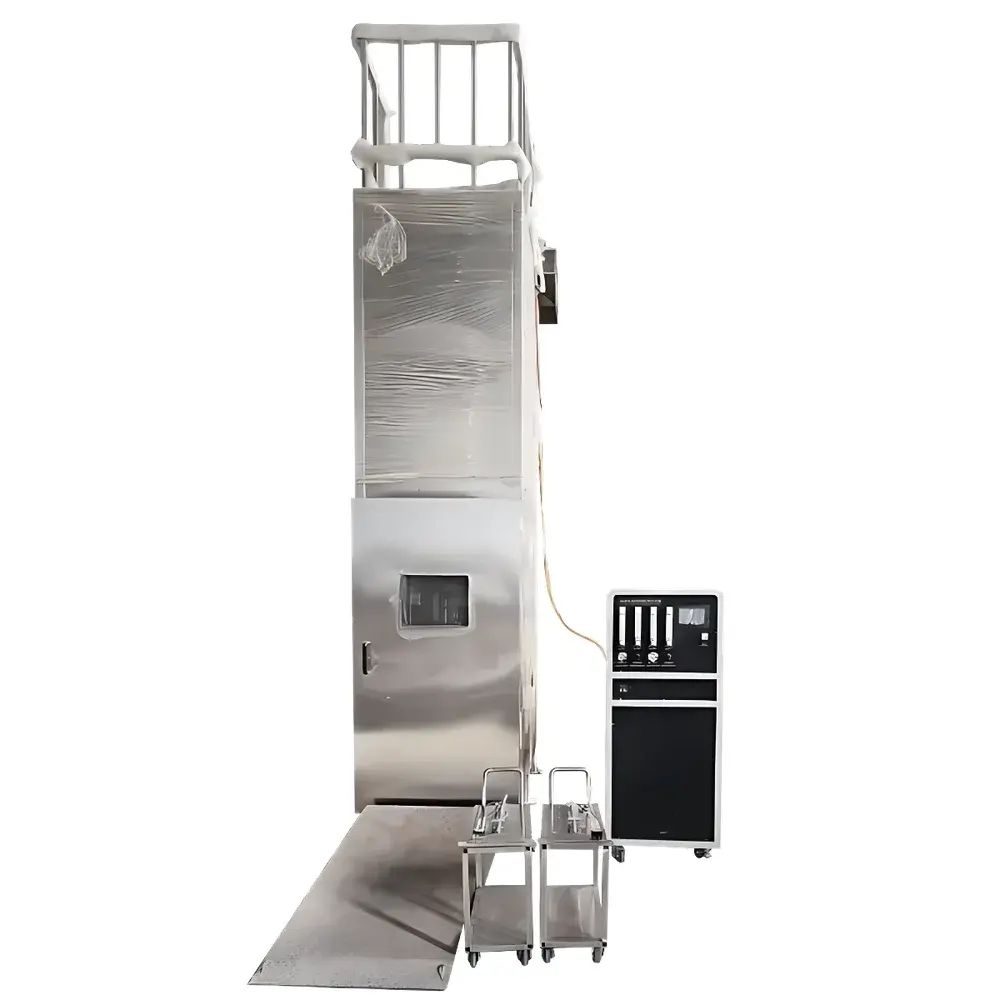
Aerospace RSJF-2 Bundled Cable Vertical Flame Propagation & Smoke Release Test Chamber
| Brand | Aerospace |
|---|---|
| Origin | Beijing, China |
| Manufacturer Type | Authorized Distributor |
| Country of Origin | China |
| Model | RSJF-2 |
| Application Field | Electrical Wires and Cables |
| Test Object | Bundled Wire and Cable Assemblies |
| Primary Function | Fire Performance Evaluation per GB/T 31248–2014 and GB/T 18380.31–2008 (IEC 60332-3-10:2000 IDT) |
| Structural Dimensions (Overall Installation Space) | 2500 mm (W) × 4500 mm (D) × 5500 mm (H) |
| Net Weight | ~2500 kg |
| Power Supply | AC 220 V ±10%, 50 Hz, 7 kW |
| Cooling Water Requirement | Continuous supply with dedicated drainage |
| Fuel Source | Industrial propane with regulated flow (≥300 L/min compressed air via 3 kW air compressor) |
| Exhaust Handling | Integrated smoke collection and wet-scrubbing system compliant with local emission regulations |
| Safety Infrastructure | Requires 5-ton forklift, overhead crane, and three 5-m-height scaffolds for installation |
Overview
The Aerospace RSJF-2 Bundled Cable Vertical Flame Propagation & Smoke Release Test Chamber is a fully integrated, standards-compliant fire testing system engineered for quantitative assessment of flame spread, heat release rate (HRR), total smoke production (TSP), and smoke obscuration in vertically installed bundled cable assemblies. It operates in strict accordance with GB/T 31248–2014 (“Test method for fire performance of cables used in buildings”) and GB/T 18380.31–2008 (identical to IEC 60332-3-10:2000), while extending capability beyond basic flame propagation to include dynamic combustion gas analysis and optical density measurement. The chamber employs a controlled convective airflow environment (5000 ± 500 L/min at 100 kPa / 20 °C) to simulate realistic fire ventilation conditions, enabling reproducible evaluation of cable fire behavior under standardized thermal insult. Its dual-propane burner configuration—equipped with precision orifice plates (242 × 1.32 mm holes, tri-row staggered layout) and independent mass-flow-controlled fuel/air delivery—ensures stable, repeatable ignition source geometry and thermal flux distribution, critical for inter-laboratory comparability.
Key Features
- Modular dual-chamber architecture: Combustion test chamber (2500 × 3200 × 4500 mm) with thermally insulated stainless steel cladding (65 mm mineral fiber, U-value ≈ 0.7 W·m⁻²·K⁻¹) and separately configured exhaust ducting and analytical manifold.
- Calibrated twin propane burners: Each equipped with rotameter-based flow control for propane (13.5 ± 0.5 L/min) and air (77.7 ± 4.8 L/min) at reference conditions (100 kPa, 20 °C); burner positioning fixed at (75 ± 5) mm from cable front surface and (600 ± 5) mm above floor level.
- Comprehensive real-time gas analysis suite: Paramagnetic O₂ analyzer (16–21% range, 1% FS), and optical smoke density meter (0–99.9% obscuration, ±5% filter-certified accuracy).
- Automated data acquisition and control: PC-based system with embedded PID regulation of airflow, fuel pressure, and temperature; synchronized logging of time-resolved HRR, TSP, flame duration, afterflame time, and drop particle detection.
- Dual-ladder support system: Interchangeable 500 mm standard and 800 mm wide steel ladders mounted 150 mm from rear wall; lowest rung elevated 400 mm above floor to ensure consistent specimen elevation and airflow interaction.
- Integrated exhaust management: 5.5 kW centrifugal extractor fan delivering ≥1.5 m³/s volumetric flow; double-walled insulated ducting with uniform-flow conditioning per EN 14390; smoke hood (1500 × 1000 mm base) positioned 200–400 mm above chamber exhaust port.
Sample Compatibility & Compliance
The RSJF-2 accommodates bundled cable configurations up to 300 mm wide × 600 mm high × 3.5 m tall, mounted on standardized steel ladders per IEC 60332-3-10. Specimen mounting fixtures are fabricated from black epoxy-coated steel to minimize optical interference during smoke density measurement. All operational parameters—including air velocity profile, burner flame geometry, thermocouple placement, and optical path alignment—are traceable to national metrological standards and validated against round-robin interlaboratory test data. The system supports full compliance documentation packages required for ISO/IEC 17025-accredited laboratories, including calibration certificates for all transducers (O₂/CO₂ analyzers, differential pressure sensors, thermocouples, photometric detectors), as well as audit-ready electronic logs with user authentication, timestamping, and immutable event history—fully aligned with GLP principles and compatible with FDA 21 CFR Part 11 electronic record requirements when deployed with validated software modules.
Software & Data Management
Control and analysis are executed via a Windows-based application with deterministic real-time scheduling, ensuring sub-second synchronization across 12+ analog input channels (temperature, pressure, O₂, CO₂, light attenuation, airflow). Raw sensor outputs undergo digital filtering and linearization using factory-applied NIST-traceable coefficients. Calculated metrics—including peak HRR (kW), total heat release (MJ), specific extinction area (SEA, m²/kg), and smoke production rate (SPR, m²/s)—are exported in ASTM E1354-compliant CSV and PDF report formats. The software includes built-in validation routines: automatic zero/span checks for gas analyzers, self-diagnostic verification of photometric baseline stability, and real-time plausibility monitoring of differential pressure gradients across the exhaust duct. Audit trails record all operator actions, parameter changes, and instrument calibrations with SHA-256 hashing to prevent tampering. Remote access is supported via TLS-encrypted VNC for technical support, subject to network security policy enforcement.
Applications
This system serves as a core qualification tool for wire and cable manufacturers validating compliance with building code requirements (e.g., GB 50016, IEC 60332, UL 1685), fire safety engineering consultants performing material selection studies, and third-party certification bodies conducting type approval testing. Typical use cases include comparative flame retardancy screening of halogen-free low-smoke (HFFR) compounds, evaluation of char-forming polymer additives under vertical bundle exposure, correlation of small-scale cone calorimeter data with full-scale cable tray fire behavior, and generation of input parameters for computational fluid dynamics (CFD) fire modeling. It also supports R&D investigations into synergistic flame inhibition mechanisms, post-combustion residue characterization, and development of next-generation low-toxicity insulation materials meeting stringent EU CPR Class B2ca/Cca requirements.
FAQ
What standards does the RSJF-2 fully support?
GB/T 31248–2014, GB/T 18380.31–2008 (IEC 60332-3-10:2000 IDT), and supplementary methodologies aligned with ASTM E603 and ISO 5659-2 for smoke density quantification.
Is the system suitable for ISO/IEC 17025 accreditation?
Yes—provided laboratory-specific procedures for equipment calibration, environmental monitoring, and personnel training are implemented and documented per ISO/IEC 17025:2017 Clause 6.4 and 6.5.
Can the RSJF-2 operate without external exhaust ducting?
No—integrated wet-scrubbing and forced-draft exhaust are mandatory for safe operation; ambient room ventilation is insufficient to meet occupational exposure limits for CO, NOₓ, and particulate matter.
What maintenance intervals are recommended for gas analyzers?
O₂ and CO₂ sensors require quarterly zero/span verification using certified calibration gases; optical smoke density pathlength must be cleaned and verified monthly per manufacturer’s SOP.
Does the system include provisions for drop particle collection and analysis?
Yes—a dedicated drip pan with removable stainless steel liner and optional gravimetric weighing interface is supplied as standard equipment.



