
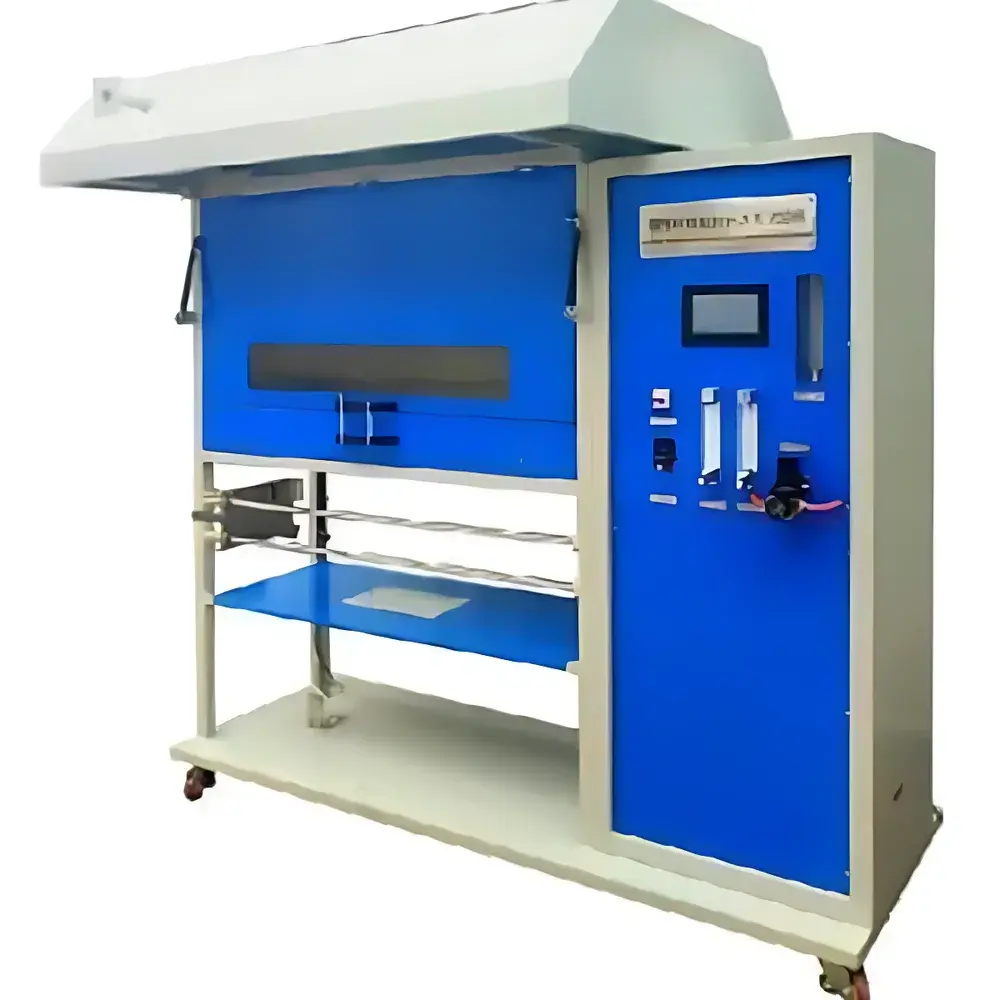
Aerospace ZFA-1 Radiant Heat Source Floor Covering Combustibility Tester
| Brand | Aerospace |
|---|---|
| Origin | Beijing, China |
| Manufacturer Type | Authorized Distributor |
| Country of Origin | China |
| Model | ZFA-1 |
| Price Range | USD 18,000 – 22,500 |
| Power Supply | AC 220 V, 50 Hz, ~0.5 kW |
| Exhaust Air Velocity | (2.5 ± 0.2) m/s |
| Fire-Resistant Porous Board Dimensions | (300 ± 10) mm × (450 ± 10) mm,耐900°C+ |
| Radiant Thermometer Range | 480–530 °C |
| Radiant Thermometer Accuracy | ±0.5% of reading |
| Thermocouple | 3.2 mm stainless steel sheathed type K |
| Heat Flux Meter Range | 0–15 kW/m² |
| Heat Flux Meter Accuracy | ±3% full scale |
| Heat Flux Meter Precision | ±0.2 kW/m² |
| Anemometer Accuracy | ±0.1 m/s |
| Timer Accuracy | <1 s/h |
| Overall Dimensions (L×W×H) | 2400 mm × 1340 mm × 3100 mm (incl. duct bend) |
| Specimen Size | (1050 ± 5) mm × (230 ± 5) mm (6 specimens per test series) |
| Conditioning Standard | EN 13238 |
| Igniter Gas Flow | (1.56 ± 0.12) L/min |
| Igniter Flame Height | 60–120 mm |
| Ignition Duration | 10 min at (10 ± 0.2) mm upstream of specimen zero point |
Overview
The Aerospace ZFA-1 Radiant Heat Source Floor Covering Combustibility Tester is a precision-engineered laboratory instrument designed to evaluate the flame spread behavior of floor covering materials under controlled radiant heat exposure. It operates in strict accordance with the fundamental principles of ISO 9239-1:2002 and GB/T 11785–2005, which define the radiant panel test method for assessing critical radiant flux (CRF) — the minimum incident heat flux at which sustained flaming combustion propagates across the surface of a horizontally mounted specimen exposed to a defined inclined thermal radiation field. The system employs a calibrated ceramic radiant panel heated by a regulated gas/air mixture, generating a spatially graded radiant heat flux profile ranging from approximately 5.1 kW/m² at the hot end (110 mm) to lower values toward the cold end (910 mm). This gradient enables determination of the critical radiant flux—the threshold value below which flame propagation ceases—thereby quantifying the material’s inherent resistance to fire spread under standardized thermal loading. The ZFA-1 is not intended for direct extrapolation to real-fire hazard assessment but serves as a reproducible, comparative metric for regulatory compliance, product development, and quality control within building material certification frameworks.
Key Features
- Dual-control architecture: Full operational capability via integrated industrial touchscreen interface or remote PC-based software—seamlessly switchable without hardware reconfiguration.
- Automated ignition sequence with real-time flame height monitoring and fail-safe alarm logic for ignition failure detection.
- Integrated thermal management: Precision-controlled exhaust airflow maintained at (2.5 ± 0.2) m/s using a variable-speed fan system; thermally stabilized chamber environment with blackbody temperature stability monitored against ±5 °C tolerance relative to reference.
- Calibration-ready instrumentation suite: NIST-traceable heat flux meter (±0.2 kW/m² absolute accuracy), high-stability K-type thermocouples (3.2 mm stainless steel sheath), and calibrated radiant thermometer (±0.5% of reading over 480–530 °C range).
- Modular specimen handling: Motorized sliding platform with adjustable clamping mechanism accommodating multi-layer assemblies—including carpet-backing composites, resilient vinyl, rubber tiles, and spray-applied coatings—ensuring representative mounting per EN 13238 conditioning requirements.
- Comprehensive data acquisition: Synchronized time-stamped recording of flame front progression (at 10-min intervals), heat flux distribution, chamber temperature, blackbody surface temperature, and smoke obscuration (via optional density measurement module).
Sample Compatibility & Compliance
The ZFA-1 accommodates standard floor covering specimens measuring (1050 ± 5) mm × (230 ± 5) mm, with six specimens tested per evaluation cycle—three oriented along the production direction and three orthogonal thereto. Specimens must be conditioned per EN 13238 (typically 23 °C ± 2 °C, 50% RH ± 5%, ≥48 h) prior to testing. The system supports evaluation of heterogeneous constructions including textile carpets with latex or polyurethane backing, cork and wood composites, PVC and rubber sheet goods, and thermoplastic elastomer flooring systems. All test configurations—including substrate selection, adhesive layer thickness, and installation method—must be documented, as these variables directly influence radiant heat absorption, pyrolysis kinetics, and flame spread dynamics. The apparatus meets mechanical and metrological requirements specified in ISO 9239-1:2002 Annex A and GB/T 11785–2005 Clause 5, and supports traceable calibration protocols aligned with ISO/IEC 17025–compliant laboratory practices.
Software & Data Management
The proprietary Windows-based control software provides full bidirectional communication over Ethernet (TCP/IP), supporting static IP configuration (default: 192.168.1.10) and DHCP compatibility. The GUI features real-time visualization of all sensor channels, interactive flame front distance entry with audible prompts at 10-min intervals, automated CRF calculation per ISO 9239-1 Annex B, and digital audit trail generation. All raw and processed data—including timestamps, operator ID, calibration history, and environmental parameters—are stored in encrypted SQLite databases with immutable logging. Report generation complies with GLP documentation standards: PDF export includes header metadata (test date, lab ID, specimen ID), graphical flame progression curves, tabulated heat flux readings, and statistical summary (mean CRF, standard deviation). Optional integration with LIMS environments is supported via CSV export and configurable ODBC drivers. Software updates are delivered via secure firmware update package with SHA-256 signature verification.
Applications
The ZFA-1 is deployed primarily in accredited fire testing laboratories, building material R&D centers, and third-party certification bodies engaged in conformity assessment for national and international construction product regulations. Key application domains include: classification of floor coverings under EN 13501-1 (Euroclass Bfl-s1, Cfl-s1, Dfl-t1), validation of fire-retardant treatment efficacy on natural fiber carpets, comparative screening of polymer-modified bitumen underlays, and developmental testing of low-smoke, halogen-free resilient flooring formulations. Its quantitative output—critical radiant flux (kW/m²)—serves as input for fire modeling tools such as FDS (Fire Dynamics Simulator) and informs performance-based design evaluations under NFPA 101 and ISO 22007-2. Regulatory submissions to authorities including the UK Building Regulations Approved Document B, German DIN 4102-14, and Chinese GB 8624–2012 rely on ZFA-1-generated data when floor coverings are classified for use in escape routes, healthcare facilities, and high-occupancy residential buildings.
FAQ
What standards does the ZFA-1 comply with?
The instrument fully implements the test methodology and equipment specifications outlined in ISO 9239-1:2002 and GB/T 11785–2005, including radiant panel geometry, flux gradient validation, specimen mounting, and data reporting requirements.
Is the system suitable for testing multi-layer composite floorings?
Yes—provided the complete installed assembly (including underlayment, adhesive, and finished surface) is mounted as a single unit and conditioned per EN 13238. Substrate effects on heat transfer and charring behavior are inherently captured.
How frequently must the heat flux profile be calibrated?
Initial calibration is required before first use, after major maintenance, or following relocation. Under stable operating conditions, recalibration is recommended every six months—but monthly verification is advised for labs performing routine certification testing.
Can test data be exported for external analysis?
Yes—raw time-series datasets (CSV format) and formatted reports (PDF) are exportable via USB drive or network share. All numerical outputs retain full traceability to sensor serial numbers and calibration certificates.
Does the system support 21 CFR Part 11 compliance?
While the base software does not include electronic signature or role-based access controls, it can be configured in validated environments with supplementary audit trail modules and procedural SOPs to meet FDA-regulated lab requirements for data integrity.



