
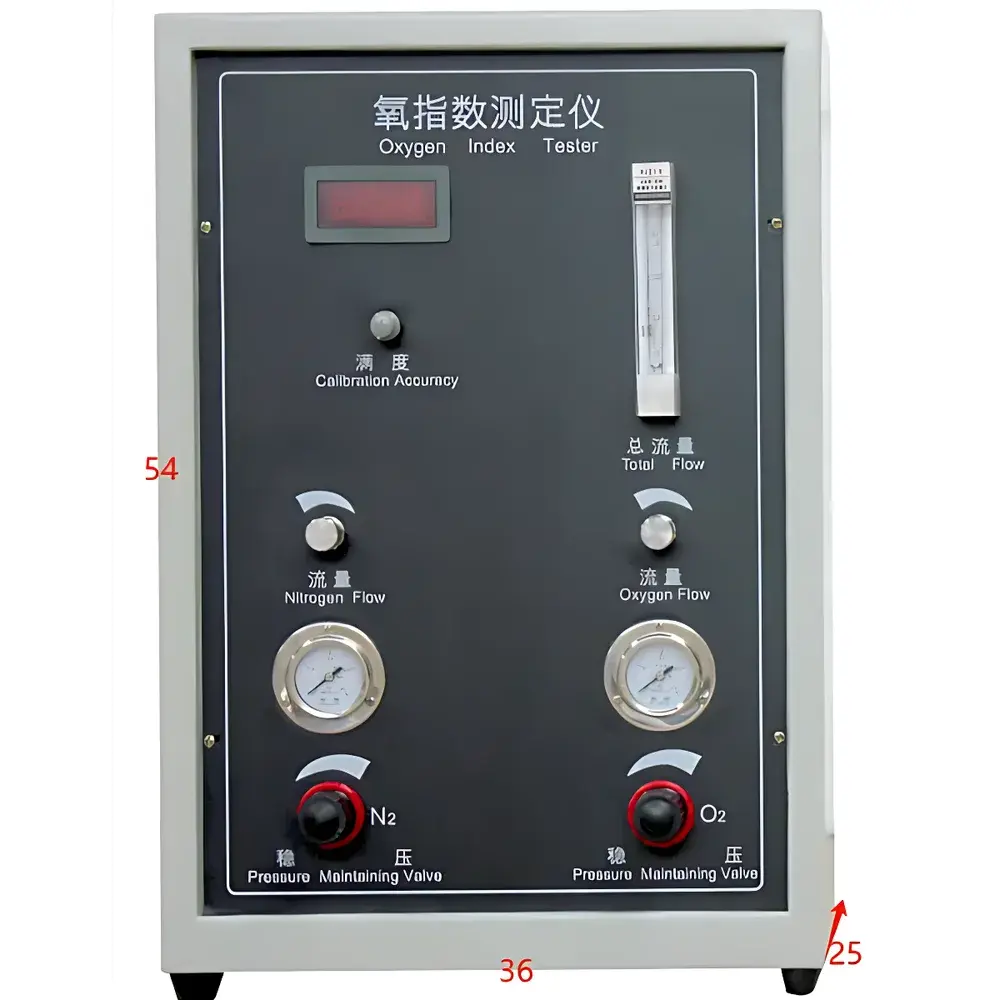
Aerospace OI-2 Oxygen Index Tester
| Key | Brand: Aerospace |
|---|---|
| Origin | Beijing, China |
| Model | OI-2 |
| Measurement Range | 0–100% O₂ |
| Accuracy | ±2.5% O₂ |
| Response Time | <10 s |
| Output Drift | <5% per year |
| Sample Form | Solid only |
| Operating Pressure | 0.1–0.15 MPa |
| Gas Flow Rate | 10.0 ± 0.5 L/min |
| Compliant With | GB/T 2406 |
Overview
The Aerospace OI-2 Oxygen Index Tester is a precision benchtop instrument engineered for the quantitative determination of the limiting oxygen index (LOI) of solid polymeric materials in accordance with GB/T 2406—China’s national standard equivalent to ISO 4589-2 and ASTM D2863. The LOI represents the minimum volume percentage of oxygen, in a controlled mixture of oxygen and nitrogen, required to support candle-like combustion of a vertically oriented specimen under specified laboratory conditions. This gravimetric-combustion method relies on stable laminar gas flow, calibrated thermal ignition, and real-time oxygen concentration monitoring via a high-stability electrochemical sensor. Unlike flame-spread or heat-release metrics, the LOI provides a fundamental, reproducible indicator of inherent material flammability—making it indispensable for comparative fire safety screening, regulatory documentation (e.g., building material classifications), and formulation development of flame-retardant polymers.
Key Features
- Electrochemical oxygen sensor with digital display output, offering ±2.5% O₂ accuracy and <10 s response time for rapid equilibrium detection
- Integrated dual-gas manifold with independent pressure regulation (O₂ and N₂), supporting precise binary gas blending at 0.1–0.15 MPa working pressure
- Standardized glass combustion column (100 mm inner diameter, 450 mm height) conforming to GB/T 2406 geometry requirements for consistent flame propagation dynamics
- Adjustable sample holder with stainless steel mesh support and brass-tipped, manually operated ignition wand (flame length 12–20 mm)
- Robust mechanical architecture: corrosion-resistant aluminum chassis, sealed gas pathways, and modular component layout for field serviceability
- No embedded software or network interface—designed for manual operation in GLP-compliant environments where audit trails are maintained externally
Sample Compatibility & Compliance
The OI-2 accommodates rigid and flexible solid specimens including molded thermoplastics, thermosets, laminates, foams, textiles, films, and sheet stock. Specimen dimensions follow strict categories defined in GB/T 2406 (Types I–V), with dimensional tolerances enforced to ensure inter-laboratory comparability (e.g., Type I: 80–150 mm × 10.0 ± 0.5 mm × 4.0 ± 0.25 mm). Non-self-supporting materials require auxiliary support during testing. The system complies fully with GB/T 2406, and its operational parameters align with the metrological and procedural requirements of ISO 4589-2 (Plastics — Determination of burning behaviour by oxygen index — Part 2: Ambient-temperature test) and ASTM D2863 (Standard Test Method for Determining the Flammability of Plastics Using the Oxygen Index). While not certified to UL 94 or EN 13501-1 directly, LOI data generated on the OI-2 serves as foundational input for classification under those frameworks.
Software & Data Management
The OI-2 operates as a standalone analog-digital hybrid instrument with no onboard firmware, microprocessor control, or data logging capability. Oxygen concentration is displayed numerically on an LED readout; all test parameters—including gas flow rates, ignition timing, burn length (50 mm), and duration (180 s)—are recorded manually by the operator in a bound laboratory notebook or validated electronic lab notebook (ELN). This design ensures full traceability under Good Laboratory Practice (GLP) and supports 21 CFR Part 11 compliance when paired with secure, time-stamped external documentation systems. Calibration certificates for the oxygen sensor and flow meters must be retained per ISO/IEC 17025 requirements. No proprietary drivers, USB interfaces, or cloud connectivity are included—eliminating cybersecurity risks and ensuring long-term operational continuity.
Applications
- Quality assurance of flame-retarded engineering plastics used in automotive interiors, electrical enclosures, and construction composites
- Comparative screening of halogen-free vs. brominated flame retardant systems during R&D
- Regulatory submission support for CE marking (EN 13501-1), CCC certification (China Compulsory Certification), and green building standards (e.g., LEED MRc4)
- Failure analysis of polymer batches exhibiting unexpected ignition behavior during production
- Academic research into combustion kinetics, char formation mechanisms, and synergistic flame inhibition effects
- Verification of material substitutions in legacy product lines requiring fire performance equivalence
FAQ
What gases are required for operation?
Industrial-grade oxygen (GB 3863) and nitrogen (GB 3864) are mandatory. Each gas supply must be equipped with a dedicated pressure regulator capable of delivering stable output within 0.1–0.15 MPa.
Is the instrument compatible with international standards beyond GB/T 2406?
Yes—the physical configuration, gas delivery specifications, and test protocol are technically aligned with ISO 4589-2 and ASTM D2863. Users should verify local accreditation body acceptance prior to regulatory submission.
Does the OI-2 include automated data export or PC connectivity?
No. It is a manually operated instrument. All measurements and observations must be transcribed externally to meet ALCOA+ data integrity principles.
What maintenance intervals are recommended for the oxygen sensor?
Annual recalibration against certified gas standards is advised. Sensor drift is specified at <5% per year under continuous use; replacement is recommended after 24 months or if zero/span verification fails.
Can thin films or foams be tested without modification?
Yes—provided they conform to Type V (films) or Type II (foams) specimen geometry per GB/T 2406. Non-self-supporting samples must be mounted using the supplied metal mesh and clamping fixture to prevent sagging or lateral flame spread.



