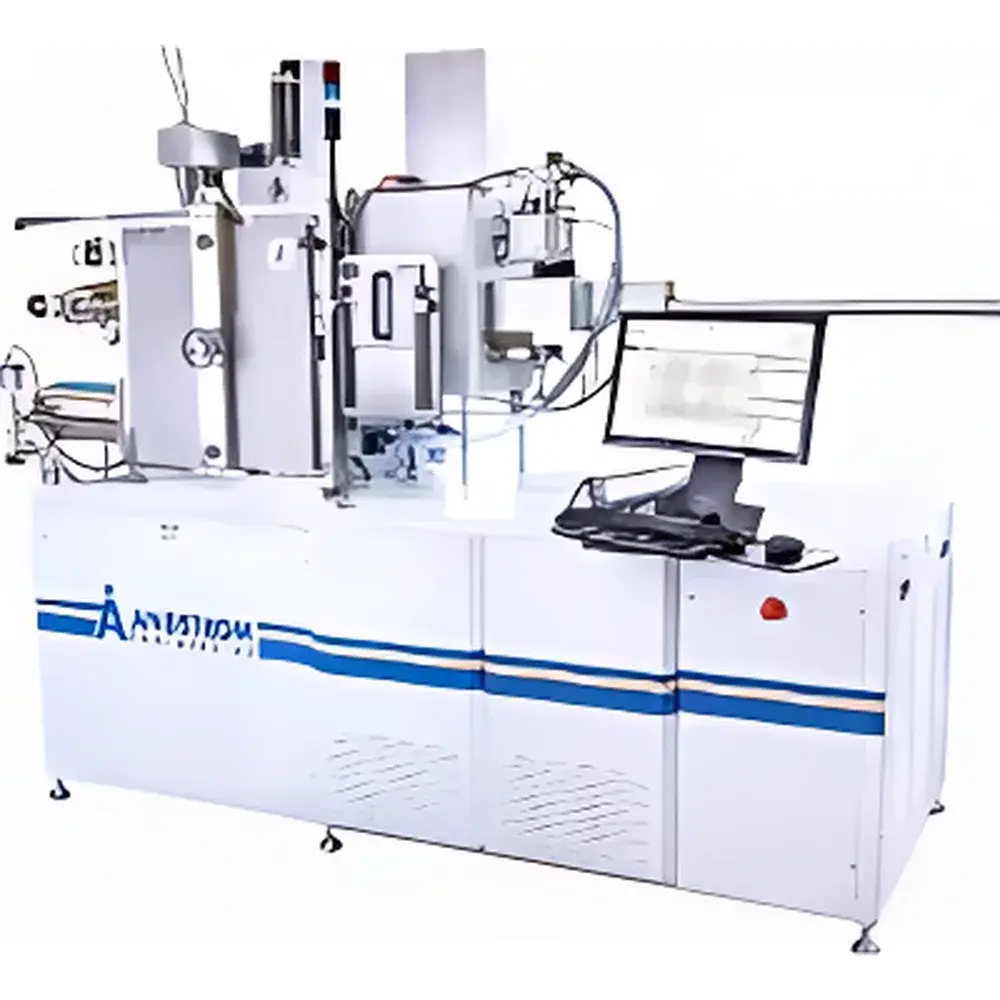
Angstrom Engineering EvoVac Physical Vapor Deposition Platform
| Brand | Angstrom |
|---|---|
| Origin | Canada |
| Model | EvoVac |
| Chamber Dimensions | 500 mm × 700 mm substrate stage |
| Vacuum capability | UHV-compatible (≤1×10⁻⁹ Torr base pressure) |
| Source options | RF sputtering, DC sputtering, Pulsed DC sputtering, HIPIMS, reactive sputtering |
| Cathode configurations | circular, linear, and cylindrical |
| Application domain | microelectronics |
Overview
The Angstrom Engineering EvoVac Physical Vapor Deposition (PVD) Platform is an engineered thin-film synthesis system designed for high-precision, reproducible material deposition under controlled ultra-high vacuum (UHV) conditions. It operates on core PVD principles—thermal evaporation, magnetron sputtering, and pulsed laser ablation—where solid-phase source materials are physically transformed into vapor-phase species via energetic particle bombardment or resistive/inductive heating, followed by directional condensation onto temperature-controlled substrates. The platform serves as a foundational tool in semiconductor process development, enabling atomic-scale control over film stoichiometry, thickness uniformity (<±1.5% across 200 mm wafers), crystallinity, and interfacial integrity. Its modular architecture supports both R&D and pilot-line integration, with vacuum integrity maintained by cryogenic pumping and turbomolecular backing, ensuring minimal hydrocarbon contamination and residual gas partial pressures compliant with ASTM F1929–22 standards for clean vacuum environments.
Key Features
- Modular multi-source chamber: Accommodates up to 14 independently controllable physical vapor sources—including thermal evaporators, electron-beam crucibles, and magnetron sputter cathodes—enabling sequential, co-deposition, or combinatorial thin-film synthesis.
- Large-format substrate handling: 500 mm × 700 mm motorized, heated, and cooled substrate stage with ±0.1° tilt precision and programmable rotation (0–30 rpm), supporting wafer sizes up to 300 mm and custom-shaped substrates.
- Advanced sputter flexibility: Integrated RF/DC/Pulsed DC/HIPIMS power delivery with real-time impedance matching; selectable cathode geometries (circular, linear, cylindrical) for optimized plasma confinement and target utilization efficiency (>75% for planar targets).
- UHV-ready vacuum architecture: Base pressure <1×10⁻⁹ Torr achieved with cryopanels and dual-stage turbo-molecular pumps; all internal surfaces electropolished 316L stainless steel with low-outgassing seals meeting ISO 10110-7 cleanliness specifications.
- In-situ metrology readiness: Standard flanges (CF100, CF160) support integration of quartz crystal microbalances (QCM), optical emission spectroscopy (OES), residual gas analyzers (RGA), and laser interferometric thickness monitors.
Sample Compatibility & Compliance
The EvoVac platform accommodates rigid and semi-rigid substrates including silicon wafers (50–300 mm), fused silica optics, ceramic carriers, metal foils, and MEMS devices. Substrate temperature control ranges from –120 °C to +600 °C using liquid nitrogen cooling and resistive heating, enabling low-temperature amorphous film growth or high-temperature epitaxial annealing. All vacuum components conform to ASME BPVC Section VIII Div. 1 and PED 2014/68/EU pressure equipment directives. System design supports GLP-compliant operation with audit-trail-capable recipe logging, and optional 21 CFR Part 11–compliant software packages for regulated semiconductor fabrication environments.
Software & Data Management
Control is executed via Angstrom’s proprietary AEGIS™ platform—a deterministic real-time operating system with deterministic I/O latency (<10 ms). The GUI enables synchronized multi-parameter scripting (pressure, power, shutter timing, substrate motion), full recipe versioning, and export of timestamped deposition logs in CSV and HDF5 formats. Integration with LabVIEW™, Python (via PyVISA), and OPC UA enables factory-level MES/SCADA connectivity. All process data—including source power waveforms, chamber pressure transients, and thermocouple histories—are stored with SHA-256 hash integrity verification for traceability in ISO 9001:2015 and IATF 16949 audits.
Applications
- Semiconductor front-end process development: Deposition of gate dielectrics (HfO₂, Al₂O₃), barrier layers (TiN, TaN), and interconnect metals (Cu, Co, Ru) with sub-nanometer thickness control and interface roughness <0.2 nm RMS.
- Advanced packaging: Thin-film redistribution layers (RDLs), passivation stacks (SiNₓ/SiO₂), and under-bump metallization (UBM) on fan-out wafer-level packages (FO-WLP).
- Photonic integrated circuits (PICs): Low-loss SiN and TiO₂ waveguide claddings with refractive index tunability via stoichiometric O/N ratio control.
- Hard mask and etch-stop layer fabrication: High-density carbon-based films and transition-metal nitrides for sub-5 nm node lithography processes.
- Research-scale quantum materials: Growth of topological insulators (Bi₂Se₃), superconducting oxides (YBCO), and 2D heterostructures requiring UHV background and atomic-layer precision.
FAQ
What vacuum level can the EvoVac achieve with standard configuration?
Standard configuration achieves ≤5×10⁻⁹ Torr with cryo-cooled chamber walls and dual turbo-molecular pumping; UHV add-ons (ion pumps, NEG strips) extend performance to ≤1×10⁻¹⁰ Torr.
Is the system compatible with reactive gas injection for oxide/nitride deposition?
Yes—dual-channel MFC-controlled reactive gas inlets (O₂, N₂, NH₃, CHF₃) are standard, with inline mass flow verification and endpoint detection via OES.
Can the EvoVac be integrated into a cluster tool environment?
Yes—modular load-lock designs with ISO-KF and CF porting support SEMI E157-compliant front-end module integration and automated wafer transfer via robotic handlers.
Does Angstrom provide installation qualification (IQ) and operational qualification (OQ) documentation?
Yes—factory-verified IQ/OQ protocols aligned with ISO/IEC 17025 and SEMI S2/S8 safety standards are included with turnkey delivery.
What level of technical support is available post-installation?
Angstrom provides remote diagnostics, annual preventive maintenance contracts, and on-site application engineering support for process optimization and failure root-cause analysis.