
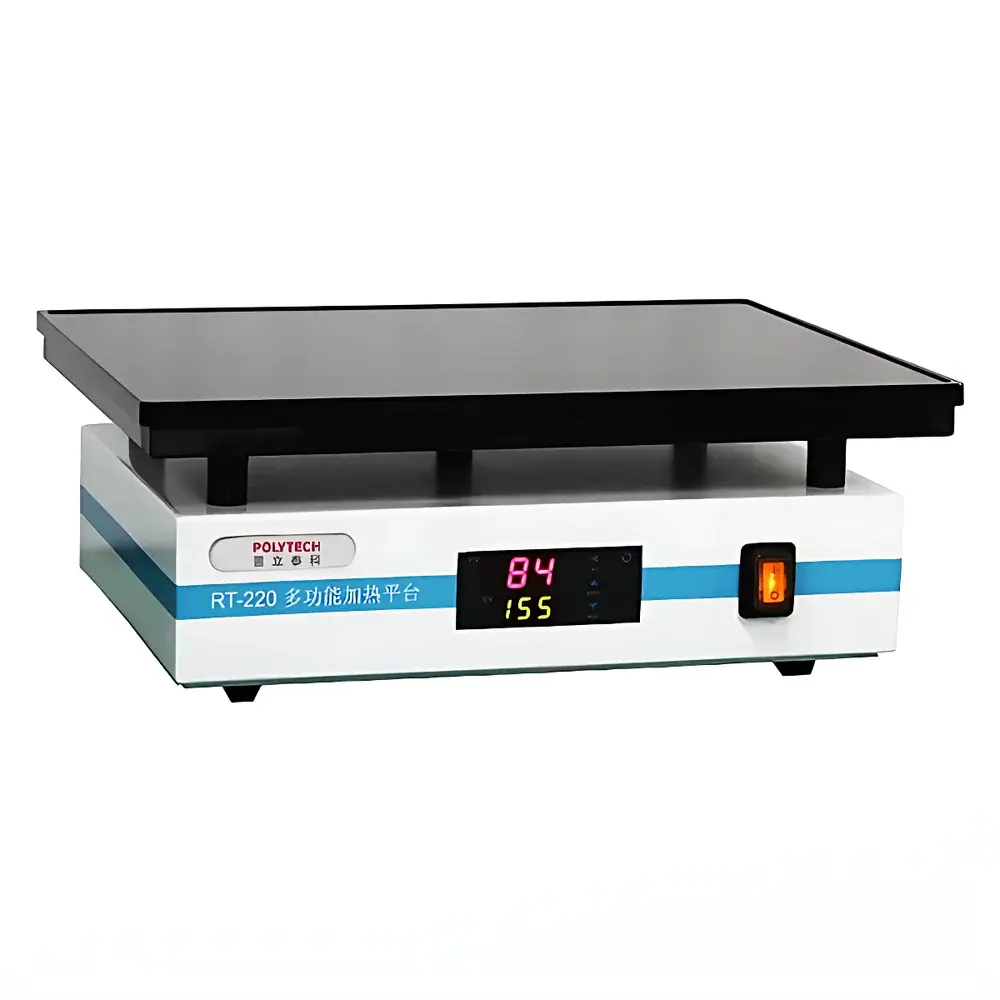
Polytech RT220 Electric Heating Plate
| Brand | Polytech |
|---|---|
| Model | RT 220 |
| Heating Surface | Solid Aluminum Alloy Plate with PTFE Coating |
| Max Operating Temperature | 220 °C |
| Temperature Control Accuracy | ±1 °C |
| Heating Rate | ≤15 °C/min (typical, ambient to 200 °C) |
| Power Supply | 220 V AC, 50 Hz |
| Dimensions (W×D×H) | 280 × 280 × 120 mm |
| Weight | 4.2 kg |
| Compliance | CE-marked, RoHS-compliant, designed per IEC 61010-1 for laboratory use |
Overview
The Polytech RT220 Electric Heating Plate is a precision-engineered laboratory heating platform designed for reproducible, contamination-free thermal treatment of samples during sample preparation and acid digestion workflows. Built upon a monolithic aluminum alloy heating surface coated with industrial-grade polytetrafluoroethylene (PTFE), the RT220 delivers exceptional chemical resistance—withstanding exposure to concentrated nitric, hydrochloric, sulfuric, and hydrofluoric acids commonly used in EPA Method 3050B, 3051A, and 3052 digestions. Its fully enclosed chassis architecture prevents corrosive vapors from penetrating internal electronics, significantly extending service life and reducing maintenance frequency in high-throughput analytical labs. Unlike ceramic or glass-top plates, the solid-metal construction ensures superior thermal conductivity, minimal temperature gradients (<±1.5 °C across surface at 180 °C), and rapid thermal response—critical for method standardization in environmental, food safety, and agricultural testing laboratories.
Key Features
- Monolithic aluminum alloy heating plate with uniform PTFE coating—resistant to thermal degradation up to 220 °C and chemically inert against aggressive mineral acids.
- Hermetically sealed housing design minimizes vapor ingress, protecting internal circuitry and ensuring long-term reliability in corrosive digestion environments.
- Microprocessor-based PID temperature controller with digital display—provides setpoint resolution of 0.1 °C and sustained accuracy of ±1 °C over full operating range (room temperature to 220 °C).
- Optimized thermal mass and low-thermal-resistance heater elements enable consistent ramp rates (≤15 °C/min) and stable dwell performance under load.
- Integrated overtemperature protection (hardware cutoff at 230 °C) and automatic shutdown on fault detection comply with IEC 61010-1 safety requirements for Class II laboratory equipment.
- Modular accessory compatibility—including PTFE-coated aluminum digestion block adapters for 12-, 16-, and 24-position tube configurations—enables transition from planar to vertical heating geometry without compromising thermal uniformity or tube stability.
Sample Compatibility & Compliance
The RT220 accommodates a wide range of digestion vessels—including borosilicate glass test tubes, quartz crucibles, PFA and ETFE vials, and Teflon-lined microwave digestion vessels—without risk of surface adhesion or coating delamination. Its flat, non-porous surface facilitates rapid cleaning and eliminates residue carryover between runs. The system meets essential regulatory prerequisites for accredited laboratories: it supports GLP-compliant documentation when paired with external data loggers, aligns with ISO/IEC 17025 method validation requirements for heating uniformity verification, and is routinely deployed in workflows adhering to US EPA, ASTM D3682, ISO 11466, and GB/T 17134 standards. While not intrinsically compliant with FDA 21 CFR Part 11, its analog control interface can be integrated into validated systems via third-party electronic lab notebook (ELN) or LIMS platforms with audit-trail functionality.
Software & Data Management
The RT220 operates as a standalone analog-controlled instrument with no embedded firmware or network connectivity. Temperature setpoints and real-time readings are displayed locally via a 4-digit LED screen; no software installation or driver configuration is required. For laboratories requiring traceable thermal records, the unit features a 0–5 V analog output port compatible with standard data acquisition systems (e.g., National Instruments DAQ, LabVIEW, or Eurotherm controllers) to capture time-stamped temperature profiles. Optional RS-485 Modbus RTU communication module (sold separately) enables integration into centralized lab automation networks for remote monitoring and batch-level parameter logging—supporting audit-ready documentation in GMP and ISO 17025 environments.
Applications
The RT220 serves as a primary thermal platform for open-vessel hotplate digestion in environmental analysis (soil, sediment, sludge), food matrix preparation (vegetables, grains, dairy), and clinical sample pretreatment (urine, serum, tissue homogenates). It is widely adopted for pre-concentration steps prior to ICP-OES, ICP-MS, AAS, and IC analyses. Additional routine uses include solvent evaporation, reagent drying, enzymatic reaction incubation at elevated temperatures, and controlled polymer annealing in materials science research. Its robustness and reproducibility make it especially suitable for QA/QC labs performing routine compliance testing under CNAS, ILAC, or APHL accreditation scopes.
FAQ
What is the maximum safe operating temperature for continuous use?
The RT220 is rated for continuous operation up to 220 °C; prolonged exposure above this threshold may accelerate PTFE coating aging and compromise thermal stability.
Can the RT220 be used with hydrofluoric acid (HF)?
Yes—the PTFE coating provides full resistance to HF at concentrations up to 40% w/w below 180 °C; however, proper fume hood ventilation and HF-specific PPE remain mandatory.
Is calibration certificate included with shipment?
A factory-issued calibration report (traceable to NIST standards) is available upon request at time of order; on-site calibration services are supported through authorized Polytech service partners in EMEA and APAC regions.
Does the unit support programmable ramp-hold profiles?
No—the RT220 features single-setpoint PID control only; multi-step thermal protocols require external programmable controllers interfaced via the analog output or optional Modbus module.
What maintenance is recommended for long-term performance?
Monthly visual inspection of PTFE surface integrity, quarterly cleaning with deionized water and lint-free cloth, and annual verification of temperature accuracy using a calibrated reference thermometer (e.g., Fluke 1523) are advised per Polytech Maintenance Protocol MP-RT220 Rev. 3.



