
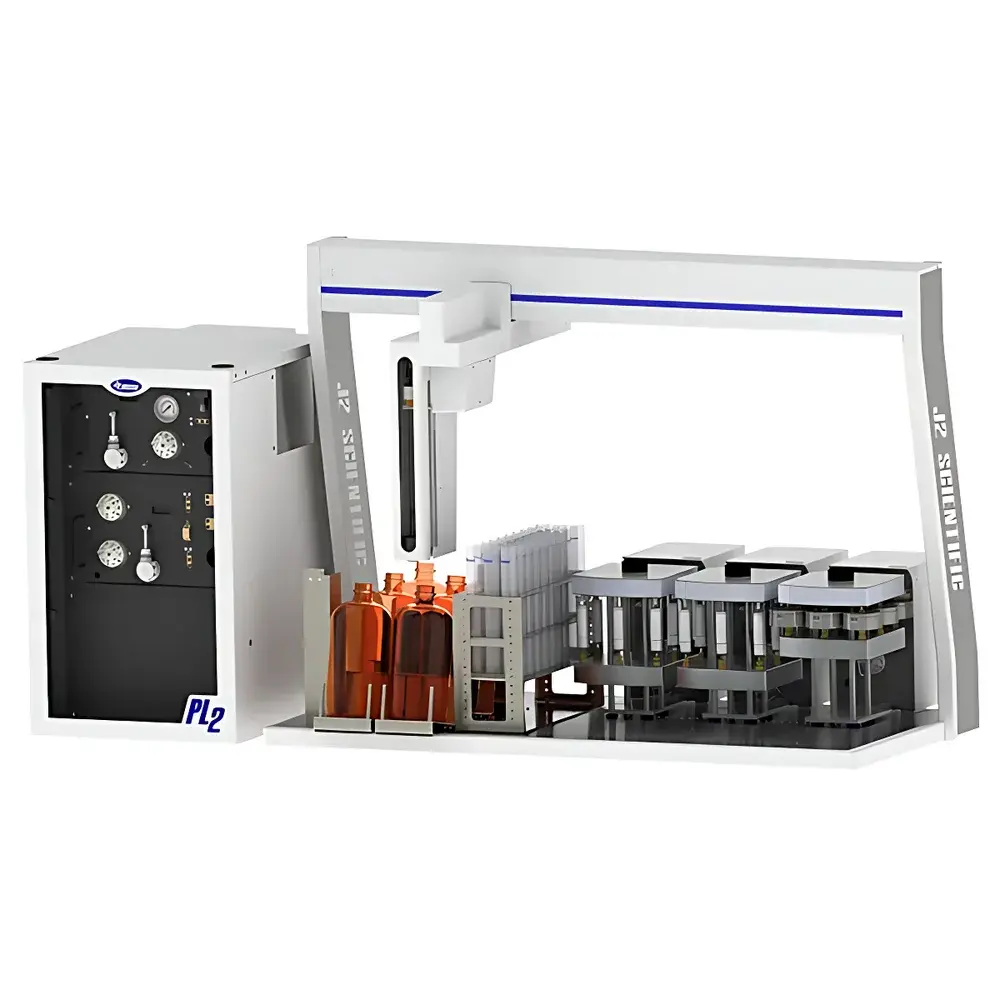
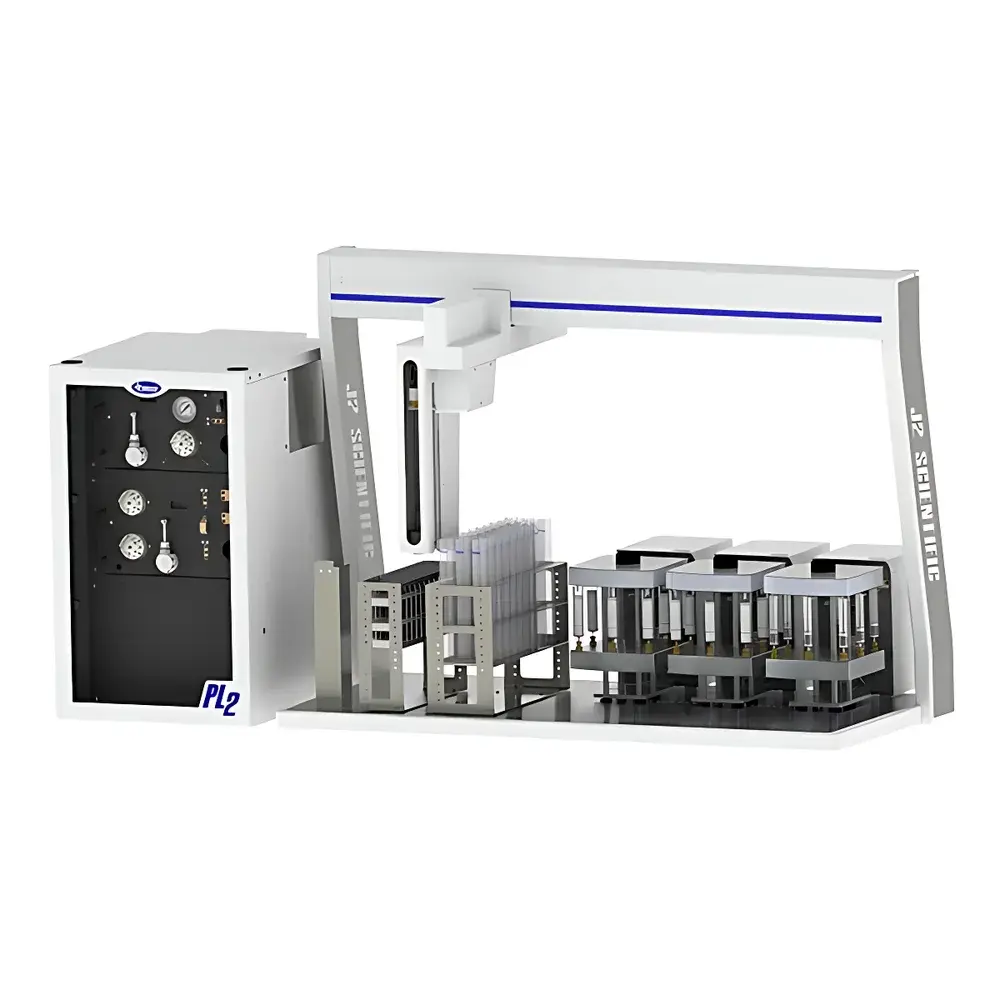
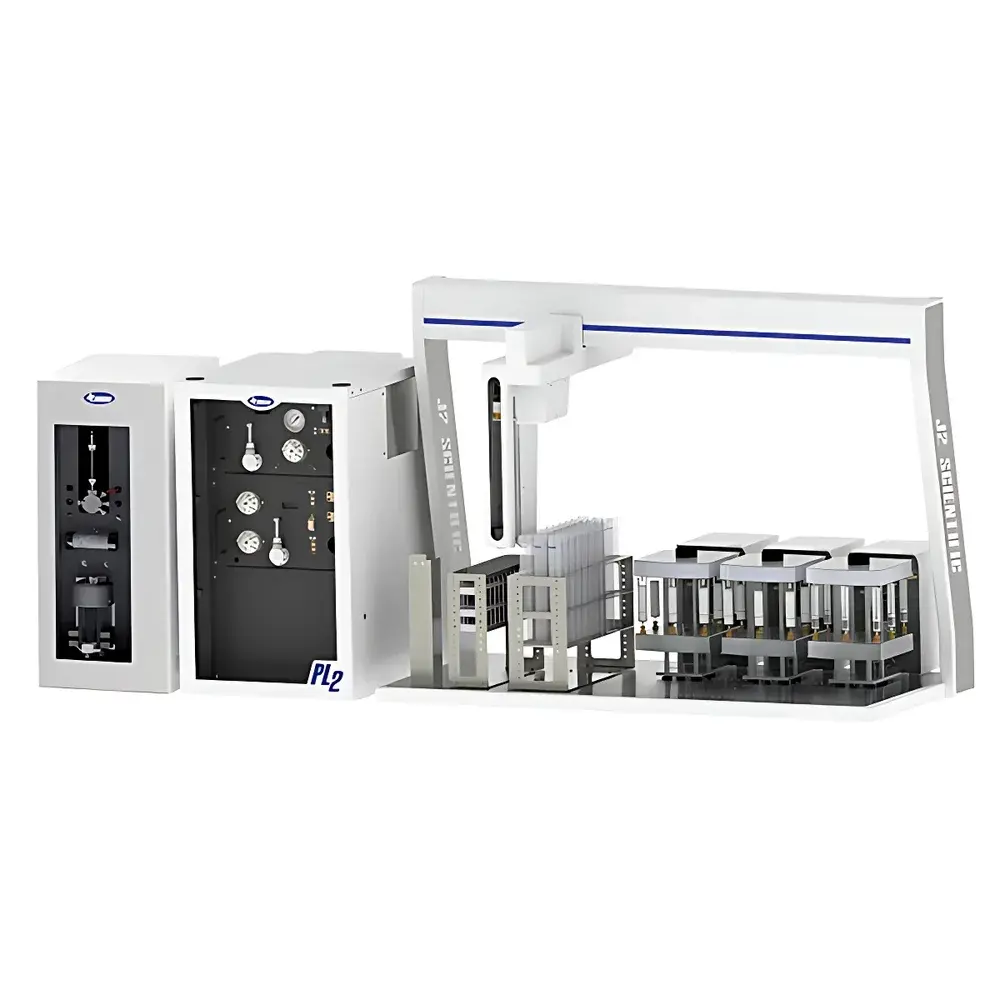
J2 Scientific PrepLinc 2 Platform
| Brand | J2 Scientific |
|---|---|
| Origin | USA |
| Model | PrepLinc 2 Platform |
| Flow Rate | 0.01–10.00 mL/min |
| Maximum Pressure | 2500 PSI |
| Flow Stability | ±0.5% |
| Autosampler Volume Range | 100 µL – 1000 mL |
| Autosampler Capacity | 36 positions |
| Integrated Modules | GPC Purification, SPE Extraction, AccuVap® Quantitative Evaporation |
| UV Detection Options | Fixed- or Variable-Wavelength Detector |
| Solvent Exchange Capability | Yes |
| Column Compatibility | Glass GPC columns (700 × 25 mm), High-Efficiency GPC columns (300 × 20 mm), SPE cartridges (1–15 mL) |
| Software Control | Unified platform with audit trail, method storage, and sequence scheduling |
| Compliance Support | ASTM D7067, ISO 17025 workflows, FDA 21 CFR Part 11–ready data handling |
Overview
The J2 Scientific PrepLinc 2 Platform is an integrated, fully automated sample preparation system engineered for high-throughput laboratories performing multiresidue analysis in food safety, environmental monitoring, and regulatory compliance testing. It unifies three critical orthogonal purification techniques—gel permeation chromatography (GPC), solid-phase extraction (SPE), and quantitative solvent evaporation—into a single, software-coordinated architecture. Unlike standalone instruments requiring manual transfer between steps, the PrepLinc 2 employs a shared fluidic backbone and robotic autosampler to execute sequential GPC cleanup, SPE fractionation, and precise solvent exchange/concentration without human intervention. Its core principle relies on size-exclusion separation (GPC), selective adsorption/desorption (SPE), and controlled thermal/vacuum-assisted evaporation (AccuVap®), enabling reproducible removal of macromolecular interferences (e.g., lipids, proteins, polymers) while retaining target analytes across diverse matrices—including animal tissues, fruits, vegetables, soil extracts, and water concentrates.
Key Features
- Modular configuration flexibility: Operates as independent GPC, SPE, or evaporation modules—or seamlessly couples any two or all three functions within a single method sequence.
- Integrated high-pressure solvent delivery: Dual-pump architecture supports flow rates from 0.01 to 10.00 mL/min at up to 2500 PSI, optimized for both conventional GPC columns and high-efficiency packed beds.
- Autosampler with 36-position tray and expandable 216-sample capacity via optional AS4 carousel; accommodates vials (2–20 mL), SPE cartridges, and collection tubes.
- Zero-dead-volume 5 mL syringe pump with <0.01% RSD repeatability and <0.1% accuracy for precise injection, fraction collection, and solvent addition.
- In-line UV detection with fixed- or variable-wavelength options (190–400 nm) for real-time fraction monitoring during GPC elution and SPE eluate tracking.
- Patented loop-based concentration design enables simultaneous purification and solvent reduction—eliminating intermediate drying steps and minimizing analyte loss or degradation.
- Column protection system featuring automatic bypass valve actuation during idle or shutdown phases to maintain column hydration and extend lifetime.
- Direct needle-injection port ensures full transfer of sample volumes from 100 µL to 10 mL with no dilution or carryover risk.
Sample Compatibility & Compliance
The PrepLinc 2 Platform processes complex biological and environmental extracts—including lipid-rich meat homogenates, pesticide-spiked fruit pulps, sediment supernatants, and wastewater concentrates—without matrix-induced clogging or breakthrough. Its SPE module accepts commercial 1–15 mL cartridges (C18, Florisil®, silica, NH₂, mixed-mode), supports serial cartridge stacking and reverse-phase elution protocols, and maintains consistent bed integrity across >1000 cycles under GLP conditions. The system complies with method requirements outlined in GB/T 5009.x, SN/T 24xx series, and AOAC Official Methods® for multiresidue pesticide analysis. It supports traceability through electronic lab notebook integration, time-stamped audit logs, and user-access-controlled method libraries aligned with ISO/IEC 17025 documentation standards.
Software & Data Management
Controlled by J2’s proprietary PrepLinc Method Studio™, the platform provides a unified interface for method development, sequence definition, real-time instrument status monitoring, and post-run review. All hardware modules—including GPC detector signals, SPE fraction triggers, and evaporation endpoint detection—are synchronized via timestamped event logging. Data files are stored in vendor-neutral formats (CSV, PDF reports) with embedded metadata (operator ID, calibration date, column lot number). The software includes built-in validation tools for linearity checks, spike recovery calculations, and QC flagging per USP and FDA 21 CFR Part 11 guidelines. Audit trails are immutable and exportable for regulatory submission.
Applications
- Routine multiresidue screening of >380 pesticides in animal muscle tissue per GB/T 20772–2006 using GPC–SPE–evaporation workflow.
- Cleanup of fatty food extracts prior to GC–MS analysis of organochlorines (GB/T 5009.19–2008) or organophosphates (GB/T 5009.161–2003).
- Removal of humic substances from environmental water samples before LC–MS/MS quantitation of pharmaceutical residues.
- Pre-concentration and solvent exchange of phytochemical extracts into acetonitrile or methanol for HPLC–DAD analysis per GB 5009.32–2016.
- Automated preparation of reference standards and QC samples in accredited food testing labs seeking ISO/IEC 17025 accreditation.
FAQ
Can the PrepLinc 2 Platform be validated for regulated environments such as FDA-regulated labs?
Yes—the system supports IQ/OQ/PQ documentation packages and generates 21 CFR Part 11–compliant electronic records including user authentication, electronic signatures, and tamper-evident audit trails.
Is method transfer possible between PrepLinc 1 and PrepLinc 2 systems?
Method parameters (flow gradients, fraction windows, evaporation profiles) are backward-compatible; however, hardware-level optimizations in PrepLinc 2—such as enhanced pump stability and improved UV baseline noise—may require minor recalibration.
Does the system support custom column packing or third-party GPC columns?
It accepts standard 25 mm ID glass or stainless-steel GPC columns (700 × 25 mm) and high-efficiency 20 mm ID columns (300 × 20 mm); column dimensions and packing materials must conform to J2’s hydraulic specifications to ensure pressure integrity.
How is carryover managed during high-sensitivity analyses?
The system implements dual-stage needle wash (internal + external) using programmable solvent sequences, with validation data demonstrating <0.05% carryover for chlorpyrifos at 10 ng/mL level across 216-sample batches.
What maintenance intervals are recommended for routine operation?
Pump seals and UV lamp replacement every 12 months; GPC column regeneration every 200 runs; SPE cartridge holder cleaning after each 50-run sequence; full system performance verification quarterly per ISO/IEC 17025 internal QA protocol.



