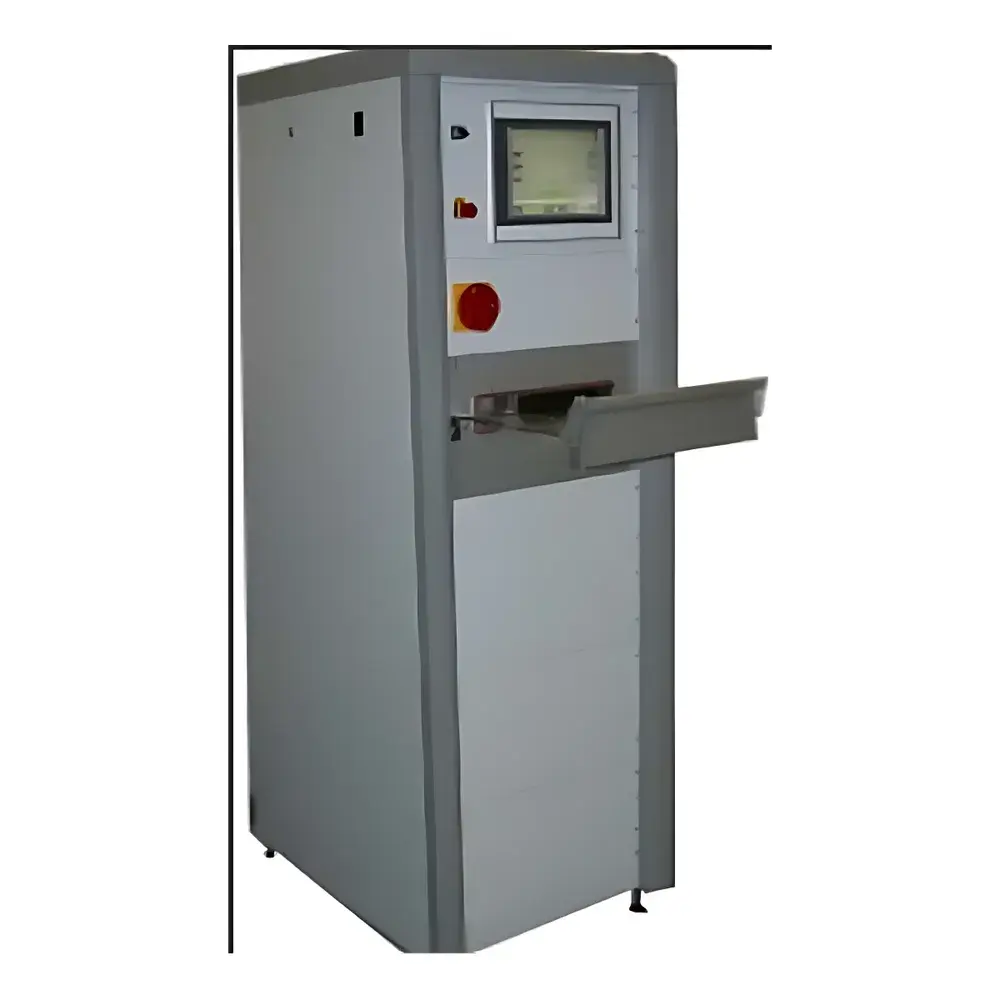
UniTemp PTP-300 Plasma Cleaning and Heating System
| Brand | UniTemp |
|---|---|
| Model | PTP-300 |
| Origin | Germany |
| Chamber Dimensions (Process Zone) | 305 mm × 305 mm × 25 mm |
| Chamber Height | 35 mm |
| Chamber Material | Anodized Aluminum or Optional Quartz Glass |
| External Dimensions | 600 mm × 1850 mm × 880 mm (W × D × H) |
| Gas Inlets | 2 × MFC-controlled lines |
| Vacuum Interface | DN25 KF flange |
| Microwave Generator | 2.45 GHz, 100–600 W (water-cooled, optional chiller) |
| Heating System | 24 IR lamps, total 18 kW |
| Control System | B&R SPS controller PP420 with LCD interface |
| Power Supply | 3/N/PE, AC 50/60 Hz, 230/400 V |
Overview
The UniTemp PTP-300 Plasma Cleaning and Heating System is an integrated dry-process instrument engineered for precision surface conditioning in semiconductor fabrication, MEMS packaging, and advanced microelectronics R&D. It combines low-pressure microwave-excited plasma generation (2.45 GHz, 100–600 W) with synchronized infrared thermal processing (18 kW total output) within a single vacuum-compatible chamber. Unlike wet chemical cleaning methods, the PTP-300 operates via non-equilibrium plasma chemistry—ionizing process gases (e.g., O₂, Ar, CF₄, or N₂/H₂ mixtures) to generate reactive species (ions, radicals, UV photons) that selectively etch organic contaminants, native oxides, photoresist residues, and adventitious carbon layers without substrate sputtering or lattice damage. The integrated IR heating stage enables controlled thermal activation of surface reactions—accelerating desorption kinetics, enhancing radical diffusion into submicron features, and promoting post-cleaning dehydration to prevent recontamination during venting. Designed for Class 100 cleanroom integration, the system complies with SEMI S2-0216 safety guidelines and supports vacuum-level process stability down to 1 × 10⁻² mbar.
Key Features
- Multi-functional dry processing: Simultaneous or sequential plasma cleaning, surface activation, oxide reduction, and thermal annealing in one chamber
- High-reproducibility microwave plasma source: 2.45 GHz magnetron with water-cooled cavity and power regulation from 100 W to 600 W (±2% setpoint accuracy)
- Dual-zone thermal control: 24 individually shielded IR emitters provide uniform radiant heating across the 305 × 305 mm process area; temperature ramp rates up to 10 °C/s, stable ±3 °C at 200 °C
- Modular gas delivery: Two independent mass flow controllers (MFCs) support precise gas blending and dynamic recipe switching (e.g., O₂ plasma followed by forming gas anneal)
- Robust chamber architecture: Anodized aluminum construction with optional quartz-glass viewport for real-time optical emission spectroscopy (OES) monitoring
- Industrial-grade automation: B&R PP420 programmable logic controller (PLC) with Ethernet/IP connectivity, password-protected recipe management, and audit-trail-capable event logging
Sample Compatibility & Compliance
The PTP-300 accommodates wafers up to 200 mm diameter, diced die stacks, ceramic substrates, glass masks, and flexible polyimide carriers. Its shallow 25 mm process zone ensures uniform plasma density and thermal flux across low-profile assemblies—including flip-chip underfills, TSV interposers, and thin-film sensors. Chamber geometry and RF shielding meet IEC 61000-6-4 electromagnetic compatibility requirements. Process validation aligns with ISO 14644-1 (Class 5 cleanroom operation), ASTM F209 (standard practice for contamination control), and JEDEC J-STD-033 (moisture sensitivity level preconditioning). Optional traceable calibration certificates (NIST-traceable thermocouples and pressure gauges) support GLP/GMP environments requiring documented metrological traceability.
Software & Data Management
The embedded B&R Automation Studio runtime provides intuitive recipe-driven operation via a 7-inch LCD HMI. Each process sequence stores full parameter metadata—including gas composition, pressure profile, microwave power ramp, IR temperature setpoints, and vacuum pump-down timing. All operational events (valve actuations, fault triggers, manual overrides) are timestamped and archived locally with configurable retention (default: 90 days). Remote monitoring and data export (CSV/Excel) are enabled via standard Ethernet TCP/IP; OPC UA server option allows seamless integration into MES platforms (e.g., Siemens Opcenter, Rockwell FactoryTalk). Audit trail functionality satisfies FDA 21 CFR Part 11 requirements when paired with user-role authentication and electronic signature modules.
Applications
- Semiconductor front-end: Pre-bond cleaning of Si/SiO₂ wafers, removal of HMDS residues prior to lithography, and native oxide reduction before ALD nucleation
- MEMS packaging: Activation of gold bond pads and removal of release-layer polymers from inertial sensor cavities
- Advanced packaging: Surface conditioning of fan-out wafer-level substrates (FO-WLP) prior to underfill dispensing
- Research & development: Controlled surface functionalization of graphene, MoS₂, and perovskite thin films for optoelectronic characterization
- Medical device manufacturing: Sterilization and hydrophilicity enhancement of microfluidic PDMS chips without solvent exposure
FAQ
What vacuum level is required for stable plasma ignition?
The system achieves reliable plasma ignition at ≤5 × 10⁻² mbar using the integrated DN25 KF vacuum line; optimal cleaning uniformity is maintained between 1 × 10⁻² and 8 × 10⁻² mbar.
Can the PTP-300 operate with hydrogen-containing gas mixtures?
Yes—when equipped with optional explosion-proof gas manifold and H₂-certified MFCs, it supports forming gas (N₂/H₂) and pure H₂ plasmas for oxide reduction, subject to local safety authority approval.
Is quartz chamber material necessary for UV-sensitive processes?
Quartz construction (optional upgrade) transmits >85% of 185–254 nm UV-C photons, enabling direct photolysis-assisted cleaning; aluminum chambers attenuate UV below 200 nm but retain full radical-based efficacy.
How is cooling managed for the microwave generator?
The magnetron requires continuous deionized water cooling (flow rate ≥3 L/min, ΔT ≤5 °C); an integrated recirculating chiller (UniTemp C-1800) is available as a factory-configured option.
Does the system support remote diagnostics and firmware updates?
Yes—via secure SSH-enabled Ethernet access, authorized service engineers can perform real-time diagnostics, log analysis, and signed firmware updates compliant with IEC 62443-3-3 cybersecurity standards.
Related Products