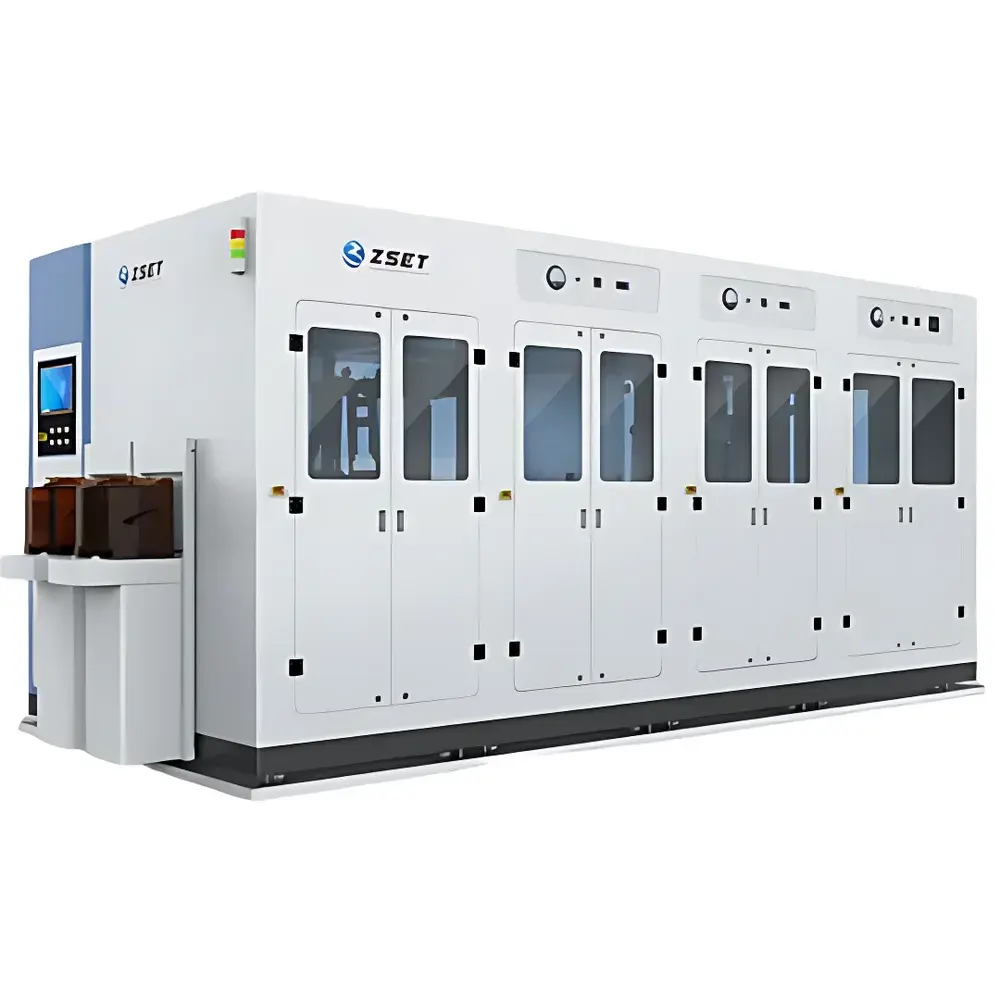
Zhipure Customized-2 Trough-Type Wet Etching and Cleaning System
| Brand | Zhipure |
|---|---|
| Model | Customized-2 |
| Equipment Type | Batch Wet Processing System |
| Wafer Diameter | 100 mm – 300 mm |
| Cleaning Method | Liquid-phase Chemical Processing |
| Core Process Controls | Temperature Control, Chemical Concentration Control, Flow Rate Control, Pressure Control |
| Supported Processes | RCA Standard Clean, Photoresist Strip (Wet), Dielectric Layer Wet Etch (e.g., SiO₂, Si₃N₄), Metal Layer Wet Etch (e.g., Al, Ti, Cu), Pre-furnace Cleaning |
| Etch Uniformity | ≤4% intra-wafer, ≤4% inter-wafer, ≤4% batch-to-batch |
| Particle Additivity | <30 particles @ 0.09 µm (tested on thermally grown SiO₂ film |
| Metallic Contamination | <5 × 10⁹ atoms/cm² |
| Safety & Automation | Over-temperature protection per tank, leak detection sensors per process module, chemical recovery capability, Marangoni drying or spin-dry integration, automated acid replacement, auto-replenishment and formulation, SECS/GEM compliance |
Overview
The Zhipure Customized-2 Trough-Type Wet Etching and Cleaning System is an engineered platform for high-precision, repeatable batch processing of silicon wafers in semiconductor front-end fabrication. Based on the classical immersion-based wet chemistry architecture, it employs controlled liquid-phase reactions—leveraging standardized chemistries such as SC1 (NH₄OH:H₂O₂:H₂O), SC2 (HCl:H₂O₂:H₂O), HF-based etchants, and organic solvent-based strippers—to achieve surface cleaning, native oxide removal, photoresist stripping, dielectric layer patterning (e.g., SiO₂, Si₃N₄), and selective metal etching (e.g., Al, Ti, Cu). Designed for integration into 200 mm and 300 mm wafer fabs, the system adheres to fundamental requirements of process stability, contamination control, and tool-to-tool reproducibility—critical for advanced node manufacturing where surface integrity directly impacts gate oxide quality, contact resistance, and defect-limited yield.
Key Features
- Modular trough architecture supporting up to six independently controlled chemical tanks, each equipped with real-time temperature regulation (±0.3 °C), concentration monitoring via conductivity/refractometry, and precision mass-flow-controlled chemical delivery.
- Integrated fluid handling subsystems including chemical circulation, filtration (sub-10 nm particle retention), recirculation, and closed-loop recovery—minimizing chemical consumption and waste generation while maintaining bath stability over extended runs.
- Dual-drying options: programmable Marangoni drying using isopropyl alcohol (IPA) vapor meniscus or high-speed spin-dry with inert gas purge, both calibrated to limit post-process particle additivity and watermark formation.
- Comprehensive safety infrastructure: redundant over-temperature cutoffs per tank, distributed leak detection sensors with localized alarm isolation, corrosion-resistant wetted materials (PP, PVDF, quartz, PFA), and integrated exhaust scrubbing compatibility.
- Full SECS/GEM (SEMI E30/E37) implementation enabling seamless host communication, recipe management, event logging, and remote diagnostics within factory automation frameworks (FA/AMHS).
Sample Compatibility & Compliance
The system processes standard silicon wafers ranging from 100 mm (4″) to 300 mm (12″), accommodating both bare and film-coated substrates—including thermal oxide, LPCVD/PECVD SiO₂/Si₃N₄, sputtered or electroplated metals (Al, Ti, Cu, W), and photoresist layers. All wetted components comply with SEMI F57 (Materials Compatibility for Semiconductor Wet Process Equipment) and meet ASTM F2169 specifications for purity and extractables. The platform supports GLP- and GMP-aligned operation through audit-trail-enabled software logs, user-access controls, and electronic signature capability—facilitating FDA 21 CFR Part 11 readiness when deployed in qualified environments.
Software & Data Management
The embedded control software provides a deterministic, deterministic real-time operating environment with cycle-accurate timing resolution (<100 ms). Process recipes are structured hierarchically—by step, sub-step, and parameter set—with version-controlled storage and checksum verification. All sensor data (temperature, flow, pressure, conductivity, pH where applicable) is timestamped and archived at configurable intervals (default: 1 Hz). Historical run data is exportable in CSV/ATF formats compatible with SPC tools (e.g., JMP, Minitab) and MES interfaces. Remote monitoring and predictive maintenance alerts are supported via OPC UA gateway integration.
Applications
- RCA Standard Clean sequences for native oxide and metallic contaminant removal prior to epitaxy or gate oxidation.
- Photoresist stripping using sulfuric acid/peroxide mixtures or amine-based solvents, with endpoint detection via optical reflectance or inline ellipsometry (optional).
- Isotropic wet etching of silicon dioxide (HF/NH₄F), silicon nitride (hot phosphoric acid), and low-k dielectrics under tightly regulated bath composition and temperature.
- Patterned metal layer removal (e.g., Al etch with phosphoric/nitric/acetic acid blends; Cu barrier removal with ammonium persulfate-based chemistries).
- Pre-diffusion/pre-CVD/pre-ALD cleaning to eliminate organic residues, particles, and ionic contaminants that could nucleate defects or cause interface states.
FAQ
What wafer sizes does the Customized-2 support?
It accommodates 100 mm, 150 mm, 200 mm, and 300 mm wafers in standard cassettes, with mechanical adaptability for both FOUP and open-cassette loading configurations.
Is the system compatible with hazardous chemistries such as concentrated HF or hot H₃PO₄?
Yes—tanks and piping are constructed from chemically inert materials (quartz, PFA-lined PP, PVDF) rated for continuous exposure to HF, H₃PO₄, HNO₃, H₂SO₄, and organic solvents; optional secondary containment and acid mist suppression modules are available.
How is chemical concentration maintained during long-duration etch processes?
Real-time in-line conductivity and refractive index sensors feed back to the PLC-driven dosing system, which triggers automated make-up additions based on pre-calibrated concentration–property correlations and cumulative chemical consumption models.
Does the system support trace metal analysis (TMA) validation protocols?
While not an analytical instrument itself, the Customized-2’s ultra-low metallic leaching design (<5 × 10⁹ atoms/cm²) and certified material certifications enable direct qualification for TMA-critical steps; tool qualification reports include VPD-ICP-MS baseline data per SEMI D38.
Can the platform be integrated into a Smart Factory environment?
Yes—it delivers full SECS/GEM compliance, supports HSMS over TCP/IP, and includes a RESTful API for MES/ERP integration, enabling automated job dispatch, status reporting, and OEE tracking without custom middleware.