
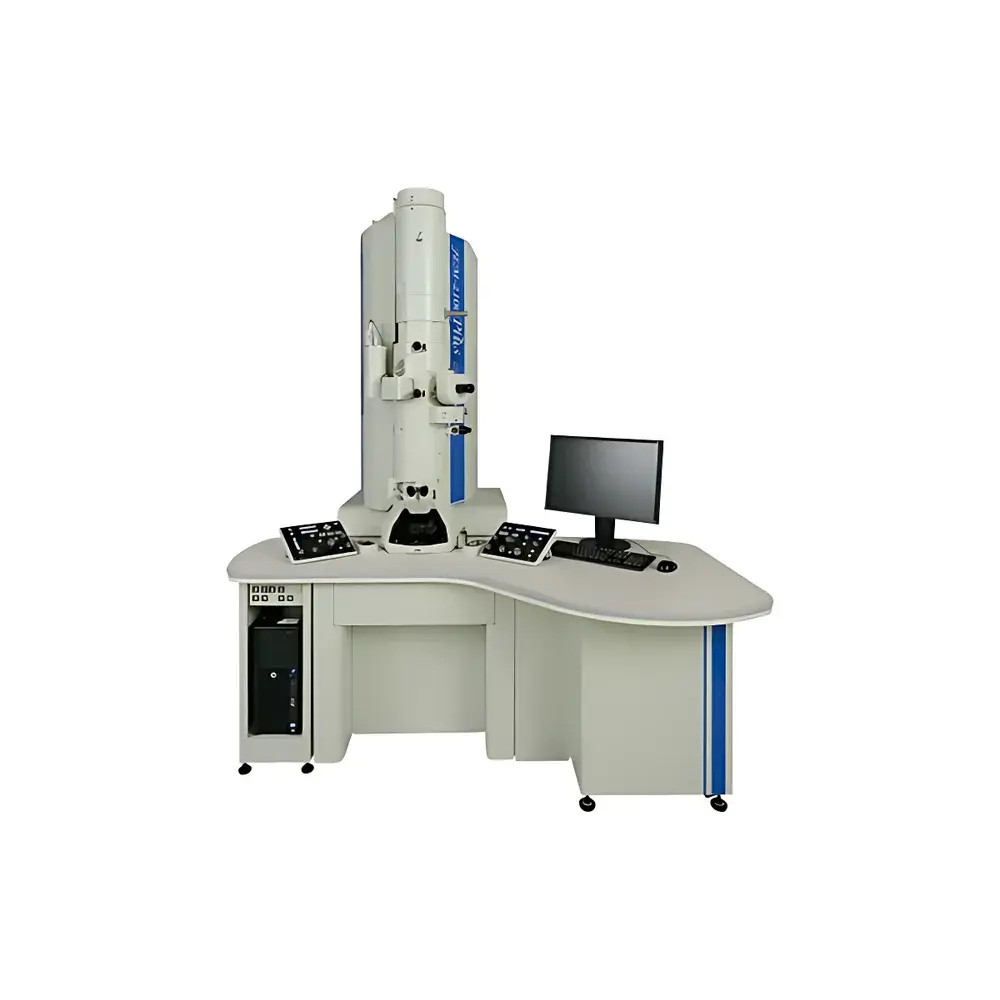
JEOL JEM-2100Plus 200 kV LaB₆ Transmission Electron Microscope
| Brand | JEOL |
|---|---|
| Origin | Japan |
| Model | JEM-2100Plus |
| Acceleration Voltages | 80, 100, 120, 160, 200 kV |
| Magnification Range | 50× to 1,500,000× |
| Point Resolution | 0.19 nm |
| Line Resolution | 0.14 nm |
| Minimum Probe Size | 0.5 nm |
| Tilt Range | ±25° |
| Condenser System | Three-Stage Lens Design |
| Pole Piece Options | UHR, HR, HT, HC, CRYO |
| Operating System | 64-bit Windows-based Control Interface |
| Integrated Detectors | STEM, EDS, CCD, EELS |
Overview
The JEOL JEM-2100Plus is a high-performance 200 kV transmission electron microscope (TEM) engineered for atomic-scale structural and compositional analysis in advanced materials research, nanotechnology development, and structural biology. Designed around a thermionic LaB₆ electron source, it delivers superior brightness and long-term beam stability compared to conventional tungsten filaments—enabling high signal-to-noise imaging and reproducible analytical performance across extended acquisition sessions. Its three-stage condenser lens system ensures optimal electron probe formation at variable spot sizes, supporting both high-resolution imaging and microanalysis modes without compromising illumination coherence or current density. The instrument’s mechanical and thermal stability—reinforced by a rigid column architecture, active vibration damping, and precision-machined pole pieces—supports routine operation at its specified point resolution of 0.19 nm and line resolution of 0.14 nm under standard UHR pole piece configuration.
Key Features
- LaB₆ thermionic electron source offering enhanced brightness, extended source lifetime (>1,000 hours), and reduced energy spread versus tungsten emitters
- Five interchangeable pole piece configurations (UHR, HR, HT, HC, CRYO) enabling rapid adaptation to diverse application requirements—from ultra-high-resolution lattice imaging to cryo-TEM or high-tension thick-specimen work
- Three-stage condenser system delivering consistent probe current and convergence angle control; minimum probe size of 0.5 nm supports nanoscale STEM and microdiffraction
- High-precision goniometer stage with ±25° tilt range and piezoelectric-driven fine positioning, optimized for tomographic tilt-series acquisition and crystallographic orientation mapping
- Integrated digital control platform based on 64-bit Windows OS, unifying TEM, STEM, EDS, EELS, and CCD camera operations within a single graphical interface
- Modular detector architecture facilitating seamless hardware expansion—including optional Gatan Rio CMOS camera, Oxford X-MaxN EDS, and Quantum GIF spectrometers
Sample Compatibility & Compliance
The JEM-2100Plus accommodates standard 3.05 mm diameter TEM grids (copper, nickel, gold, silicon nitride) and supports specialized holders for in situ heating, cooling (down to liquid nitrogen temperatures), and electrical biasing. Its column vacuum system maintains base pressure <2 × 10⁻⁷ Pa, ensuring low contamination rates during extended acquisitions. The instrument complies with IEC 61000-6-3 (EMC emission standards) and IEC 61000-6-2 (immunity requirements), and meets CE marking directives for laboratory equipment. When configured with audit-trail-enabled software modules and user-access controls, the system supports GLP-compliant workflows and can be validated per ISO/IEC 17025 requirements for accredited testing laboratories.
Software & Data Management
Control and acquisition are managed via JEOL’s proprietary DigitalMicrograph-compatible software suite, which provides full scripting capability (via Python API), real-time FFT processing, and automated calibration routines for magnification, stigmation, and alignment. All image and spectrum data are stored in standardized TIFF/DM3 formats with embedded metadata—including acquisition parameters, stage coordinates, lens settings, and detector gain values—to ensure traceability and interoperability with third-party analysis tools (e.g., HyperSpy, EMAN2, TomoJ). Optional FDA 21 CFR Part 11 compliance packages include electronic signatures, role-based access control, and immutable audit logs for regulated environments.
Applications
- Atomic-resolution imaging of crystalline defects, grain boundaries, and interfacial structures in metals, ceramics, and 2D materials
- Nanoscale chemical mapping via energy-dispersive X-ray spectroscopy (EDS) and electron energy-loss spectroscopy (EELS)
- 3D structural reconstruction through electron tomography using tilt-series acquisition and weighted back-projection algorithms
- In situ characterization of dynamic processes—including phase transformations, catalytic reactions, and battery electrode degradation—using compatible environmental and heating stages
- Structural validation of synthetic nanoparticles, quantum dots, and bio-nanocomposites in pharmaceutical and life science R&D
FAQ
What pole piece options are available for the JEM-2100Plus, and how do they affect performance?
The five pole piece configurations—UHR (ultra-high resolution), HR (high resolution), HT (high tension), HC (high contrast), and CRYO (cryo-optimized)—are mechanically interchangeable and tailored to specific resolution, contrast, or working distance requirements. UHR delivers the highest spatial resolution; CRYO minimizes aberrations at low temperatures.
Is the JEM-2100Plus compatible with third-party detectors and software?
Yes—the system features standard RS-232, USB, and Ethernet interfaces, and JEOL provides documented SDKs for integration with Gatan, Oxford Instruments, and EDAX hardware. Raw data export follows open-format conventions for cross-platform analysis.
Does the instrument support automated acquisition protocols for tomography or diffraction?
Yes—integrated scripting tools enable programmable tilt-series acquisition, precession electron diffraction (PED) pattern collection, and multi-region STEM-EDS mapping with stage synchronization and dose control.
What maintenance intervals are recommended for the LaB₆ source and vacuum system?
LaB₆ source replacement is typically required every 1,000–1,500 operating hours depending on vacuum integrity and usage profile; turbomolecular pump oil changes are recommended annually, and ion pump regeneration every 2 years under continuous operation.
Can the JEM-2100Plus be upgraded to field-emission capability?
No—the JEM-2100Plus is fundamentally designed for thermionic LaB₆ operation; field-emission upgrades require column redesign and are not supported. Users requiring sub-0.1 nm resolution should consider JEOL’s JEM-ARM series.




