
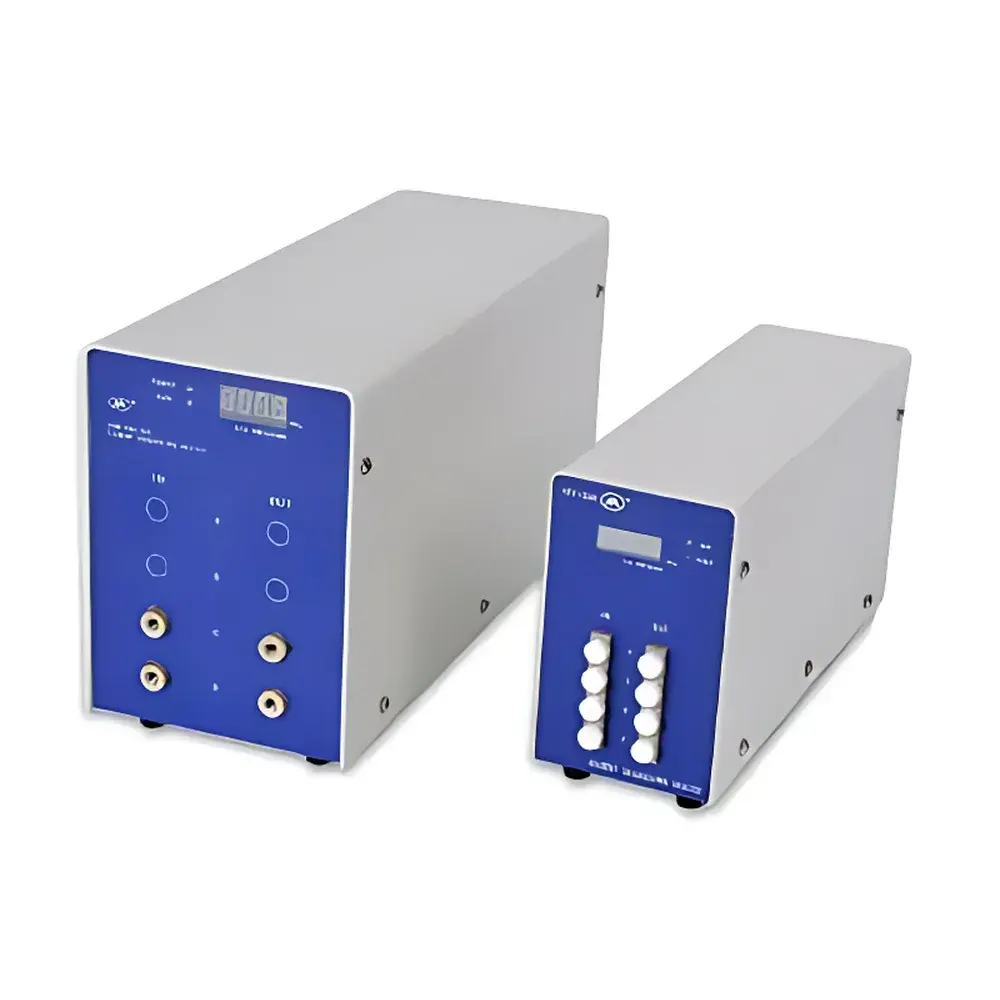
HengAo HDG-02/04 Online Degasser
| Brand | Tianjin HengAo |
|---|---|
| Origin | Tianjin, China |
| Manufacturer Type | Direct Manufacturer |
| Model | HDG-02 (2-channel), HDG-04 (4-channel) |
| Vacuum Pressure | 0.085 MPa |
| Max Flow Rate | 10 mL/min per channel |
| Solvent Volume per Channel | 12 mL |
| Dimensions | 150 × 340 × 180 mm |
| Degassing Efficiency | ≤1.8 ppm O₂ at 1 mL/min |
| Technology | Vacuum-based gas–liquid membrane separation |
Overview
The HengAo HDG-02 and HDG-04 Online Degassers are engineered for continuous, real-time removal of dissolved gases—primarily oxygen and nitrogen—from mobile phases in high-performance liquid chromatography (HPLC) systems. These instruments operate on the principle of vacuum-driven gas–liquid membrane separation: solvent flows through proprietary hydrophobic microporous tubing housed within a sealed vacuum chamber. The pressure differential across the membrane enables dissolved gas molecules to diffuse selectively out of the liquid phase into the vacuum space, where they are evacuated by an integrated vacuum pump. This physical separation mechanism preserves solvent composition, avoids chemical additives or thermal stress, and ensures compatibility with sensitive detection modalities—including UV-Vis, fluorescence, electrochemical, and mass spectrometric detectors—where dissolved oxygen induces baseline drift, elevated noise, ghost peaks, or detector quenching.
Key Features
- Vacuum-based membrane degassing architecture with automatic vacuum pump activation—ensures consistent performance without manual intervention.
- Fully enclosed fluid path constructed from chemically inert, low-absorption materials (e.g., PTFE-lined stainless steel and fluoropolymer tubing) to prevent leaching, adsorption, or solvent degradation.
- Multi-channel scalability: HDG-02 supports two independent solvent lines; HDG-04 accommodates four—enabling simultaneous degassing of binary, ternary, or quaternary gradient mobile phases.
- Standardized 1/16″ OD stainless steel fittings and 0.005″–0.010″ ID capillary-compatible tubing interfaces ensure plug-and-play integration with Agilent, Waters, Shimadzu, Thermo Fisher, and other major HPLC platforms.
- Compact benchtop footprint (150 × 340 × 180 mm) with front-access service panel for filter replacement and vacuum line inspection—designed for space-constrained analytical laboratories.
- No consumables required beyond periodic vacuum pump oil changes (per manufacturer schedule); no membranes to replace or cartridges to regenerate.
Sample Compatibility & Compliance
The HDG series is compatible with all common HPLC-grade solvents—including water, acetonitrile, methanol, tetrahydrofuran, isopropanol, and buffer solutions (pH 2–10). Its sealed, non-venting design prevents vapor loss and eliminates exposure hazards when handling volatile or flammable solvents (e.g., diethyl ether, hexane, ethyl acetate). The system meets general safety requirements outlined in IEC 61010-1 for laboratory electrical equipment. While not certified to ISO/IEC 17025 or FDA 21 CFR Part 11 as a standalone unit, its stable output supports GLP/GMP-compliant workflows when deployed within validated HPLC methods. Users performing pharmacopeial analyses (USP , EP 2.2.46) may document degasser performance via periodic dissolved oxygen verification using calibrated optical sensors (e.g., PreSens Fibox or Metrohm Eco Chemie probes).
Software & Data Management
The HDG-02/04 operates as a hardware-integrated peripheral without embedded firmware or digital control interface. It requires no driver installation, software license, or network connection—functioning purely as a passive, analog conditioning module. All operational status (vacuum readiness, pump cycling) is indicated via LED indicators on the front panel. For traceability in regulated environments, laboratories may log degasser commissioning date, maintenance events (e.g., pump oil change), and routine O₂ verification results in their electronic lab notebook (ELN) or chromatography data system (CDS)—consistent with ALCOA+ principles (Attributable, Legible, Contemporaneous, Original, Accurate, Complete, Consistent, Enduring, Available).
Applications
- Routine HPLC and UHPLC method development and validation where baseline stability and low system noise are critical—especially for low-UV-wavelength detection (e.g., 210 nm) or trace-level quantitation.
- Gradient elution with mixed aqueous–organic solvents prone to outgassing upon mixing (e.g., water/acetonitrile transitions).
- Electrochemical detection (ECD), where dissolved O₂ causes electrode oxidation and signal suppression.
- Fluorescence detection (FLD), where O₂ quenches excited-state analytes and reduces sensitivity.
- Preparative and semi-preparative LC systems requiring uninterrupted solvent delivery over extended run times (>24 h).
- LC–MS coupling, where residual gas bubbles induce ion source instability or erratic spray formation in electrospray ionization (ESI) sources.
FAQ
Does the HDG degasser alter solvent composition or pH?
No. The vacuum membrane process is purely physical—no reagents, heating, or catalytic surfaces are involved. Buffer ionic strength, pH, and organic modifier ratios remain unchanged.
What maintenance is required?
Vacuum pump oil should be replaced every 6–12 months depending on usage frequency; inlet filters (if installed upstream) require quarterly inspection. No membrane replacement or recalibration is needed.
Can it handle viscous solvents like glycerol–water mixtures?
It is designed for standard HPLC mobile phases (viscosity ≤5 cP). Solvents exceeding 10 cP may reduce degassing efficiency and increase backpressure—consult technical specifications before deployment.
Is the HDG series compatible with supercritical fluid chromatography (SFC)?
No. The system is rated for liquid-phase operation only and is not designed for CO₂-based mobile phases or high-pressure SFC conditions (>100 bar).
How is performance verified during qualification?
Users typically measure dissolved oxygen concentration pre- and post-degasser using a calibrated luminescent dissolved oxygen (LDO) probe under steady-state flow (e.g., 1–5 mL/min), confirming reduction to ≤2 ppm at low flow and ≤4 ppm at maximum rated flow.



