
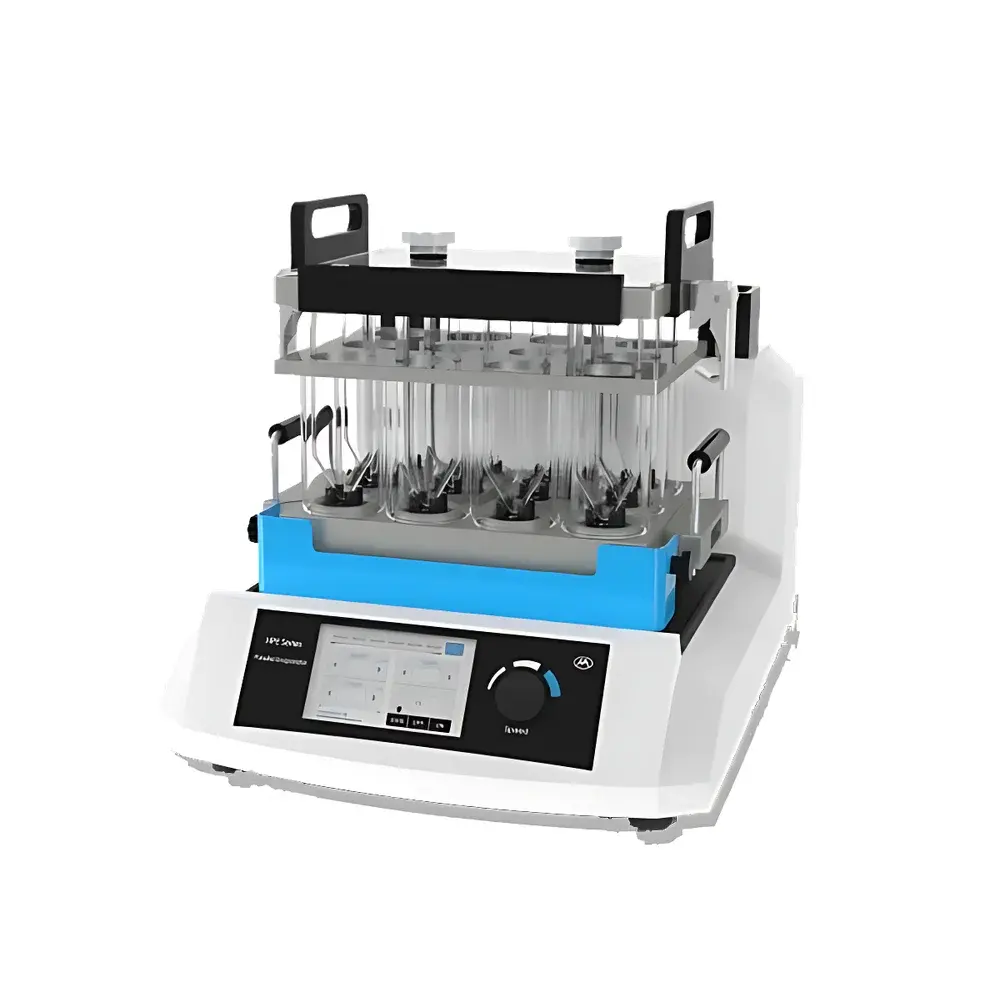
HengAo HPE-12A Parallel Vacuum Concentrator
| Brand | Tianjin HengAo |
|---|---|
| Origin | Tianjin, China |
| Manufacturer Type | Direct Manufacturer |
| Instrument Type | Automated Quantitative Concentrator |
| Temperature Range | Ambient +5 °C to 100 °C |
| Temperature Control Accuracy | ±0.5 °C |
| Sample Capacity per Position | 150 mL |
| Throughput | 12 Samples Simultaneously |
| Endpoint Detection | Fixed Volume (0.5 mL or 1 mL) Automatic Termination |
| Vacuum & Heating & Orbital Shaking | Integrated Simultaneous Operation |
| Solvent Recovery | Condensate Collection Enabled |
| Cooling Water Circulator & Vacuum Controller | Optional Accessories |
Overview
The HengAo HPE-12A Parallel Vacuum Concentrator is an engineered solution for high-throughput, quantitative solvent removal under controlled reduced-pressure conditions. It operates on the principle of simultaneous vacuum-assisted evaporation, conductive heating, and gentle orbital agitation—optimized to accelerate mass transfer while preserving thermally labile analytes. Unlike single-sample rotary evaporators or nitrogen blow-down systems, the HPE-12A processes up to 12 samples in parallel within a shared vacuum manifold, each housed in an individually sealed, temperature-regulated chamber. This architecture ensures uniform process conditions across all positions while eliminating cross-contamination—a critical requirement in regulated environmental testing, pesticide residue analysis, and pharmaceutical QC workflows. Designed for integration into GLP-compliant laboratories, the system supports method reproducibility through precise thermal control (±0.5 °C), programmable ramp-and-hold profiles, and automated endpoint detection based on fixed residual volume thresholds.
Key Features
- Parallel processing of 12 independent samples with individual sealing gaskets—no vapor crossover or carryover between vessels.
- Integrated triple-action operation: vacuum generation (adjustable setpoint), conductive heating (ambient +5 °C to 100 °C), and low-shear orbital shaking (50–250 rpm, user-selectable).
- Quantitative endpoint control: automatic termination upon reaching user-defined residual volumes (0.5 mL or 1 mL), verified via optical level sensing or gravimetric feedback (when paired with compatible balance interface).
- Passive solvent recovery: integrated cold finger condenser with external cooling water port (optional recirculating chiller support); typical recovery efficiency >92% for common organic solvents (e.g., acetonitrile, ethyl acetate, dichloromethane).
- No nitrogen gas dependency—reducing infrastructure requirements, operational costs, and laboratory footprint versus traditional blow-down concentrators.
- Real-time process visibility through transparent polycarbonate lid and illuminated chamber interior; compatible with standard 15–150 mL conical tubes, culture tubes, and custom glassware (with adapter kit).
- Gradient temperature programming: multi-step profiles allow staged evaporation (e.g., rapid initial removal at 60 °C followed by gentle finishing at 35 °C) to prevent bumping or foaming.
Sample Compatibility & Compliance
The HPE-12A accommodates a broad range of sample matrices including aqueous extracts, organic eluates from SPE cartridges, QuEChERS supernatants, and reaction mixtures from parallel synthesis workflows. Vessel compatibility extends to borosilicate glass, polypropylene, and PTFE-lined tubes (max. height: 180 mm; max. OD: 32 mm). All wetted materials comply with USP Class VI biocompatibility standards. The system meets mechanical safety requirements per IEC 61010-1 and electromagnetic compatibility per EN 61326-1. While not certified for ISO/IEC 17025 calibration traceability out-of-the-box, it supports audit-ready documentation when operated with validated SOPs—including electronic log export (CSV), user access control (via password-protected interface), and timestamped run records—facilitating alignment with FDA 21 CFR Part 11 data integrity expectations where connected to compliant LIMS environments.
Software & Data Management
The embedded controller features a 7-inch capacitive touchscreen with intuitive icon-driven navigation. Protocols are stored locally (up to 100 methods) and support parameter locking, operator ID tagging, and version-controlled editing. USB export enables full run logs—including vacuum pressure curves, temperature ramps, shake speed profiles, and endpoint timestamps—for retrospective review or regulatory submission. Optional Ethernet connectivity allows remote monitoring via secure HTTP(S) interface and integration with enterprise lab informatics platforms (e.g., LabVantage, Thermo Fisher SampleManager) using standard RESTful API endpoints. Audit trail functionality records all configuration changes, method executions, and alarm events with immutable timestamps—critical for GxP-aligned quality systems.
Applications
- Environmental testing labs: concentration of EPA Method 525.3 and 8270 extractates prior to GC-MS/MS analysis.
- Food safety QA/QC: parallel cleanup of multi-residue pesticide extracts (e.g., SANTE/2023/1249-compliant workflows).
- Pharmaceutical development: solvent removal from parallel combinatorial reaction plates without compromising stereochemical integrity.
- Clinical research: preparation of plasma/urine extracts for LC-HRMS biomarker quantification under controlled thermal stress.
- Academic core facilities: high-efficiency sample prep for metabolomics, lipidomics, and natural product isolation pipelines.
FAQ
What vacuum level is required for optimal performance?
The system operates effectively within 5–50 mbar (absolute); optimal evaporation rates are achieved between 15–30 mbar for most polar solvents. A dedicated vacuum controller (optional) enables dynamic pressure regulation during multi-stage protocols.
Can the HPE-12A be used with corrosive solvents such as hydrochloric acid or trifluoroacetic acid?
Standard configuration supports acetone, methanol, acetonitrile, ethyl acetate, and hexane. For halogenated or strongly acidic solvents, optional PTFE-coated manifolds and Viton-free seals are available—contact technical support for material compatibility verification.
Is gravimetric endpoint detection supported?
Yes—the instrument includes RS-232 and USB ports for direct connection to analytical balances (e.g., Mettler Toledo XS series). When enabled, concentration terminates automatically upon reaching target mass loss, supplementing or replacing volumetric threshold logic.
How is cleaning and maintenance performed?
All sample-contact surfaces are accessible without tools. Condenser coils and vacuum lines can be flushed with isopropanol; heating blocks are wiped with ethanol-dampened lint-free cloth. Annual calibration of temperature sensors and vacuum transducers is recommended per ISO/IEC 17025 guidelines.
Does the system comply with energy efficiency standards?
It meets China’s GB 30253-2013 Class II energy efficiency rating and exceeds EU Ecodesign Directive Lot 11 standby power limits (<0.5 W), verified by third-party testing report HAO-ECO-2023-089.
Related Products



