
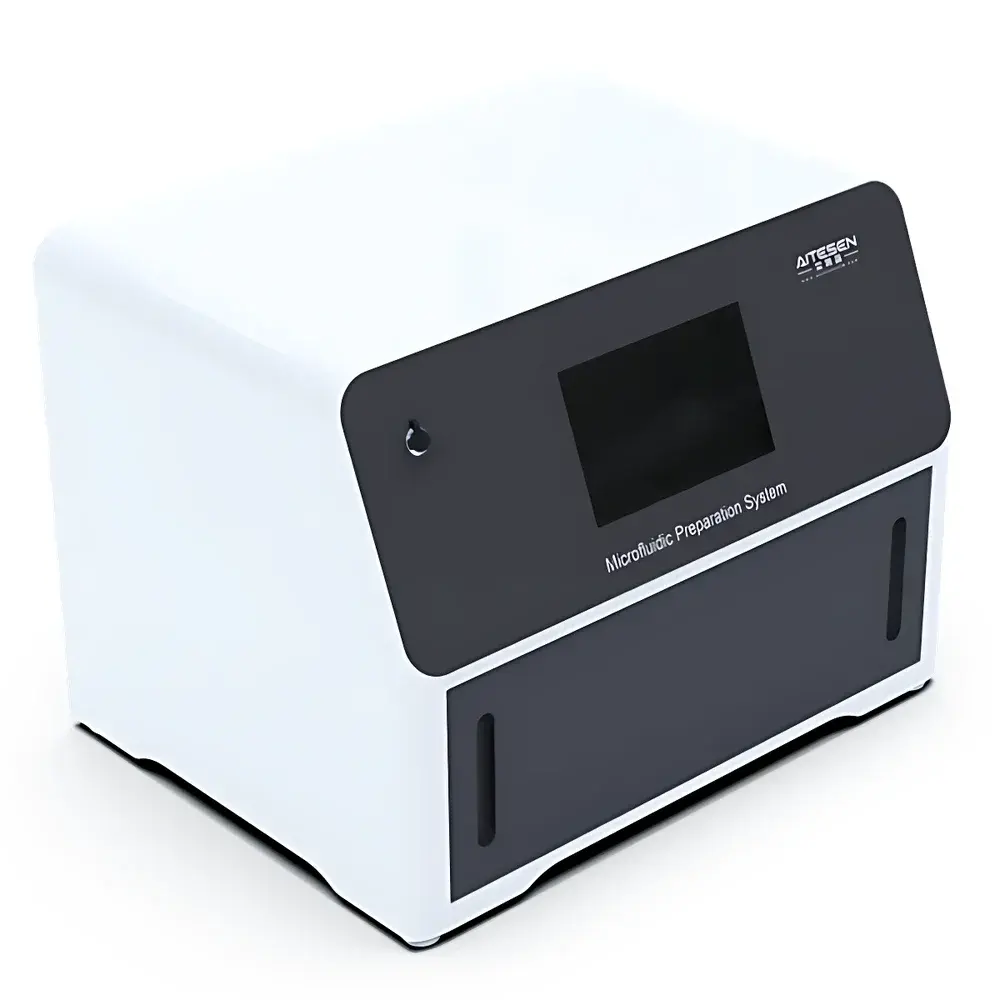
Aitesen MPE-P1 Microfluidic Nanomedicine Production System
| Brand | Aitesen |
|---|---|
| Origin | Jiangsu, China |
| Model | MPE-P1 |
| Carrier Type | Lipid Nanoparticles (LNP) |
| Application Scope | LNP, Liposome, Polymeric Nanoparticles (e.g., PLGA, PEG-PLGA), Emulsions, Inorganic/Organic Nanoparticles (e.g., Gold NPs) |
| Particle Size Range | <100 nm |
| Polydispersity Index (PDI) | <0.1 |
| Flow Control | Dual-channel precision syringe pumps with programmable flow rate ratio and total throughput |
| Chip Interface | Standardized high-pressure microfluidic chip mount (1/4"-28 UNF) |
| Data Logging | Batch-recorded process parameters (flow rates, pressure, temperature, time) with CSV export |
| Compliance Support | Designed for GLP-compliant process development |
Overview
The Aitesen MPE-P1 Microfluidic Nanomedicine Production System is an integrated, pilot-scale platform engineered for the reproducible, continuous preparation of lipid-based and polymeric nanocarriers under controlled hydrodynamic conditions. It operates on the principle of hydrodynamic focusing and controlled turbulent mixing within precisely fabricated microchannels—leveraging laminar-to-turbulent transition regimes to achieve rapid, homogeneous nanoprecipitation or solvent displacement. Unlike batch-based sonication or extrusion methods, the MPE-P1 enables real-time manipulation of critical process parameters—including phase flow ratio, total volumetric throughput, interfacial shear stress, and residence time—thereby establishing a direct link between process inputs and colloidal output (size, PDI, encapsulation efficiency, and structural integrity). This architecture aligns with the FDA’s Process Analytical Technology (PAT) framework, supporting Quality-by-Design (QbD) implementation for nucleic acid therapeutics (mRNA, siRNA), small-molecule liposomal formulations (e.g., doxorubicin, irinotecan), and vaccine adjuvant emulsions.
Key Features
- Modular dual-pump fluid delivery system with independent control over Phase A (aqueous phase) and Phase B (organic/lipid phase), enabling precise volumetric ratios from 1:10 to 10:1 at combined flow rates up to 50 mL/min.
- High-pressure microfluidic chip interface rated for operating pressures up to 20,000 psi, facilitating robust particle size reduction via impingement jet mixing and extensional flow fields.
- Integrated touchscreen HMI with embedded data acquisition: records timestamped values for flow rates, backpressure, ambient temperature, and total run duration; exports structured CSV files compatible with LIMS and statistical process control (SPC) platforms.
- Interchangeable chip configurations supporting sequential unit operations: primary emulsification → post-mixing incubation → secondary size refinement → inline dilution or quenching.
- Stainless-steel wetted path components compliant with USP Class VI biocompatibility standards; surface-passivated channels minimize nonspecific adsorption of biomacromolecules.
Sample Compatibility & Compliance
The MPE-P1 accommodates a broad spectrum of nanocarrier chemistries: ionizable cationic LNPs for mRNA delivery; DSPC/cholesterol/PEG-lipid formulations for stable liposomes; PLGA and PEG-PLGA nanoparticles prepared via nanoprecipitation; oil-in-water emulsions (e.g., squalene-based vaccine adjuvants); and colloidal gold nanoparticles synthesized by micro-mixed reduction. All process workflows are designed to meet current Good Manufacturing Practice (cGMP) readiness requirements for early-phase clinical manufacturing. The system supports traceable batch documentation aligned with ISO 13485 and ICH Q5A guidelines. When paired with validated software modules, it provides electronic signatures, user access controls, and immutable audit trails—fully compatible with FDA 21 CFR Part 11 and EU Annex 11 regulatory expectations for computerized systems in pharmaceutical development.
Software & Data Management
The onboard firmware implements deterministic real-time control loops with sub-second sampling resolution. Process logs include synchronized metadata: pump actuation cycles, pressure transducer readings, thermal sensor outputs, and operator-initiated event markers (e.g., “chip load,” “run start,” “quench injection”). Raw data exports retain native precision (16-bit ADC resolution) without interpolation or smoothing. Optional Aitesen ProcessLink™ software extends functionality with multivariate correlation analysis (e.g., flow ratio vs. Z-average diameter), automated PDI trending, and comparative batch overlay visualization. All exported datasets conform to ASTM E2500-18 standards for scientific data interchange and are structured for seamless ingestion into JMP, Python (pandas), or MATLAB environments.
Applications
- mRNA-LNP formulation optimization for preclinical toxicology and GMP lot production
- Scale-down modeling of commercial lipid nanoparticle manufacturing processes
- Rapid screening of lipid molar ratios and PEG-lipid variants for improved endosomal escape
- Continuous synthesis of sterically stabilized liposomes with narrow size distributions (PDI <0.1)
- Preparation of nanoemulsions for intramuscular vaccine delivery with controlled droplet coalescence kinetics
- Development of PLGA nanoparticles for sustained-release oncology therapeutics
- In-line characterization coupling: integration-ready with dynamic light scattering (DLS) or UV-Vis flow cells for real-time monitoring
FAQ
What types of microfluidic chips are supported?
The MPE-P1 accepts standardized high-pressure chips with 1/4″-28 UNF threading. Aitesen offers four base chip architectures: Y-junction (for rapid mixing), herringbone (for enhanced diffusion-limited blending), staggered herringbone (for extended incubation), and double-T impingement (for high-shear size reduction). Custom chip designs are available under NDA.
Can the system be used for sterile processing?
While the MPE-P1 itself is not a Class A/B isolator, its fluid path can be sterilized via autoclaving (chips and tubing) or SIP (steam-in-place) using validated protocols. Integration with downstream sterile filtration and aseptic filling stations is routinely implemented in client facilities.
Is remote monitoring or network connectivity available?
Yes—via optional Ethernet/Wi-Fi module, enabling secure SSH access, SNMP-based system health telemetry, and OPC UA server integration for MES/SCADA connectivity.
How does the MPE-P1 support technology transfer to commercial manufacturing?
It generates dimensionally consistent, statistically robust process maps (e.g., Design Space per ICH Q8) that directly inform scale-up decisions. Its hydraulic similarity to industrial microfluidic manifolds (e.g., Precision NanoSystems NanoAssemblr® GMP systems) enables predictive translation of critical quality attributes (CQAs) across scales.
What validation documentation is provided?
Each unit ships with Factory Acceptance Test (FAT) reports, IQ/OQ templates aligned with ASTM E2500, and a complete set of calibration certificates for all embedded sensors (pressure, temperature, flow). Installation qualification support is available upon request.




