
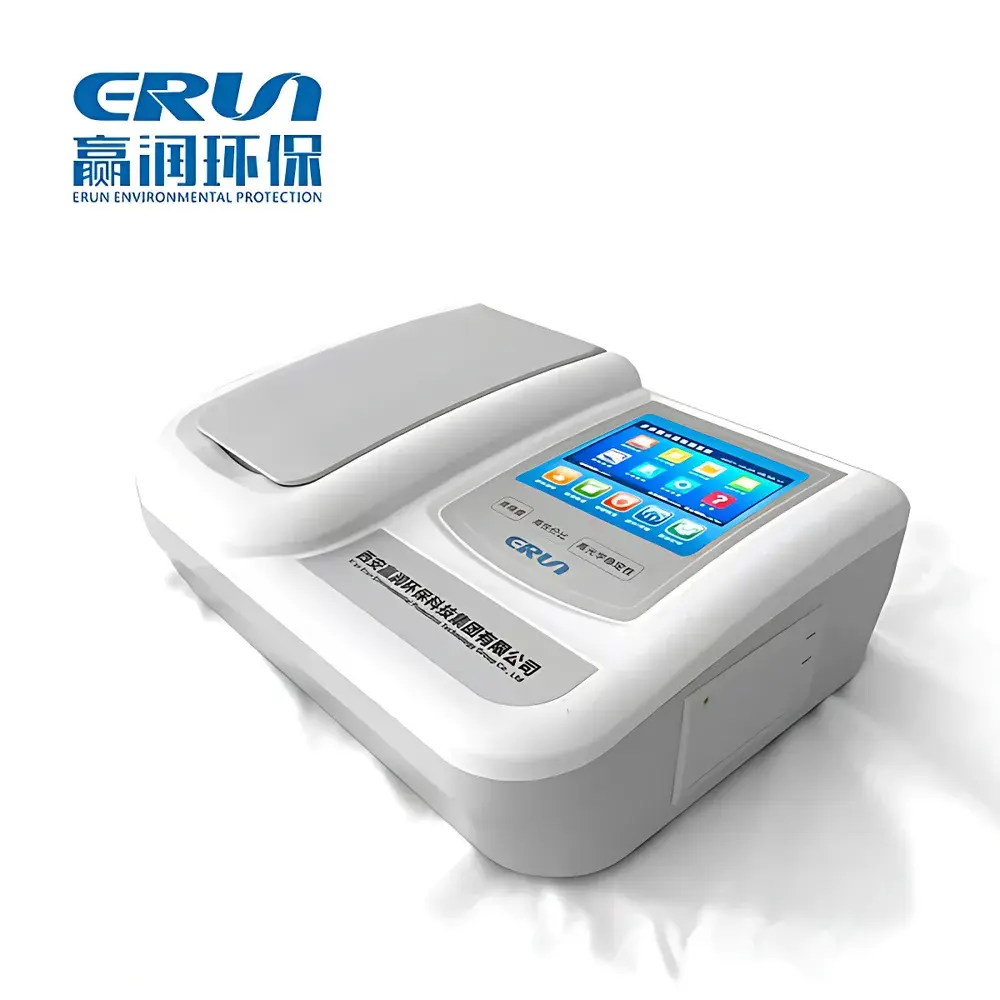
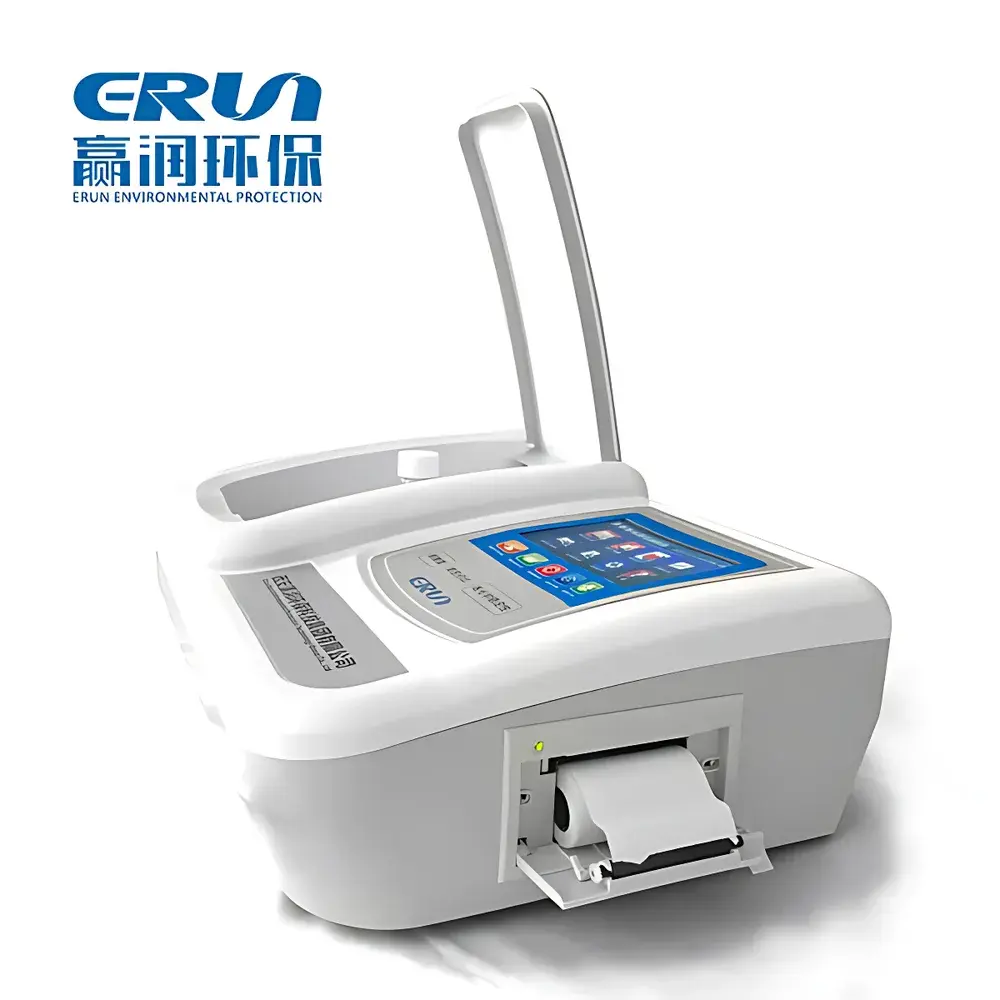
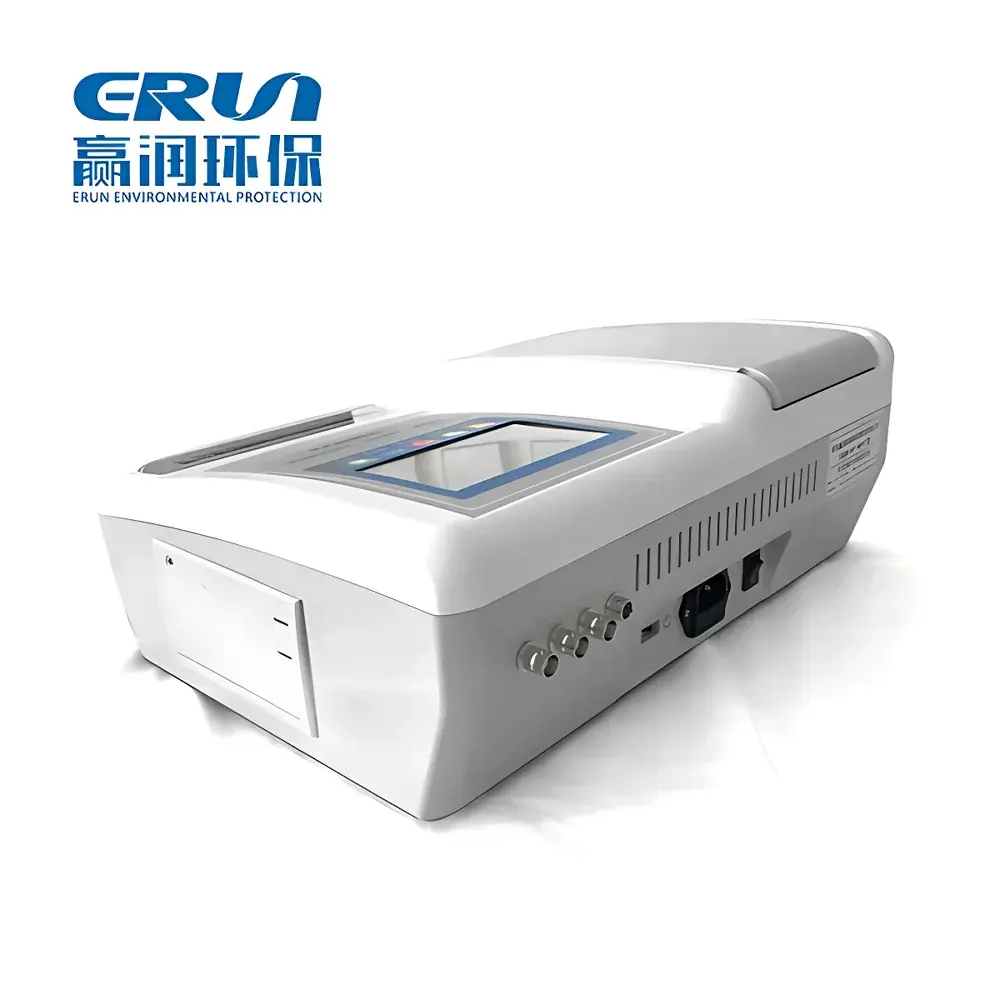
ERUN-ST7-D4 Benchtop Cyanide Analyzer
| Brand | ERUN |
|---|---|
| Origin | Shaanxi, China |
| Manufacturer Type | Authorized Distributor |
| Product Category | Domestic |
| Model | ERUN-ST7-D4 |
| Instrument Type | Benchtop Laboratory Analyzer |
| Measurement Principle | Spectrophotometric Method (ISO 6439, APHA 4500-CN⁻ F/G) |
| Wavelength Selection | Automatic, Dual-Beam Optical System |
| Wavelength Repeatability | ±0.2 nm |
| Photometric Range | 0–3.0 A |
| Light Intensity Control | 16-step Adjustable LED Source |
| Calibration Modes | Linear & Multi-Point Nonlinear (Piecewise) |
| Data Storage Capacity | 100,000 Records with Timestamp, Sample ID, Operator ID, and Calibration Log |
| Data Recovery | Built-in Backup/Restore for Calibration Curves & Measurement History |
| Auto-Reset Function | Factory Reset with Audit-Trail Preserved |
| Power Supply | AC 220 V ±10%, 50 Hz ±1% |
| Operating Environment | 10–35 °C, RH ≤85% (non-condensing), Vibration- and EMI-Shielded Lab |
| Measurement Range | 0.01–0.50 mg/L CN⁻ |
| Accuracy | ±5% of Full Scale |
| Repeatability (RSD) | ≤2% |
| Baseline Drift | <0.002 A/30 min |
| Compliance | Designed to support ISO/IEC 17025 workflows, GLP-compliant data integrity per FDA 21 CFR Part 11 (audit trail enabled) |
Overview
The ERUN-ST7-D4 Benchtop Cyanide Analyzer is a dedicated spectrophotometric instrument engineered for precise, trace-level quantification of free and total cyanide (CN⁻) in aqueous environmental and industrial wastewater matrices. It operates on the internationally standardized pyridine-barbituric acid colorimetric method (ISO 6439:1981 and APHA Standard Method 4500-CN⁻ F/G), where cyanide reacts under controlled acidic distillation or direct alkaline digestion to form a stable chromophore with absorbance maxima at 578 nm. The analyzer integrates a dual-beam optical architecture with automatic wavelength selection and real-time photometric compensation—ensuring high reproducibility across variable sample turbidity, matrix interferences, and ambient light conditions. Designed explicitly for laboratory-based regulatory compliance testing, the ERUN-ST7-D4 supports routine analysis in facilities subject to national discharge permits (e.g., China’s GB 8978–1996, US EPA Method 335.4 equivalents), enabling trace detection down to 0.01 mg/L CN⁻ with metrological traceability to NIST-traceable reference standards.
Key Features
- Dual-beam spectrophotometric engine with auto-wavelength positioning and ±0.2 nm repeatability—minimizing spectral drift during extended batch runs.
- 16-step adjustable LED light source intensity—enabling dynamic signal optimization for low-absorbance (<0.1 A) and high-absorbance (>2.0 A) samples without manual gain adjustment.
- Configurable calibration algorithms: linear regression for certified reference materials; multi-point piecewise (‘折线法’) fitting for non-linear response curves typical of complex wastewater digests.
- Comprehensive data governance: onboard storage for up to 100,000 measurement records—including sample ID, operator code, timestamp, calibration curve metadata, and raw absorbance values—with SHA-256 checksum verification.
- Full audit-trail functionality compliant with GLP and FDA 21 CFR Part 11 requirements: all user actions (calibration edits, data deletion, system reset) are time-stamped, user-logged, and non-erasable.
- One-touch recovery protocol preserving calibration history and measurement logs—even after unexpected power loss or firmware interruption.
Sample Compatibility & Compliance
The ERUN-ST7-D4 is validated for use with pretreated liquid samples from industrial effluents including coking plant condensates, electroplating rinse waters, metallurgical leachates, mining tailings pond discharges, petrochemical process streams, and pesticide synthesis byproduct solutions. Sample preparation follows ISO 6439 protocols: distillation under weakly alkaline conditions (pH 11–12) for total cyanide, or direct analysis after pH adjustment for free cyanide. The instrument meets design criteria aligned with ISO/IEC 17025:2017 Clause 7.2.2 (method validation) and supports laboratories undergoing accreditation audits. Its optical stability (<0.002 A drift over 30 min) satisfies APHA-recommended baseline stability thresholds for Class I environmental analyzers.
Software & Data Management
The embedded firmware implements a secure, role-based interface supporting three user tiers: Operator, Supervisor, and Administrator—each with configurable permissions for calibration, data export, and system configuration. All measurement data are stored in encrypted SQLite databases with immutable timestamps. USB export (CSV/Excel-compatible) includes full metadata headers and digital signatures. Optional PC software (ERUN-LabLink v3.2) enables remote calibration management, trend analysis, QC charting (X-bar/R charts), and automated report generation compliant with ISO 14001 environmental management documentation requirements.
Applications
- Regulatory monitoring of cyanide discharge limits in municipal and industrial wastewater treatment plants.
- Quality control in electroplating bath maintenance and spent rinse water recycling systems.
- Environmental site assessment of former mining or smelting sites per ASTM D7365–14 guidance.
- Process validation in chemical manufacturing where cyanide is an intermediate (e.g., adiponitrile synthesis).
- Research applications in aquatic toxicology requiring sub-0.1 mg/L CN⁻ quantification in spiked ecotoxicity test media.
FAQ
Does the ERUN-ST7-D4 comply with international cyanide testing standards?
Yes—it implements the reaction chemistry and optical detection parameters specified in ISO 6439 and APHA 4500-CN⁻ F/G, and its performance specifications meet the sensitivity and precision thresholds defined in US EPA Method 335.4 for laboratory-grade analyzers.
Can the instrument distinguish between free and total cyanide?
No—the ERUN-ST7-D4 is a concentration-measuring photometer; differentiation requires upstream sample pretreatment (e.g., distillation for total cyanide vs. direct analysis for free cyanide), as defined in ISO 6439 Annex A and B.
Is data export compatible with LIMS integration?
Yes—CSV exports include structured fields for LIMS ingestion (Sample_ID, CN_mgL, Analyst, Date_Time, Curve_ID, Abs_578nm); optional RS-232/USB-serial mode supports Modbus RTU protocol for legacy SCADA interfacing.
What maintenance is required for long-term optical stability?
Annual verification of wavelength accuracy using holmium oxide reference filter (NIST SRM 2034) and photometric linearity check with neutral density filters is recommended per ISO 17025 Clause 6.4.1.
Is the device suitable for field-deployable use?
No—it is strictly a benchtop laboratory instrument requiring stable AC power, temperature-controlled environment (10–35 °C), and protection from vibration and ambient light—per its stated operating specifications.







