
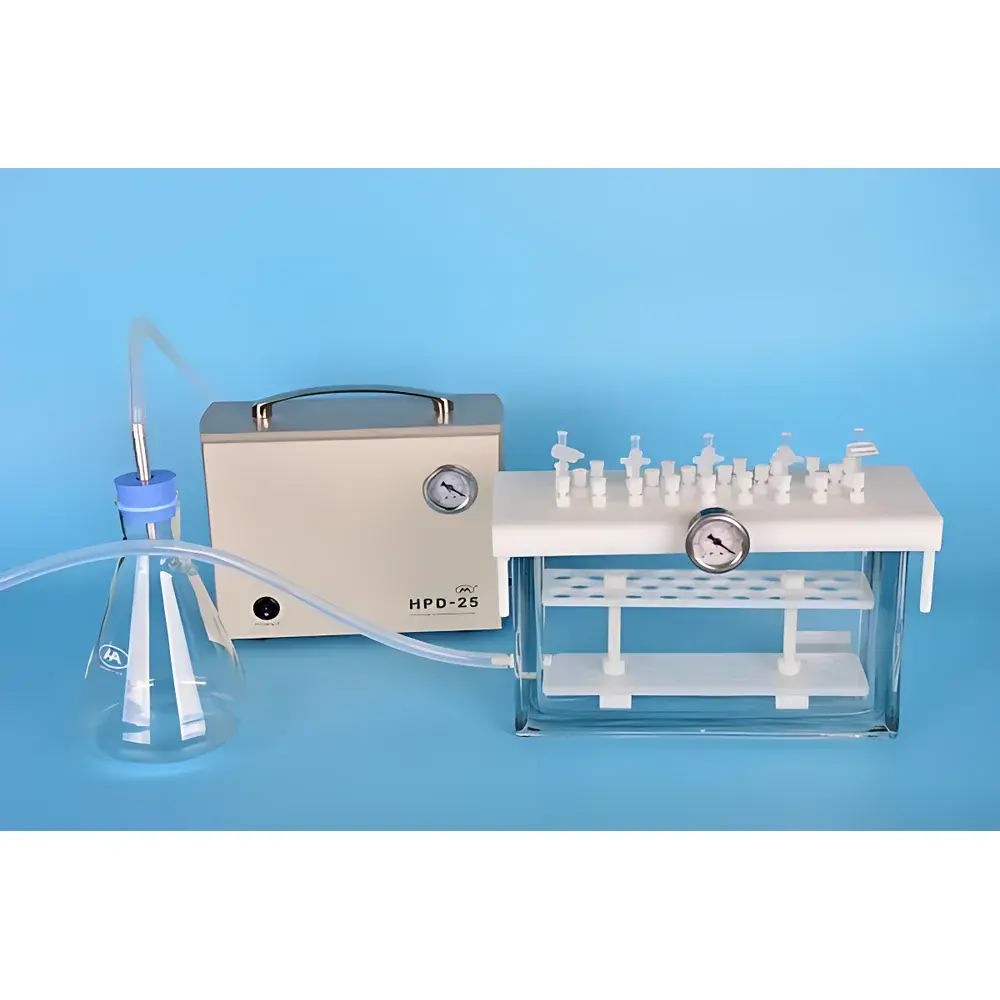
HengAo HSE-12D Semi-Automatic Multi-Channel Solid Phase Extraction System
| Brand | Tianjin HengAo |
|---|---|
| Origin | Tianjin, China |
| Manufacturer Type | Direct Manufacturer |
| Country of Origin | China |
| Model | HSE-12D |
| Price Range | USD 420–690 (FOB) |
| Automation Level | Semi-Automatic |
| Channel Count | 12-Channel |
| Extraction Format | Cartridge-Based SPE |
Overview
The HengAo HSE-12D is a semi-automatic, 12-channel solid phase extraction (SPE) system engineered for reproducible, high-efficiency sample preparation in analytical laboratories. It operates on vacuum-assisted positive-pressure or gravity-driven elution principles—depending on configuration—and is designed to process liquid samples through disposable or reusable sorbent cartridges. The system integrates a reinforced borosilicate glass vacuum manifold chamber, precision-machined PTFE and 316 stainless steel fluidic components, and a modular collection tray accommodating standard 12–15 mL conical-bottom SPE tubes or custom-sized receiving vessels. Its core function is the selective isolation, concentration, and cleanup of target analytes—including semi-volatile and non-volatile organic compounds—from complex matrices such as environmental water, biological fluids, food extracts, and pharmaceutical formulations. Unlike conventional liquid–liquid extraction (LLE), the HSE-12D eliminates emulsion formation, reduces solvent consumption by up to 70%, improves analyte recovery (>85% for typical pesticides and pharmaceuticals under optimized protocols), and delivers consistent breakthrough volumes across all 12 channels due to uniform flow-path geometry and calibrated vacuum regulation.
Key Features
- 12-position circular manifold with individually controllable PTFE-coated stainless steel valves—enabling sequential or parallel processing without cross-contamination;
- Vacuum chamber constructed from thick-walled, chemically resistant borosilicate glass (≥5 mm wall thickness), rated for continuous operation at −80 kPa;
- Integrated anti-fogging vacuum seal design with dual O-ring compression joints between cartridge holders and base plate;
- All wetted surfaces fabricated from virgin PTFE or electropolished 316 stainless steel—ensuring compatibility with aggressive solvents (e.g., dichloromethane, acetonitrile, methanol, 1% formic acid) and resistance to corrosion from halogenated or acidic samples;
- Modular collection architecture supporting both bottom-collection (for waste diversion) and side-port configurations—facilitating integration with downstream evaporation or autosampler vials;
- Compatible with industry-standard 1 mL, 3 mL, 6 mL, and 12 mL SPE cartridges (including bonded silica, C18, SCX, SAX, Florisil, and mixed-mode phases);
- Optional add-ons include a heated nitrogen blow-down module (for rapid solvent removal post-elution) and a large-volume sampling adapter (up to 1 L per channel with inline filtration).
Sample Compatibility & Compliance
The HSE-12D supports a broad range of aqueous and partially miscible sample types, including surface water, wastewater, plasma, urine, fruit juice, vegetable homogenates, soil leachates, and ethanol-based herbal extracts. It meets fundamental functional requirements outlined in EPA Method 508.1 (halogenated organics), EPA Method 525.3 (pesticides), ISO 17025-accredited validation frameworks for sample prep, and USP chromatographic system suitability guidelines when used within validated SOPs. While not inherently 21 CFR Part 11-compliant (as it lacks embedded electronic audit trail), its manual valve operation and physical vacuum control allow full traceability when paired with laboratory notebook documentation and instrument logbooks—making it suitable for GLP environments where procedural rigor is maintained via operator training and calibration records.
Software & Data Management
The HSE-12D is a hardware-only platform with no onboard microcontroller or digital interface; therefore, it does not require firmware updates or software licensing. All operational parameters—including vacuum setpoint, dwell time per step (conditioning, loading, washing, elution), and flow rate—are manually controlled via external vacuum source (e.g., diaphragm pump with pressure regulator) and user-defined timing protocols. This analog architecture ensures long-term reliability, zero risk of firmware obsolescence, and seamless integration into legacy workflows. For laboratories implementing LIMS or ELN systems, process metadata (e.g., batch ID, analyst initials, date/time stamp, cartridge lot number, solvent lot) must be recorded externally—consistent with ISO/IEC 17025 clause 7.5.2 on result reporting integrity.
Applications
- Environmental Analysis: Trace-level extraction of organochlorine pesticides (e.g., DDT, endosulfan), PAHs, PCBs, and metal chelates from drinking water, groundwater, and sediment pore water;
- Food Safety Testing: Multi-residue analysis of veterinary drug residues (e.g., sulfonamides, tetracyclines, fluoroquinolones) in meat, milk, honey, and cereal products per EU Commission Decision 2002/657/EC criteria;
- Clinical & Forensic Toxicology: Isolation of benzodiazepines, opioids, and stimulants from serum and urine prior to LC–MS/MS quantification;
- Pharmaceutical Development: Clean-up of stability-indicating assays involving forced degradation samples containing excipient interferences;
- Beverage Quality Control: Removal of polyphenolic matrix interferences from wine and fruit juice prior to HPLC–UV detection of mycotoxins (e.g., ochratoxin A).
FAQ
What vacuum level is recommended for optimal cartridge conditioning and elution?
A regulated vacuum of −60 to −75 kPa is recommended during conditioning and washing steps; −50 kPa is advised for final elution to minimize channel-to-channel flow variance.
Can the HSE-12D accommodate 20 mL SPE cartridges?
Yes—when used with optional extended-height cartridge holders (sold separately), the system supports cartridges up to 25 mL volume and 15 mm outer diameter.
Is the manifold autoclavable?
No—the borosilicate glass chamber and PTFE components are not designed for steam sterilization; chemical decontamination using 70% ethanol or isopropanol is recommended between batches.
Does the system include a vacuum pump?
No—the HSE-12D requires an external vacuum source (e.g., oil-free diaphragm pump with adjustable pressure control and inline moisture trap).
How often should the PTFE gaskets be replaced?
Under normal use (≤500 cycles/year), gaskets maintain sealing integrity for ≥18 months; visual inspection for cracking or deformation is advised every 3 months.



