
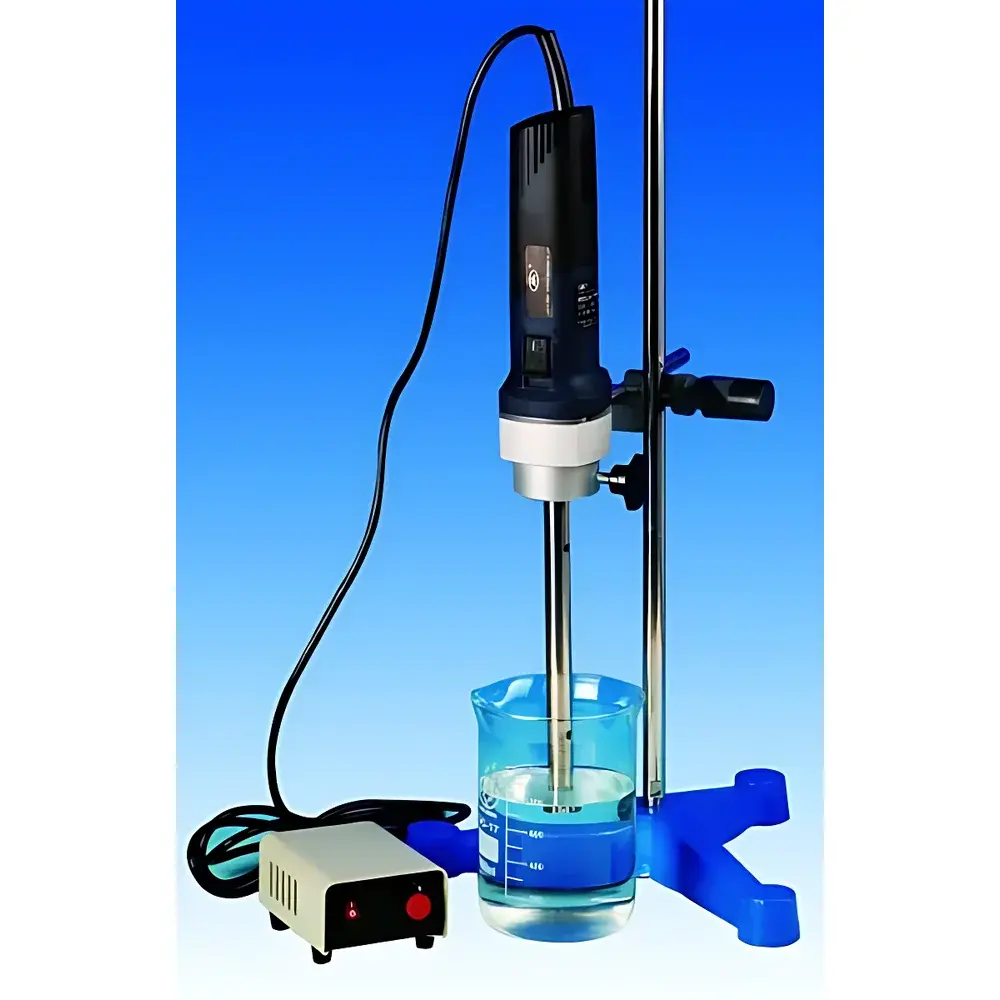
HengAo HFJ-8 / HFJ-10 Immersion Homogenizer (Handheld High-Shear Rotor-Stator Homogenizer)
| Brand | Tianjin HengAo |
|---|---|
| Origin | Tianjin, China |
| Manufacturer Type | Direct Manufacturer |
| Instrument Type | Handheld Immersion Homogenizer |
| Instrument Category | Adjustable-Speed High-Shear Dispersion System |
| Sample Volume Capacity | 500–5000 mL |
| Output Power | 200–550 W |
| Rotational Speed Range | 5,000–35,000 rpm |
| Probe Diameter | Φ8 mm (HFJ-8), Φ10 mm (HFJ-10) |
Overview
The HengAo HFJ-8 and HFJ-10 are handheld immersion homogenizers engineered for high-shear, rotor-stator-based mechanical disruption of biological and soft-material samples. Operating on the principle of intense hydrodynamic cavitation and turbulent shear generated between a rapidly rotating rotor and a fixed stator, these instruments deliver reproducible cell lysis, tissue homogenization, emulsification, and dispersion across diverse laboratory applications. Unlike ultrasonic or bead-beating methods, rotor-stator homogenization provides scalable, controllable energy input without introducing exogenous contamination (e.g., ceramic or metal beads) or thermal instability associated with prolonged sonication. The HFJ series is optimized for benchtop workflows requiring rapid sample processing in volumes ranging from 500 mL to 5 L—making it suitable for both small-scale analytical prep and pilot-scale formulation development.
Key Features
- High-speed precision motor delivering stable rotational speeds from 5,000 to 35,000 rpm, enabling tunable shear intensity for differential lysis of mammalian cells, plant tissues, and microbial suspensions.
- Interchangeable stainless steel probes (Φ8 mm for HFJ-8; Φ10 mm for HFJ-10) featuring a proprietary beveled rotor-stator geometry that enhances fluid recirculation and minimizes dead zones during homogenization.
- All wetted parts—including rotor, stator, probe shaft, and coupling interface—constructed from ASTM-grade 316 stainless steel, ensuring corrosion resistance against organic solvents, acidic buffers (e.g., citrate, acetate), and enzymatic reagents commonly used in protein extraction protocols.
- Ergonomic handheld design with quick-lock probe attachment mechanism, facilitating rapid toolhead exchange and minimizing cross-contamination risk between sequential samples.
- Thermally stable motor housing with integrated overheat protection circuitry, preventing performance drift during extended operation and supporting continuous duty cycles up to 5 minutes per sample under standard load conditions.
Sample Compatibility & Compliance
The HFJ-8 and HFJ-10 accommodate a broad spectrum of sample matrices: fresh/frozen animal tissues (liver, muscle, spleen), fibrous plant materials (roots, leaves, stems), microbial pellets (E. coli, yeast), and viscous emulsions (oil-in-water, polymer dispersions). Probe geometry and speed calibration allow selective membrane disruption—e.g., gentle lysis of peripheral blood mononuclear cells (PBMCs) at ≤10,000 rpm versus complete homogenization of fibrous cardiac tissue at ≥25,000 rpm. While not certified to ISO/IEC 17025 or FDA 21 CFR Part 11 out-of-the-box, the instrument’s mechanical design and material traceability support integration into GLP- and GMP-aligned workflows when paired with documented SOPs, calibration logs, and operator training records. It complies with IEC 61000-6-2 (immunity) and IEC 61000-6-4 (emission) standards for laboratory electromagnetic compatibility.
Software & Data Management
As analog-controlled instruments, the HFJ-8 and HFJ-10 do not incorporate embedded digital interfaces or firmware. Speed selection is performed manually via rotary dial with tactile feedback and visual RPM scale markings. For laboratories requiring audit-ready documentation, external tachometer validation (e.g., using a calibrated optical tachometer per ASTM E2579) is recommended prior to critical assays. Users may integrate speed and runtime data into electronic lab notebooks (ELNs) such as LabArchives or Benchling by recording settings alongside sample IDs and processing timestamps—ensuring full traceability in regulated environments.
Applications
- Pre-analytical tissue homogenization for downstream nucleic acid isolation (DNA/RNA), protein quantification (BCA, Bradford), and metabolite profiling (LC-MS).
- Preparation of uniform suspensions for particle size analysis (e.g., laser diffraction or dynamic light scattering) of nanoemulsions and liposomal formulations.
- Routine QC homogenization in food safety labs—e.g., pathogen enrichment media preparation from meat, dairy, or produce samples per ISO 6887-1 and AOAC guidelines.
- Cell disruption in bioprocessing R&D, including inclusion body solubilization and subcellular fractionation protocols aligned with USP and EP 2.6.27.
- Homogenization of botanical extracts for phytochemical standardization and stability testing in nutraceutical development.
FAQ
What is the maximum viscosity this homogenizer can process?
The HFJ-8 and HFJ-10 are rated for Newtonian fluids up to ~5,000 cP at full speed and mid-volume loading (2–3 L); higher viscosities require reduced speed or stepwise incremental processing.
Can the probes be autoclaved?
Yes—316 stainless steel probes and shafts are fully autoclavable at 121°C for 20 minutes; however, the motor unit must never be exposed to steam or liquid immersion.
Is there a recommended maintenance schedule?
Inspect rotor-stator alignment and probe threads before each use; lubricate O-rings monthly with medical-grade silicone grease; replace worn stators after ≥200 hours of cumulative operation.
How does probe diameter affect homogenization efficiency?
The Φ10 mm probe (HFJ-10) delivers greater volumetric throughput and lower localized shear stress—ideal for coarse tissue breakdown—while the Φ8 mm probe (HFJ-8) generates higher tip velocity and shear gradient, preferred for fine emulsions and fragile cell types.
Does this instrument meet CE or UL certification requirements?
The HFJ series carries CCC (China Compulsory Certification); CE marking is not applied, and UL listing is not available—users should verify local electrical safety compliance prior to installation.



