
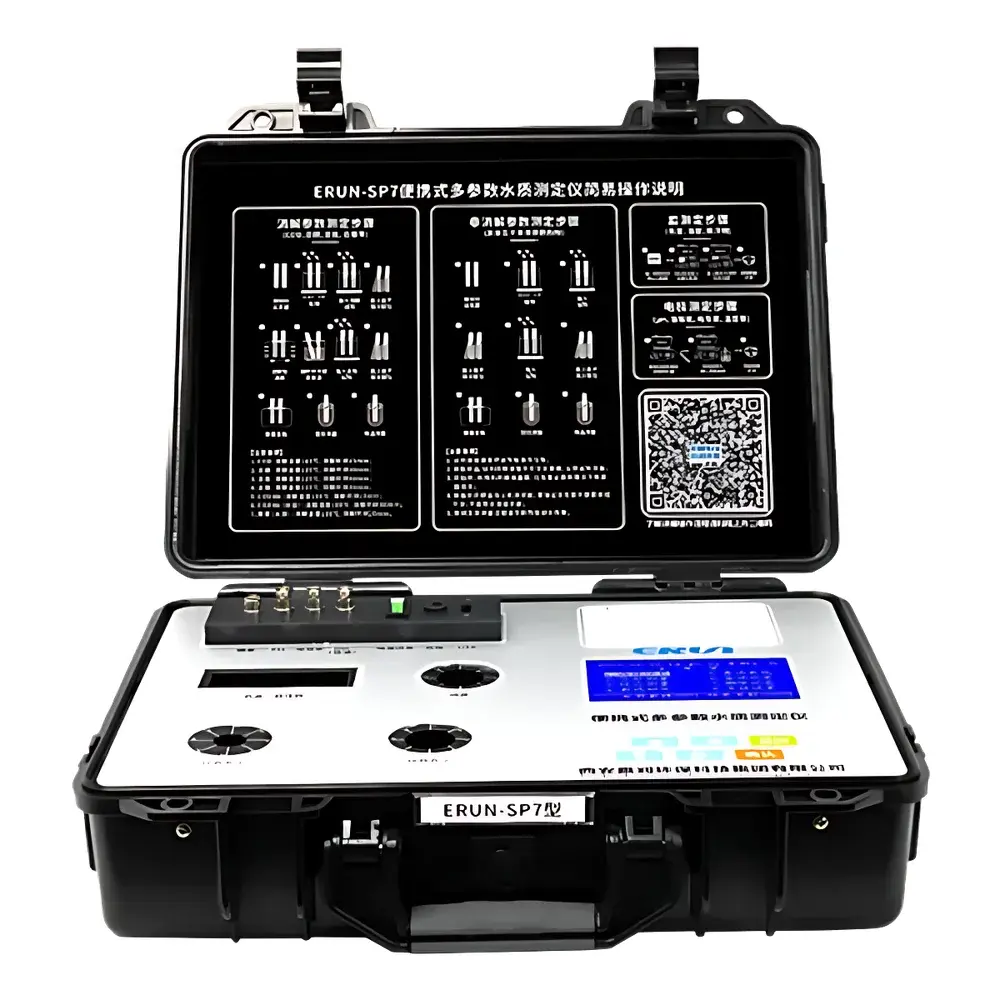
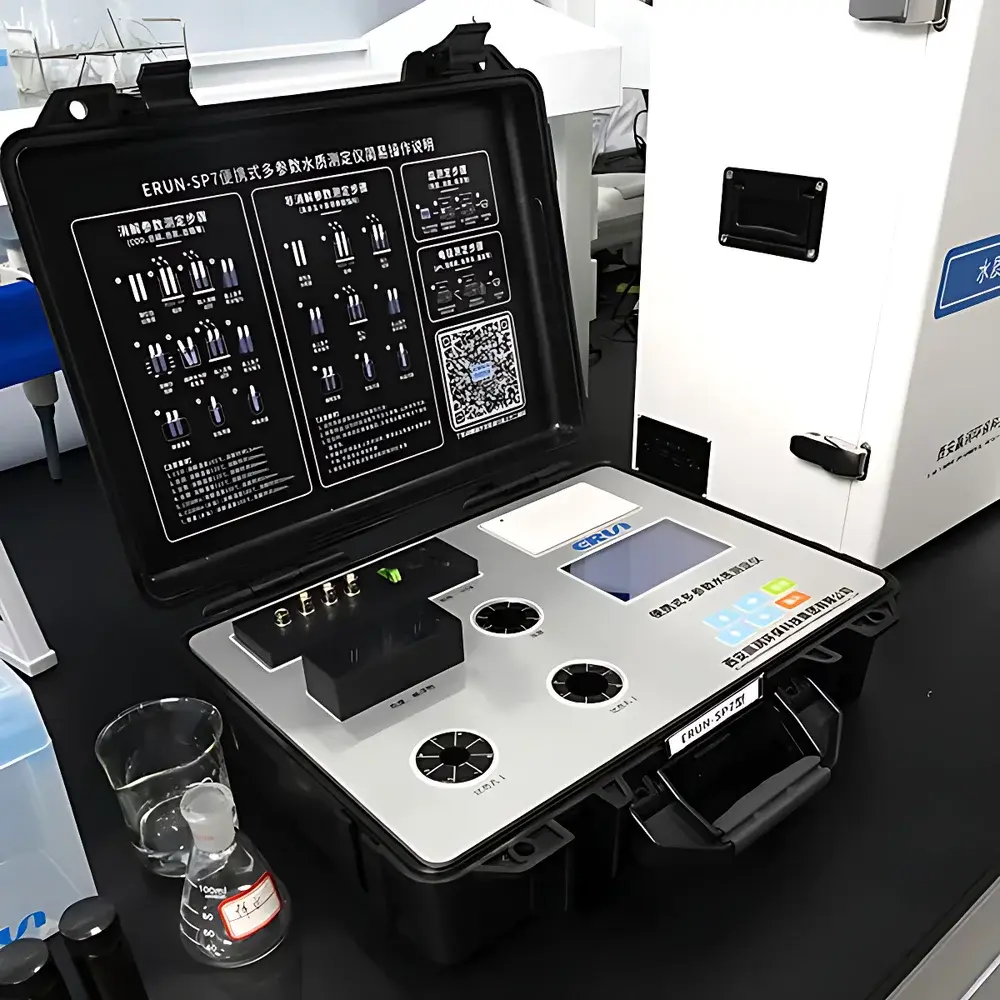
ERUN ERUN-SP7-18 Portable Heavy Metals Analyzer for Water Quality
| Brand | ERUN |
|---|---|
| Origin | Shaanxi, China |
| Manufacturer Type | Authorized Distributor |
| Country of Origin | China |
| Model | ERUN-SP7-18 |
| Instrument Type | Portable |
| Detection Principle | Photometric (Colorimetric) Method |
| Detectable Metals | Cu, Zn, Cr(VI), Pb, Hg, Ni, Fe, Mn, Al, Cd, As, Ag, Mo, Be, B, Sb, Ba |
| Analysis Time | ≤3 min per parameter |
| Accuracy | ±5% of Full Scale (F.S.) |
| Resolution | 0.1 mg/L (for most parameters) |
| Repeatability | ≤3% RSD |
| Optical Stability | Drift < 0.002 A in 20 min |
| Display | 5.0-inch TFT LCD |
| Data Storage | 100 calibration curves + 1999 tagged measurement records (with timestamp & parameter ID) |
| Power Supply | Internal rechargeable Li-ion battery + AC adapter (dual-power system) |
| Dimensions | 410 × 300 × 130 mm |
| Weight | 4.0 kg |
| Power Consumption | <10 W |
| Output | Built-in thermal printer |
| Connectivity | USB port |
| Measurement Modes | Concentration, Absorbance, Transmittance |
Overview
The ERUN ERUN-SP7-18 Portable Heavy Metals Analyzer is a field-deployable photometric instrument engineered for rapid, on-site quantification of priority toxic metals in aqueous matrices. It operates on standardized colorimetric reaction principles—where target metal ions form stable, stoichiometric chromophore complexes with selective reagents—and measures absorbance at optimized wavelengths using a precision optical path and solid-state detector. Designed to meet the operational demands of environmental field technicians, water utility responders, and regulatory compliance officers, the ERUN-SP7-18 delivers laboratory-grade data without requiring benchtop infrastructure. Its modular assay configuration supports sequential or simultaneous dual-parameter analysis (e.g., Cr(VI) + Pb; Cu + Zn), enabling multi-contaminant screening within a single 3-minute workflow. The instrument complies with foundational methodological frameworks aligned with EPA Method 200.7 (ICP-OES reference), ASTM D3559 (lead in water), ASTM D511 (calcium/magnesium—but adapted for metal-specific colorimetry), and ISO 8692 (water quality—fresh water algal growth inhibition test—methodologically analogous in reagent stability and calibration traceability requirements).
Key Features
- Automated wavelength selection per analyte—no manual filter changes required
- 5.0-inch high-contrast TFT LCD with intuitive icon-driven interface, operable under ambient daylight conditions
- Integrated thermal printer for immediate hard-copy documentation of results—including sample ID, timestamp, parameter name, concentration, and operator tag
- Dual-power architecture: 8-hour continuous operation on internal lithium-ion battery (IEC 62133 certified), plus universal AC adapter support for stationary use
- Data integrity safeguards: automatic time-stamping, parameter-tagged storage (1999 records), non-volatile memory with power-loss recovery
- Optical system calibrated to NIST-traceable standards; <0.002 A absorbance drift over 20 minutes ensures measurement consistency across extended field deployments
- USB interface enables secure data export to external drives or LIMS-compatible software (CSV format)
- Configurable bilingual UI (English/Chinese) for multinational field teams or joint inspection protocols
Sample Compatibility & Compliance
The ERUN-SP7-18 is validated for use with raw and treated drinking water, surface water (rivers, lakes), groundwater (well samples), and pre-treated industrial effluents—provided turbidity is <5 NTU and suspended solids are removed via 0.45 µm filtration prior to analysis. Sample volume requirement is 10–25 mL depending on selected method. All onboard calibration curves are generated using certified reference materials (CRMs) traceable to NIST SRM 1640a (multi-element aqueous standard) and EPA CRM 1643e (trace metals in water). The analyzer supports Good Laboratory Practice (GLP) workflows through mandatory user login, audit-trail-enabled data logging, and immutable record timestamps—features essential for regulatory submissions under US EPA Region 5 Field Screening Protocols and EU Water Framework Directive (WFD) Annex V monitoring guidelines.
Software & Data Management
Instrument firmware includes embedded data management logic compliant with ISO/IEC 17025:2017 clause 7.5.2 (control of data and information management). Each stored record contains: unique sample identifier, date/time stamp (RTC-backed), selected parameter code, measured absorbance/concentration, operator ID, and calibration curve version. Exported CSV files retain full metadata headers for direct ingestion into LIMS platforms such as LabWare LIMS or Thermo Fisher SampleManager. No cloud connectivity or remote telemetry is implemented—ensuring full data sovereignty and alignment with ITAR and GDPR Article 32 (security of processing) requirements for sensitive environmental datasets.
Applications
- Rapid response during drinking water contamination incidents (e.g., lead service line verification, post-flooding Cr(VI) assessment)
- Field validation of treatment plant effluent compliance prior to discharge reporting
- Baseline and trend monitoring for mining-adjacent watersheds (As, Cd, Sb, Ba)
- Regulatory spot-checks by provincial environmental protection bureaus (e.g., China MEP Tier-2 monitoring programs)
- Educational field labs and university environmental science practicums requiring rugged, low-infrastructure instrumentation
- Pre-screening prior to confirmatory ICP-MS or AAS analysis—reducing lab backlogs by >60% in routine surveillance programs
FAQ
Does the ERUN-SP7-18 require daily calibration?
No—factory-calibrated curves remain stable for ≥30 days under normal storage conditions. Field recalibration is recommended only after reagent lot changes or if optical drift exceeds specification.
Can it measure total chromium and hexavalent chromium separately?
Yes—two distinct methods are preloaded: one for Cr(VI) (diphenylcarbazide reaction at 540 nm) and one for total Cr (UV digestion + same detection chemistry), complying with ISO 11047:1998.
Is the instrument suitable for seawater analysis?
Not directly—high chloride matrix interference affects several assays (e.g., mercury, cadmium). Desalination pretreatment or dilution with CRM-matched synthetic seawater is required per ASTM D3919.
What reagent shelf life can be expected?
Unopened lyophilized reagent kits retain performance for 24 months at 2–8 °C; opened vials must be used within 72 hours when refrigerated and protected from light.
Does it meet FDA 21 CFR Part 11 requirements?
It supports core elements (electronic signatures, audit trails, secure login), but full Part 11 compliance requires site-specific validation documentation—not supplied by default.







