
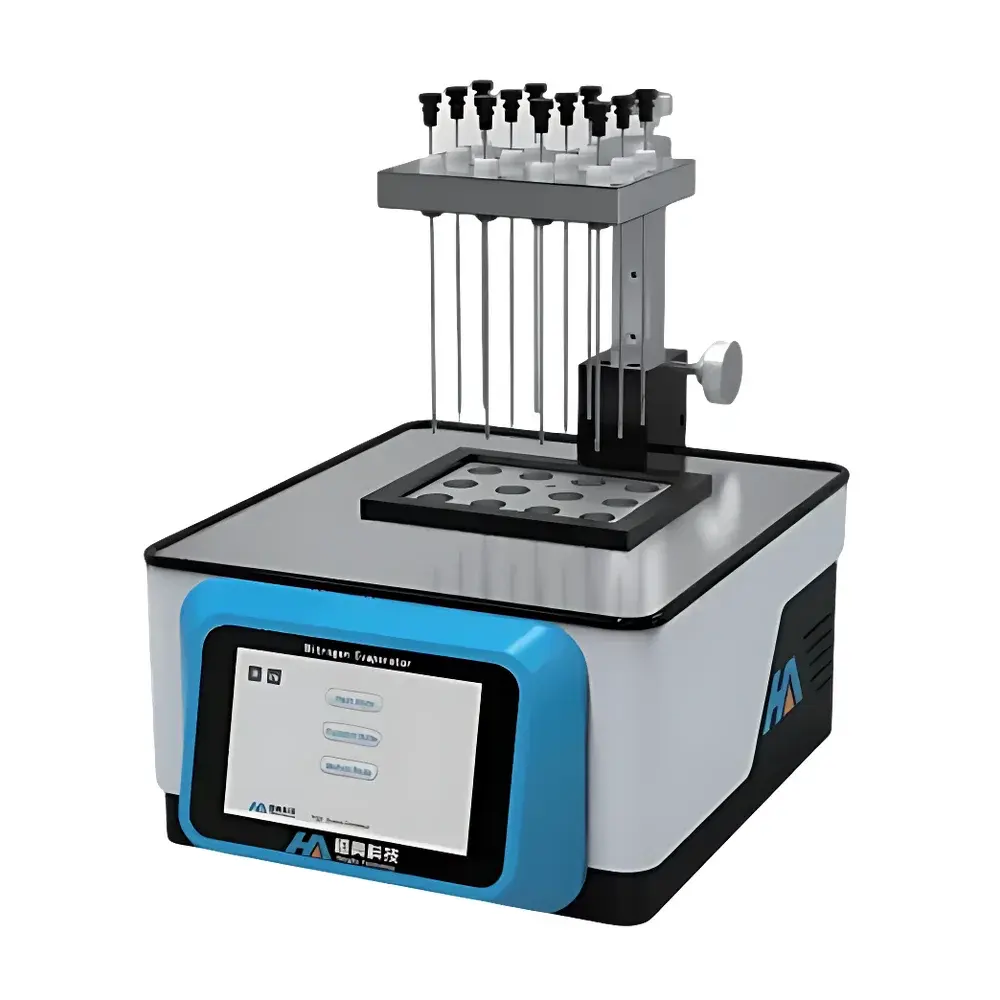
HengAo HGC-12A Dry-Block Nitrogen Evaporator
| Brand | Tianjin HengAo |
|---|---|
| Origin | Tianjin, China |
| Manufacturer Type | Direct Manufacturer |
| Product Origin | Domestic (China) |
| Model | HGC-12A |
| Heating Method | Dry-block heating |
| Temperature Range | Ambient to 150 °C |
| Temperature Stability | ±1 °C |
| Sample Tube Diameter Compatibility | 10–20 mm |
| Gas Flow Rate | 0–5 L/min |
| Sample Capacity | 12 positions |
| Heating Power | 150 W |
| Dimensions (W×D×H) | 340 × 230 × 380 mm |
| Power Supply | 220 V, 50 Hz |
| Maximum Gas Inlet Pressure | 200 kPa |
| Control System | PID temperature regulation with overheat protection and PTC heating element |
| Material Contacting Solvents | 316 stainless steel, anodized aluminum, or plastic-coated surfaces |
| Adjustable Gas Distribution Plate | Height and orientation adjustable |
| Nitrogen Needle Configuration | Modular and individually operable |
Overview
The HengAo HGC-12A Dry-Block Nitrogen Evaporator is a precision-engineered laboratory instrument designed for the gentle, reproducible, and oxygen-free concentration of volatile analytes from liquid samples. It operates on the principle of controlled inert gas (typically nitrogen) sweep across the surface of solvent-containing tubes, accelerating solvent evaporation while minimizing thermal degradation and analyte oxidation. Unlike water-bath-based systems, the dry-block design eliminates cross-contamination risks, ensures rapid thermal response, and delivers superior temperature uniformity across all 12 sample positions. The unit is optimized for routine high-throughput workflows in regulated analytical environments where method robustness, trace-level recovery, and operator safety are critical — particularly in residue analysis, clinical biochemistry, and pharmaceutical quality control.
Key Features
- Dry-block heating architecture using PTC (Positive Temperature Coefficient) elements with PID-controlled feedback loop, enabling precise setpoint maintenance within ±1 °C across the full operating range (ambient to 150 °C).
- 12-position modular aluminum heating block with interchangeable inserts accommodating tube diameters from 10 mm to 20 mm; standard bore options include Φ15 mm, Φ17 mm, and Φ21 mm — custom configurations available upon request.
- Intuitive capacitive touch interface displaying real-time parameters: elapsed time, set and actual temperature, and inlet gas pressure — supporting protocol documentation and procedural consistency.
- Gas distribution system featuring individually controllable nitrogen needles and a fully adjustable gas manifold plate (height and angular orientation), facilitating ergonomic tube access and optimal gas stream alignment.
- All wetted components — including needle guides, gas channels, and sample block surfaces — constructed from 316 stainless steel, anodized aluminum, or electrophoretically coated metals to ensure chemical resistance, long-term durability, and ease of decontamination.
Sample Compatibility & Compliance
The HGC-12A supports a broad spectrum of biological, environmental, and pharmaceutical matrices, including but not limited to serum, plasma, urine, tissue homogenates, plant extracts, aqueous environmental samples, and organic solvent extracts (e.g., ethyl acetate, hexane, acetonitrile). Its inert gas environment preserves thermolabile compounds such as pesticides (e.g., organophosphates, pyrethroids), veterinary drug residues (e.g., clenbuterol, ractopamine), and dioxin congeners during concentration. The instrument’s design aligns with fundamental requirements of ISO/IEC 17025-accredited laboratories and supports compliance with method-specific standards including AOAC Official Methods®, EPA Methods 505, 525.3, and 8082, as well as pharmacopeial procedures outlined in USP and EP 2.2.46. While not inherently 21 CFR Part 11 compliant, its digital interface allows integration into validated LIMS or ELN platforms when paired with audit-trail-enabled software.
Software & Data Management
The HGC-12A operates as a standalone benchtop device with no embedded PC or proprietary software dependency. All operational parameters are locally stored in non-volatile memory and retained after power cycling. Time-stamped temperature and pressure logs are viewable on-screen but not exportable via USB or network interface. For laboratories requiring electronic record retention, the unit may be operated in conjunction with external data acquisition systems or validated third-party lab automation platforms. Users performing GLP/GMP-regulated work are advised to implement manual logbook entries or integrate the instrument into a broader electronic quality management system (eQMS) that captures start/end times, operator ID, and calibration status per run.
Applications
- Agricultural Residue Analysis: Concentration of pesticide extracts from fruits, vegetables, cereals, and botanical tissues prior to GC-MS or LC-MS/MS quantification.
- Environmental Monitoring: Pre-concentration of trace organic pollutants (e.g., PCBs, PAHs, chlorinated hydrocarbons) from drinking water, wastewater, and sediment pore water.
- Pharmaceutical Quality Control: Solvent removal following solid-phase extraction (SPE) of active pharmaceutical ingredients (APIs) and impurities in herbal formulations and dosage forms.
- Clinical Toxicology & Biomarker Research: Rapid preparation of biological fluids (serum, urine, whole blood) for steroid profiling, therapeutic drug monitoring, and metabolite screening.
- Food & Beverage Safety Testing: Cleanup and concentration steps in multi-residue methods for mycotoxins, veterinary drugs, and process contaminants (e.g., furans, acrylamide precursors) in dairy, alcoholic beverages, and ready-to-eat products.
FAQ
What is the maximum recommended operating temperature for routine use?
For optimal longevity of seals and consistent thermal performance, we recommend sustained operation below 120 °C unless higher temperatures are specifically required by validated analytical methods.
Can the HGC-12A be used with gases other than nitrogen?
Yes — argon and other inert gases compatible with the specified inlet pressure range (0–200 kPa) may be substituted, provided gas purity meets analytical grade specifications (≥99.998%).
Is the heating block interchangeable between HGC-12A and other HGC-series models?
No — each model (HGC-12A, HGC-24A, etc.) uses a dedicated block geometry and mounting interface; cross-model compatibility is not supported.
Does the unit include a nitrogen gas regulator or supply tubing?
No — these are supplied separately as ancillary equipment; users must provide a clean, oil-free, pressure-regulated nitrogen source meeting the 0–5 L/min flow and 0–200 kPa inlet specifications.
How often should the unit undergo preventive maintenance?
We recommend visual inspection of gas pathways and cleaning of the heating block every 200 operational hours, with full calibration verification performed at least annually or per internal quality procedure requirements.



