
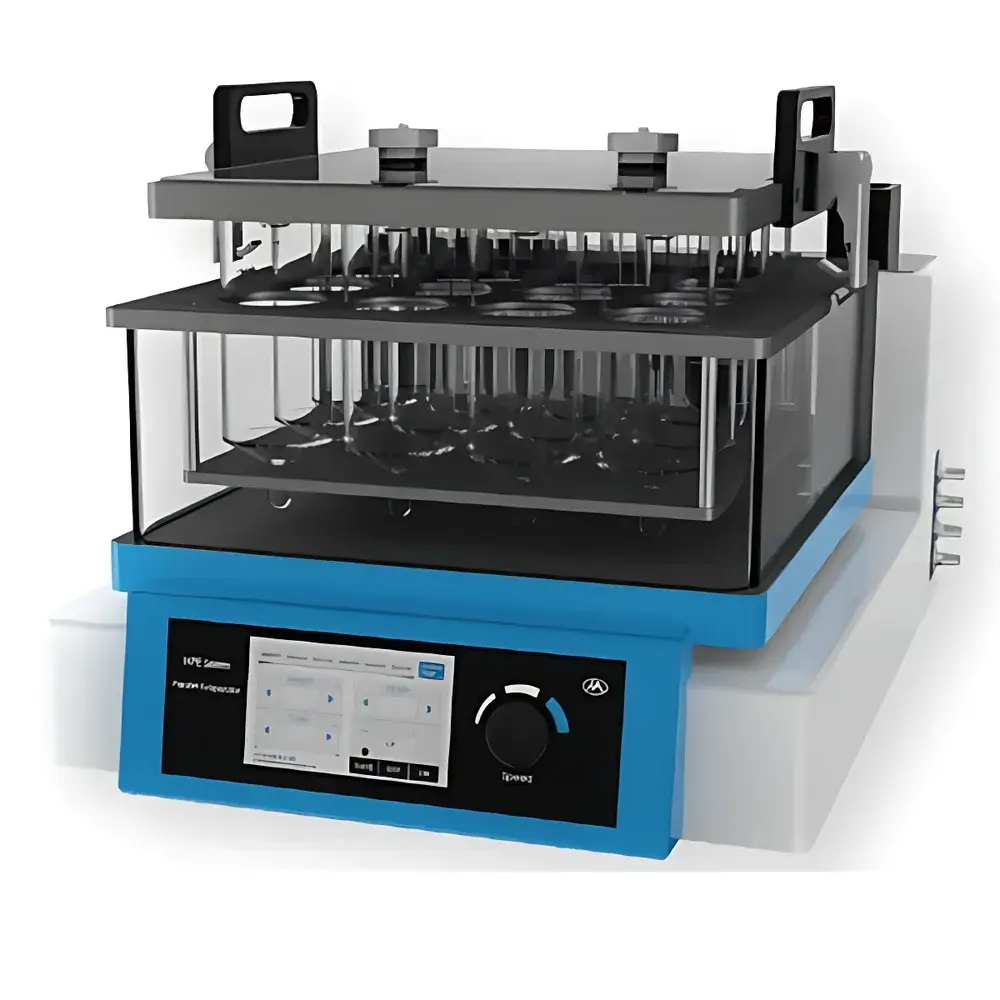
HengAo HPE-D Parallel Vacuum Concentrator
| Brand | Tianjin HengAo |
|---|---|
| Origin | Tianjin, China |
| Manufacturer Type | Direct Manufacturer |
| Instrument Type | Automated Quantitative Concentrator |
| Temperature Range | Ambient to 100 °C |
| Temperature Control Accuracy | ±0.5 °C |
| Maximum Sample Capacity | 200 mL per tube |
| Throughput Options | 9 × 850 mL |
| Evaporation Environment | Transparent Glass Water Bath |
| Quantitative Endpoint Detection | 1 mL or 0.5 mL preset volume |
| Optional Accessory | Sealed Lid Assembly |
Overview
The HengAo HPE-D Parallel Vacuum Concentrator is an engineered solution for high-throughput, gentle sample concentration in analytical, pharmaceutical, environmental, and life science laboratories. It operates on the principle of simultaneous vacuum-assisted evaporation, controlled water-bath heating, and orbital agitation—enabling rapid yet thermally benign removal of volatile solvents from multiple samples without analyte degradation. Unlike single-sample rotary evaporators or nitrogen blow-down systems, the HPE-D employs parallel processing architecture with independent thermal and vacuum regulation across sample positions, ensuring uniform solvent removal kinetics and minimizing inter-sample variability. Its design prioritizes reproducibility, operator safety, and unattended operation—critical requirements in GLP-compliant workflows and routine QC/QA environments.
Key Features
- Triple-mode process control: Integrated vacuum regulation (adjustable down to ≤10 mbar), precise water-bath temperature control (ambient to 100 °C, ±0.5 °C accuracy), and programmable orbital shaking (0–300 rpm) synergistically accelerate evaporation while preserving heat-labile compounds such as peptides, nucleotides, and small-molecule pharmaceuticals.
- Modular throughput configuration: Supports three standard rack formats—9-position for 850 mL tubes, 16-position for 280 mL tubes, and 42-position for 65 mL tubes—allowing flexible adaptation to diverse sample volumes and workflow scales without hardware modification.
- Optically transparent glass water bath: Enables real-time visual monitoring of sample level, foam formation, and condensation behavior—essential for method development and troubleshooting without interrupting the run.
- Automated endpoint detection: Optical or capacitive level sensors trigger termination at user-defined residual volumes (1 mL or 0.5 mL), eliminating over-concentration and improving inter-run consistency. Sensor calibration is traceable and configurable via front-panel interface.
- Integrated fluid management: Auto-fill and auto-drain functions maintain consistent bath level and temperature stability across extended runs; drain cycle includes anti-siphon valve protection and overflow cutoff per IEC 61000-6-3 compliance.
- Optional sealed lid assembly: Reduces ambient contamination, minimizes solvent vapor dispersion, and enhances vacuum efficiency—particularly beneficial when processing hazardous or regulated solvents under OSHA or REACH guidelines.
Sample Compatibility & Compliance
The HPE-D accommodates a broad range of sample matrices—including aqueous buffers, organic extracts (e.g., ethyl acetate, dichloromethane, methanol), and mixed-phase solutions—without requiring solvent-specific hardware adaptations. Tube compatibility extends to borosilicate glass, polypropylene, and PTFE-lined vessels rated for vacuum and thermal cycling. The system conforms to IEC 61010-1 (Safety Requirements for Electrical Equipment for Measurement, Control, and Laboratory Use) and meets electromagnetic compatibility standards per IEC 61326-1. While not pre-certified for FDA 21 CFR Part 11, its firmware supports audit-trail-enabling configurations—including timestamped event logging, user-access controls, and parameter-change history—facilitating validation under GMP/GLP frameworks.
Software & Data Management
Operation is managed via an intuitive embedded touchscreen interface with multilingual support (English, German, Chinese). All method parameters—including ramp profiles, vacuum setpoints, agitation speed, and endpoint thresholds—are stored as named protocols with version tagging. Exportable CSV logs include time-stamped temperature, pressure, and sensor status data for integration into LIMS or electronic lab notebooks (ELN). Remote monitoring is supported via Ethernet (TCP/IP) with optional Modbus RTU integration for centralized facility management systems.
Applications
- Preparative sample cleanup prior to LC-MS/MS analysis in clinical toxicology and doping control laboratories.
- High-volume solvent removal from SPE eluates in environmental residue testing (e.g., EPA Method 525.3, ISO 17892-10).
- Concentration of unstable biologics during formulation development, where thermal stress must remain below denaturation thresholds.
- Parallel processing of metabolomics extracts across multi-well plate formats, maintaining stoichiometric integrity between replicates.
- Regulatory-compliant residual solvent analysis (ICH Q3C) requiring precise endpoint control and full traceability.
FAQ
What vacuum level can the HPE-D achieve, and is it adjustable?
The system delivers adjustable vacuum down to ≤10 mbar using an integrated diaphragm pump; fine-tuning is possible in 1 mbar increments via the control interface.
Is the water bath temperature calibrated and traceable to NIST standards?
Yes—each unit ships with a factory calibration certificate referencing NIST-traceable RTD probes; field recalibration is supported using external reference thermometers compliant with ASTM E74.
Can the HPE-D be validated for use in GMP-regulated environments?
Absolutely—the instrument’s deterministic control logic, event logging capability, and parameter lockout features align with Annex 11 and ALCOA+ data integrity principles when configured with appropriate SOPs and change control documentation.
Does the system support third-party tube racks or custom vessel geometries?
Rack adaptability is limited to OEM-certified carriers; however, mechanical mounting dimensions and thermal interface specifications are provided upon request for custom fixture engineering.
What maintenance intervals are recommended for long-term reliability?
Diaphragm pump oil replacement every 6 months (or 2,000 operating hours), water bath descaling quarterly, and sensor verification semiannually—per the included Maintenance Logbook and ISO 17025-aligned service checklist.



