
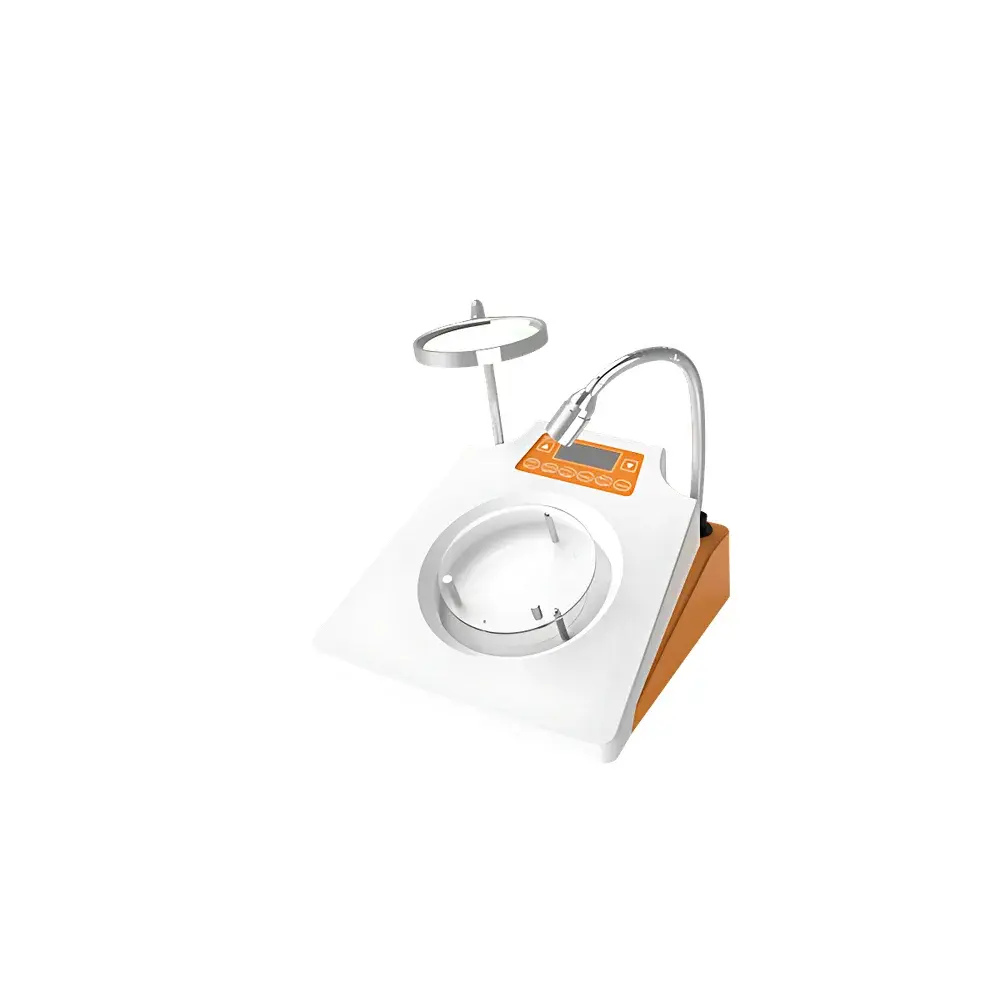
HengAo HCC-02 Semi-Automatic Colony Counter
| Brand | Tianjin HengAo |
|---|---|
| Origin | Tianjin, China |
| Manufacturer Type | Direct Manufacturer |
| Instrument Type | Semi-Automatic Colony Counter |
| Model | HCC-02 |
| Counting Method | Pressure-Sensitive Touch Probe |
| Visual Field Options | Adjustable Bright/Dark Field Background |
| Optical Magnification (Optional) | 3× or 6× |
| Illumination | Adjustable LED Light Source |
| Audio Feedback | Configurable Beep per Count |
| Pressure Sensitivity | Adjustable |
| Reset Function | Built-in Zero Reset |
| Data Interface | USB Connection for PC Communication |
| Optional Accessory | Multi-Color Smart Remote-Controlled Backlight System |
| Compliance | Designed for ISO 4833-1:2013, ASTM D5769, USP <61>, and GLP-compliant microbiological enumeration workflows |
Overview
The HengAo HCC-02 Semi-Automatic Colony Counter is an engineered solution for precise, repeatable, and operator-friendly colony enumeration in microbiological quality control and research laboratories. Based on pressure-sensitive tactile detection technology, the instrument operates via a calibrated electronic sensing pad that registers discrete mechanical contact events—each corresponding to a single colony—when activated by a stylus or probe. This principle eliminates optical miscounting due to colony clustering, haze, or low contrast, offering superior reliability over fully automated image-based systems in heterogeneous or low-density samples. The device integrates ergonomic design with regulatory-aware functionality, supporting manual counting workflows that maintain full operator traceability—a critical requirement under GLP and GMP frameworks where audit trails and procedural transparency are mandated.
Key Features
- Semi-automatic tactile counting using pressure-sensitive sensing pad with adjustable activation threshold to accommodate varying probe types and user force preferences.
- Dual-mode visual field selection: switchable bright-field and dark-field LED illumination enhances contrast for diverse agar media—including blood agar, MacConkey, Sabouraud dextrose, and chromogenic formulations.
- Integrated arithmetic module calculates mean colony counts across multiple plates or dilutions, reducing manual transcription errors and improving inter-operator consistency.
- Configurable audio feedback (beep volume and pitch) and tactile response confirmation provide real-time validation of each count without requiring visual screen monitoring.
- Optical magnification options (3× or 6× lens assembly) mount directly onto the viewing stage, enabling high-fidelity inspection of small, translucent, or irregular colonies without digital interpolation artifacts.
- USB interface enables direct connection to Windows-based laboratory PCs for timestamped data export in CSV format, supporting integration into LIMS environments and internal QC documentation systems.
- Zero-reset function allows rapid reinitialization between sample sets—essential for batch-wise analysis in food safety or pharmaceutical release testing.
Sample Compatibility & Compliance
The HCC-02 accommodates standard Petri dishes (90 mm and 100 mm diameter) and deep-plate variants up to 20 mm height. Its non-optical detection mechanism ensures robust performance with opaque, pigmented, or turbid media—common in environmental water testing (e.g., membrane filtration on mEndo or mFC agar) and clinical specimen processing (e.g., urine culture on CLED agar). The instrument supports methodologies defined in ISO 4833-1:2013 (microbiology of food and animal feeding stuffs), ASTM D5769 (enumeration of coliforms in water), and USP (microbiological examination of nonsterile products). Its manual operation mode satisfies FDA 21 CFR Part 11 requirements for attributable, legible, and contemporaneous records when paired with controlled SOPs and electronic logbooks.
Software & Data Management
While the HCC-02 operates as a standalone counter, its USB interface facilitates seamless data transfer to external applications. Exported files include plate ID, date/time stamp, total count, operator ID (manually entered), and magnification setting—structured to align with ISO/IEC 17025 documentation standards. No proprietary software installation is required; exported CSV files are compatible with Microsoft Excel, GraphPad Prism, and validated LIMS platforms. Audit-ready metadata generation supports internal quality audits and regulatory inspections without reliance on cloud services or third-party licensing.
Applications
This instrument serves core enumeration tasks across regulated and research-driven environments: routine aerobic plate counts in dairy and beverage manufacturing; bioburden assessment of raw materials in pharmaceutical excipient production; environmental monitoring in cleanroom facilities per ISO 14644-1; microbial limit testing of cosmetics per ISO 18416; and pathogen screening (e.g., Staphylococcus aureus, Escherichia coli) in clinical microbiology labs. Its tactile precision proves especially valuable in validating automated colony imagers or resolving borderline counts flagged during method equivalence studies.
FAQ
Does the HCC-02 require calibration certification?
Yes—annual verification against NIST-traceable reference plates is recommended and supported by HengAo’s calibration protocol documentation.
Can it be used with double-layer or selective/differential media?
Yes—the pressure-sensing principle is unaffected by color differentiation or substrate opacity, making it suitable for XLD, TCBS, and CHROMagar plates.
Is the remote-controlled multi-color backlight included by default?
No—it is an optional accessory (HCC-BL-MC) designed to optimize contrast for red, green, or yellow colonies on complex backgrounds.
What probe types are compatible with the sensing pad?
Felt-tip pens, fine-point markers, stainless-steel styluses, and custom ergonomic probes—all within 0.5–2.5 N actuation force range.
How is data integrity ensured during PC transfer?
Each exported file contains SHA-256 checksum metadata and embedded timestamps synchronized to the host PC’s system clock, satisfying ALCOA+ data governance criteria.



