
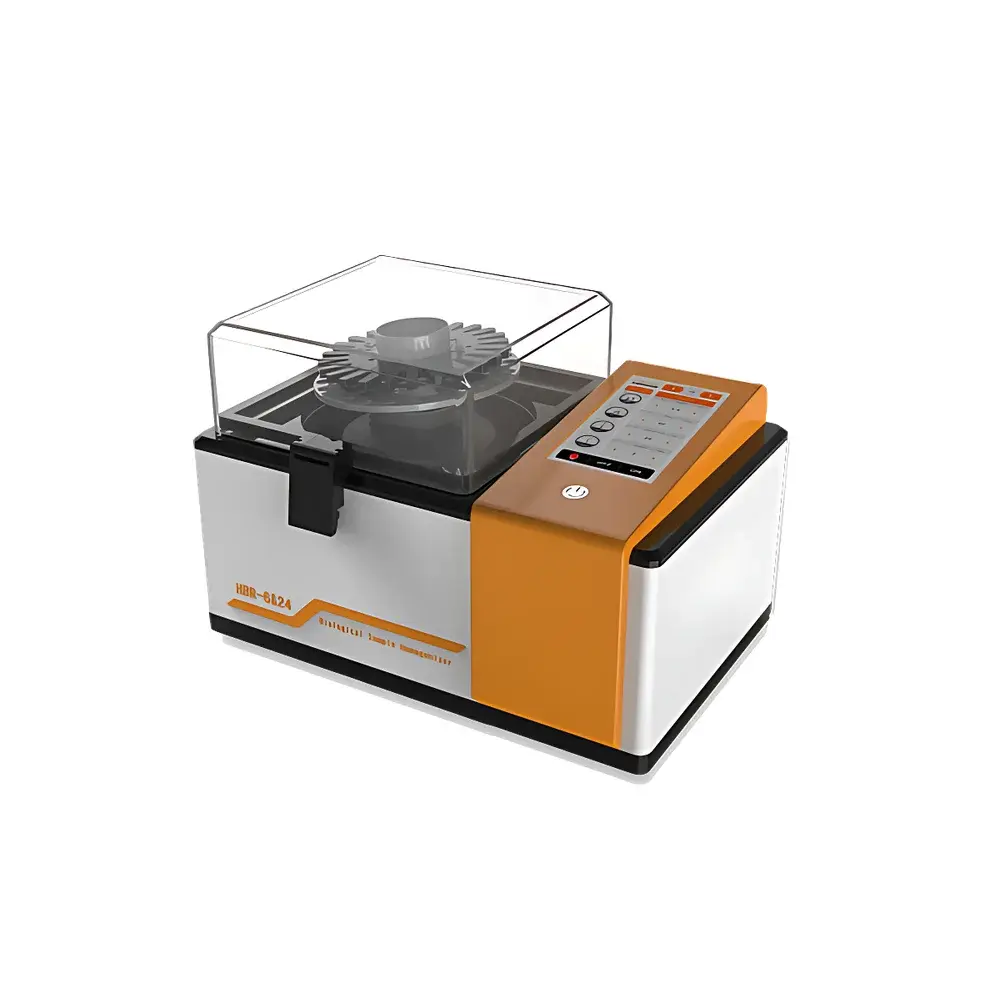
HengAo HBR-6/24 High-Throughput Bead Mill Homogenizer
| Brand | Tianjin HengAo |
|---|---|
| Origin | Tianjin, China |
| Manufacturer Type | Direct Manufacturer |
| Instrument Type | Bead-Based Milling Homogenizer |
| Model | HBR-6/24 |
| Dimensions (W×D×H) | 280 × 440 × 260 mm |
| Sample Volume per Tube | 2–7 mL |
| Maximum Speed | 6800 rpm |
| Throughput | 6 or 24 samples per run |
Overview
The HengAo HBR-6/24 is a high-throughput, benchtop bead mill homogenizer engineered for rapid, reproducible mechanical lysis and homogenization of biological tissues, cells, microorganisms, and plant materials. It operates on the principle of high-frequency orbital shaking combined with kinetic energy transfer from grinding beads—typically glass, ceramic, or stainless steel—to disrupt cellular structures via impact and shear forces. Unlike rotor-stator or ultrasonic systems, this instrument delivers consistent energy input across all sample positions simultaneously, minimizing inter-sample variability and eliminating thermal buildup when operated within recommended time and temperature protocols. Designed for routine use in molecular biology, genomics, proteomics, and clinical diagnostics laboratories, the HBR-6/24 supports scalable workflows—from single-tube optimization to parallel processing of up to 24 samples—without requiring manual intervention between cycles.
Key Features
- Two interchangeable processing configurations: 6-tube (2–7 mL) and 24-tube (2–7 mL) adapters, enabling flexible throughput adjustment without hardware modification.
- Programmable digital controller with adjustable speed (1000–6800 rpm), time (1 s–99 min 59 s), and pause intervals for precise protocol replication.
- Robust aluminum alloy housing with reinforced vibration-dampening base and safety interlock lid system to prevent accidental operation during loading/unloading.
- Low-noise motor design (<65 dB at 1 m distance) suitable for shared laboratory environments and continuous multi-run operation.
- Non-contact drive mechanism ensures long-term reliability and eliminates belt slippage or wear-related calibration drift.
- Compatible with standard 2 mL and 5 mL screw-cap microcentrifuge tubes, including certified low-binding and RNase/DNase-free variants.
Sample Compatibility & Compliance
The HBR-6/24 accommodates a broad spectrum of biological matrices—including mammalian tissues (liver, brain, muscle), cultured cells (adherent and suspension), yeast, bacteria, fungi, and fibrous plant material—provided appropriate bead type, size, and buffer composition are selected. For RNA integrity preservation, users are advised to pre-chill adapters and employ cryogenic protocols (e.g., dry ice or −80 °C pre-cooling). The instrument complies with IEC 61000-6-2 (electromagnetic immunity) and IEC 61000-6-3 (emission) standards. While not certified under ISO 13485 or FDA 21 CFR Part 11, its operational parameters support GLP-aligned documentation practices when integrated into validated SOPs; audit trails may be maintained externally via timestamped log files generated by connected PCs.
Software & Data Management
The HBR-6/24 operates via an embedded microcontroller interface with no proprietary software dependency. All method parameters—including speed, duration, cycle count, and rest intervals—are stored locally in non-volatile memory and recalled instantly via numeric keypad navigation. Optional RS-232 or USB-to-serial interface enables external logging using third-party data acquisition platforms (e.g., LabVIEW, Python-based automation scripts). No cloud connectivity or firmware updates are required, ensuring stable performance over extended service life. Method export/import functionality is not implemented; however, standardized operating procedures can be documented and archived per institutional quality management systems.
Applications
- Genomic DNA and total RNA extraction from difficult-to-lyse samples such as Gram-positive bacteria, spores, and root tissues.
- Preparation of lysates for downstream immunoassays (ELISA, Western blot), enzymatic assays, and mass spectrometry-based proteomics.
- Homogenization of FFPE tissue sections prior to nucleic acid recovery in pathology labs.
- Routine QC testing of microbial cell wall disruption efficiency in bioprocess development.
- High-throughput screening of lysis buffer formulations during assay development.
FAQ
What types of grinding beads are compatible with the HBR-6/24?
Glass, zirconia, stainless steel, and ceramic beads ranging from 0.1 mm to 2.0 mm diameter are supported. Selection depends on sample toughness and desired fragment size distribution.
Can the instrument be used for cryogenic homogenization?
Yes—pre-chilled adapters and tubes may be loaded manually; however, the unit does not include integrated cooling. Dry ice or liquid nitrogen pre-cooling is recommended for thermolabile analytes.
Is there a risk of cross-contamination between samples?
No measurable carryover occurs when using sealed, high-quality tubes and fresh beads per run. Cross-contamination risk is further minimized by adherence to validated cleaning protocols for adapters and lid surfaces.
Does the HBR-6/24 meet regulatory requirements for GMP environments?
It is not individually certified for GMP, but its consistent mechanical output and programmable repeatability support qualification under Annex 15 and USP guidelines when included in a fully validated system.
How often does the instrument require preventive maintenance?
Annual inspection of motor coupling, lid switch actuation, and vibration isolation mounts is recommended. No lubrication or recalibration is necessary under normal usage conditions.



