
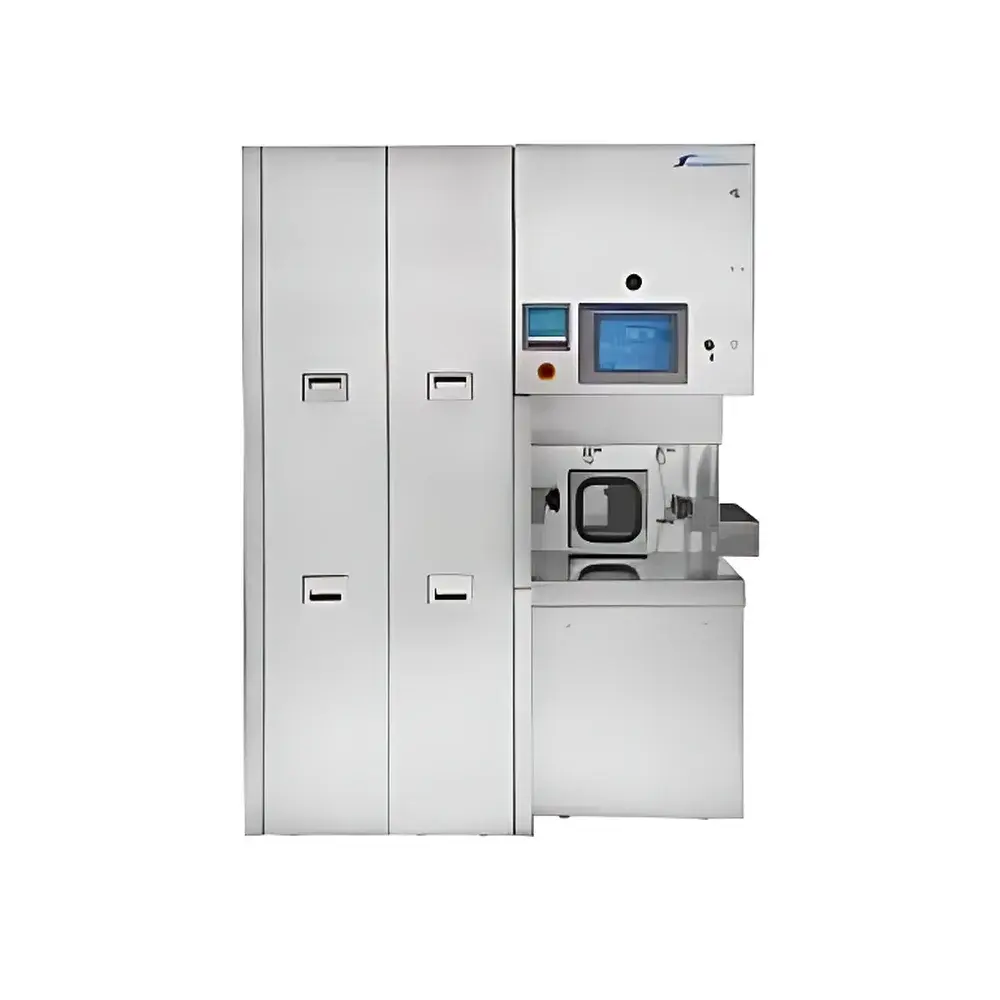
SP PennTech Sterilization Tunnel
| Origin | USA |
|---|---|
| Manufacturer Type | Distributor |
| Origin Category | Imported |
| Model | Sterilization Tunnel |
| Quotation | Upon Request |
| Chamber Volume | Not Applicable |
| Heating Power | Not Specified |
| Wash Temperature | Not Applicable |
| Cleaning Solution Type | Not Applicable |
| External Dimensions (L×W×D) | Not Specified |
Overview
The SP PennTech Sterilization Tunnel is an engineered thermal decontamination system designed for continuous, validated depyrogenation and sterilization of glass vials—primarily Type I borosilicate pharmaceutical containers—in aseptic manufacturing environments. Operating on the principle of dry-heat sterilization via forced convection, the tunnel subjects vials to precisely controlled high-temperature air flow within a thermally stabilized chamber. Unlike batch autoclaves, this continuous-flow architecture eliminates hold times, manual transfers, and recontamination risks between washing and filling steps. It integrates seamlessly into fully automated parenteral production lines, serving as the critical thermal barrier between washing and aseptic filling zones. The system complies with core regulatory expectations for depyrogenation validation per USP , ISO 13408-2, and EU Annex 1 requirements for sterile product manufacturing. Its design adheres to cGMP principles throughout mechanical layout, material selection (e.g., 316L stainless steel construction), and documentation traceability.
Key Features
- Continuous-feed architecture enabling uninterrupted throughput from washer exit to isolator or filling line entry
- Thermally uniform chamber maintained within ±2°C of setpoint via PID-controlled silicon-controlled rectifier (SCR) heating elements
- Forced-air recirculation at ~0.7 m/s velocity ensures consistent heat transfer across all vial surfaces
- Validated residence time range of 6–10 minutes in the sterilization/depyrogenation zone at nominal operating temperature
- cGMP-compliant construction using electropolished 316L stainless steel for corrosion resistance and cleanability
- Modular design compatible with SP PennTech’s full suite of aseptic line equipment—including bottle washers, loading modules, stoppering units, and cappers
- No internal moving parts inside the hot zone; drive systems located outside the thermal envelope to minimize maintenance and contamination risk
Sample Compatibility & Compliance
The tunnel is optimized for standard pharmaceutical glass containers, including 2R–50R West or Schott-type vials (10–50 mL capacity), with validated performance for both empty and partially filled configurations under defined airflow and dwell conditions. It supports qualification protocols aligned with FDA 21 CFR Part 211, EU GMP Annex 1, and ISO 14644-1 Class A/B environmental control standards. Depyrogenation efficacy is demonstrated through endotoxin challenge studies using Bacillus atrophaeus spores and standardized lipopolysaccharide (LPS) assays. System qualification includes Installation Qualification (IQ), Operational Qualification (OQ), and Performance Qualification (PQ) documentation packages compliant with ALCOA+ data integrity principles.
Software & Data Management
Equipped with a programmable logic controller (PLC)-based control system featuring HMI interface for real-time monitoring of zone temperatures, airflow velocity, conveyor speed, and alarm status. All critical process parameters are logged continuously with time-stamped records stored on redundant media. Audit trail functionality meets FDA 21 CFR Part 11 requirements, supporting electronic signatures, user access levels, and immutable record retention. Data export supports CSV and PDF formats for integration into enterprise quality management systems (QMS) and MES platforms. Optional Ethernet/IP or OPC UA connectivity enables centralized supervision across multi-unit production floors.
Applications
- Depyrogenation of glass vials prior to aseptic filling of injectables, vaccines, and biologics
- Terminal sterilization of components requiring dry-heat stability (e.g., stainless steel tools, silicone stoppers)
- Integration into fully automated lyophilization line feed systems
- Supporting ISO 5 (Class A) environments in conjunction with RABS or isolator technologies
- Facilitating regulatory submissions requiring documented microbial reduction kinetics (e.g., 4-log or 6-log reductions)
FAQ
What is the nominal operating temperature of the SP PennTech Sterilization Tunnel?
The typical setpoint is 320°C, selected based on established depyrogenation kinetics for pharmaceutical-grade borosilicate glass.
How is thermal uniformity verified and maintained across the chamber?
Uniformity is ensured through calibrated RTD sensor arrays, laminar airflow design, and closed-loop SCR power modulation—validated per ISO 14644-3 Annex B.
Does the system support IQ/OQ/PQ documentation?
Yes—comprehensive qualification templates, test protocols, and summary reports are provided as part of the delivery package.
Can the tunnel be integrated with third-party washers or fillers?
Yes—mechanical and electrical interfaces follow SEMI E10 and ISA-88 standards, enabling interoperability with major OEM equipment.
Is the system compliant with FDA 21 CFR Part 11 for electronic records?
Yes—the embedded control system includes role-based access, audit trails, and electronic signature capability meeting Part 11 requirements.



