
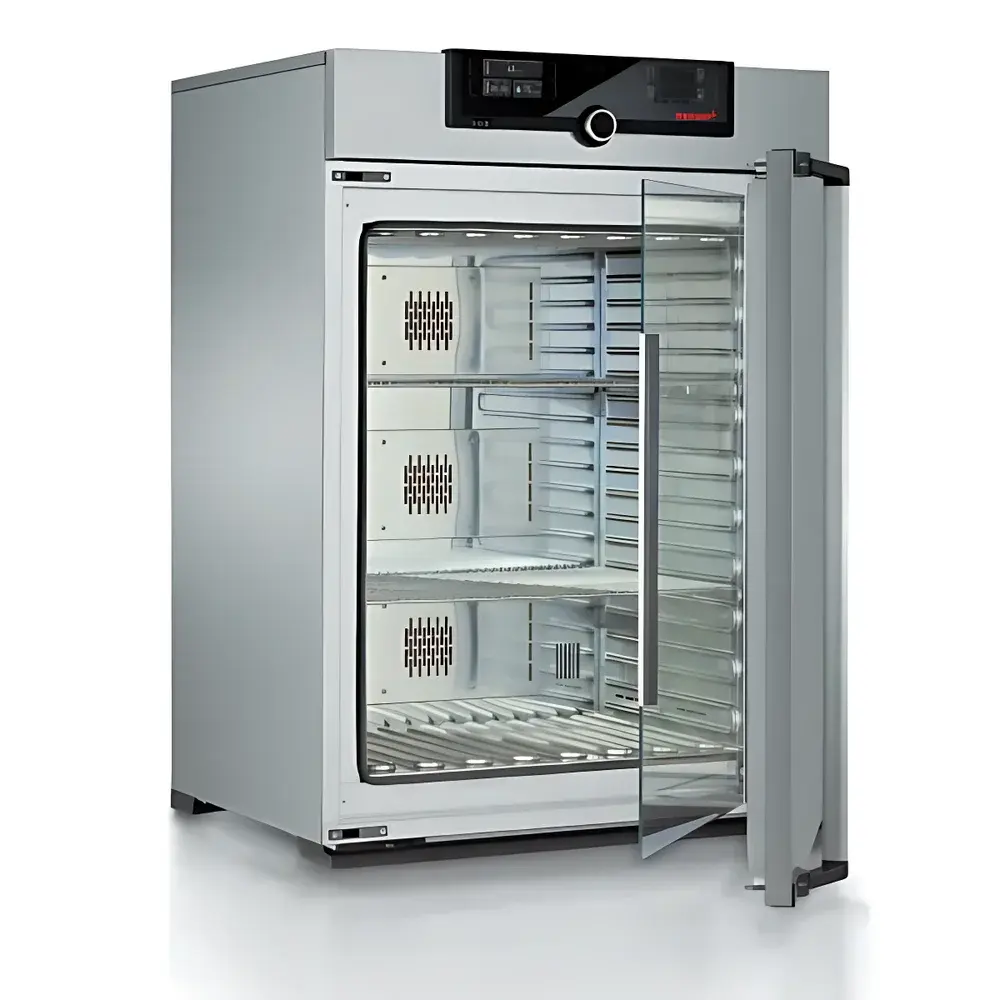
Memmert IPPeco Series Peltier-Cooled Low-Temperature Incubator
| Brand | Memmert (Germany) |
|---|---|
| Origin | Germany |
| Model Range | IPPeco 110 / 260 / 400 / 750 / 1060 / 1400 / 2200 |
| Temperature Range | 0 °C to +70 °C |
| Cooling Technology | Solid-State Peltier Modules |
| Heating Method | Precision Resistive Heating |
| Energy Efficiency | Up to 90% Lower Power Consumption vs. Compressor-Based Systems |
| Vibration Level | <0.5 µm RMS |
| Noise Emission | ≤38 dB(A) |
| Internal Air Circulation | Forced Convection with Optimized Flow Path |
| Condensation Management | Externalized Condensate Formation |
| Humidity Compatibility | Not Integrated (Use HPPeco Series for Humidity Control) |
Overview
The Memmert IPPeco Series represents a paradigm shift in laboratory incubation technology, leveraging solid-state Peltier thermoelectric modules to deliver precise, bidirectional temperature control—from 0 °C to +70 °C—without mechanical compressors. Unlike conventional vapor-compression systems, the IPPeco operates on the Peltier effect: applying direct current across semiconductor junctions induces heat transfer from one side to the other, enabling simultaneous heating and cooling within the same compact architecture. This principle eliminates moving parts, oil-based refrigerants, and high-pressure gas circuits—resulting in inherently low vibration (<0.5 µm RMS), near-silent operation (≤38 dB[A]), and zero internal condensation. The system is engineered for applications demanding thermal stability under dynamic load conditions, including microbiological culture, enzyme kinetics, insect rearing, and cell-based assays where mechanical perturbation or ambient noise must be minimized.
Key Features
- Compressor-Free Thermoregulation: Fully solid-state Peltier modules eliminate compressor wear, refrigerant leakage risks, and maintenance intervals associated with traditional refrigeration cycles.
- Energy-Efficient Operation: Consumes up to 90% less electrical energy than equivalent compressor-based incubators during active cooling phases; power draw scales linearly with thermal load—not fixed capacity.
- Vibration-Sensitive Compatibility: Designed for vibration-critical workflows—including microplate-based assays, live-cell imaging, and entomological studies—where even sub-micron mechanical excitation compromises experimental integrity.
- Condensation-Free Interior: Condensate forms exclusively on external heat-sink surfaces due to hermetically sealed Peltier assemblies—preserving sample integrity, preventing cross-contamination, and eliminating manual defrost cycles.
- Precision Airflow Engineering: Optimized forced convection path ensures uniform temperature distribution (±0.3 °C at setpoint, measured per DIN 12880-1) across all chamber volumes, validated at multiple spatial points.
- Modular Scalability: Available in seven chamber capacities (110–2200 L), all sharing identical control firmware, sensor calibration protocols, and mechanical interface standards for lab-wide deployment consistency.
Sample Compatibility & Compliance
The IPPeco series is validated for use with standard ISO/IEC 17025-accredited laboratories and aligns with key regulatory expectations for equipment qualification. Its absence of hydrofluorocarbon (HFC) refrigerants satisfies EU F-Gas Regulation (EU No 517/2014) and supports LEED-certified facility sustainability goals. While not intrinsically humidity-controlled, its stable thermal environment complies with ASTM E1265 (Standard Practice for Performance Testing of Incubators) and supports GLP-compliant documentation when integrated with Memmert’s optional data logging modules (e.g., CombiControl software with audit trail). Chamber materials meet USP Class VI biocompatibility requirements for non-metallic components in contact with biological samples.
Software & Data Management
All IPPeco models integrate seamlessly with Memmert’s CombiControl v4.x platform—a 21 CFR Part 11-compliant software suite supporting electronic signatures, role-based access control, and automated event-driven reporting. Real-time temperature traces, deviation alerts, and calibration history are stored with cryptographic timestamping and immutable audit trails. Optional Ethernet/IP or RS485 interfaces enable integration into centralized LIMS or MES environments. Firmware updates follow IEC 62304 Class B medical device software lifecycle standards, ensuring traceability and version control for regulated users.
Applications
- Microbiological cultivation requiring stable sub-ambient temperatures without compressor-induced vibration
- Long-term insect colony maintenance (e.g., Drosophila, Tribolium) where acoustic and mechanical stress affect development rates
- Enzyme activity profiling across narrow thermal gradients (e.g., Q10 determination)
- Pre-incubation conditioning of PCR master mixes and sensitive reagents prior to thermal cycling
- Material science testing of polymer-based biosensors under controlled thermal cycling
- Pharmaceutical stability studies compliant with ICH Q1A(R3) guidelines for intermediate storage conditions
FAQ
Does the IPPeco series support humidity control?
No—humidity regulation is not integrated. For combined temperature/humidity applications, Memmert recommends the HPPeco series, which employs dual Peltier modules for independent thermal and moisture management.
Can the IPPeco operate continuously at 0 °C in ambient environments above 30 °C?
Yes, provided the installation meets Memmert’s specified ventilation clearance (≥10 cm rear/side, ≥5 cm top) and ambient air is free of particulates and corrosive gases per DIN EN 60721-3-3 Class 3C2.
Is validation documentation available for GMP environments?
Factory-installed IQ/OQ protocols, as well as customizable PQ templates aligned with Annex 15 and ASTM E2500, are supplied with each unit upon request.
What is the expected service life of the Peltier modules?
Rated for >100,000 thermal cycles (on/off) or continuous operation exceeding 50,000 hours under nominal load, per manufacturer accelerated lifetime testing per JEDEC JESD22-A108F.
How does temperature uniformity compare to compressor-based incubators?
Independent third-party verification confirms ±0.3 °C uniformity (at 37 °C) across full volume—comparable to premium compressor systems but achieved without airflow turbulence or thermal overshoot artifacts.



