
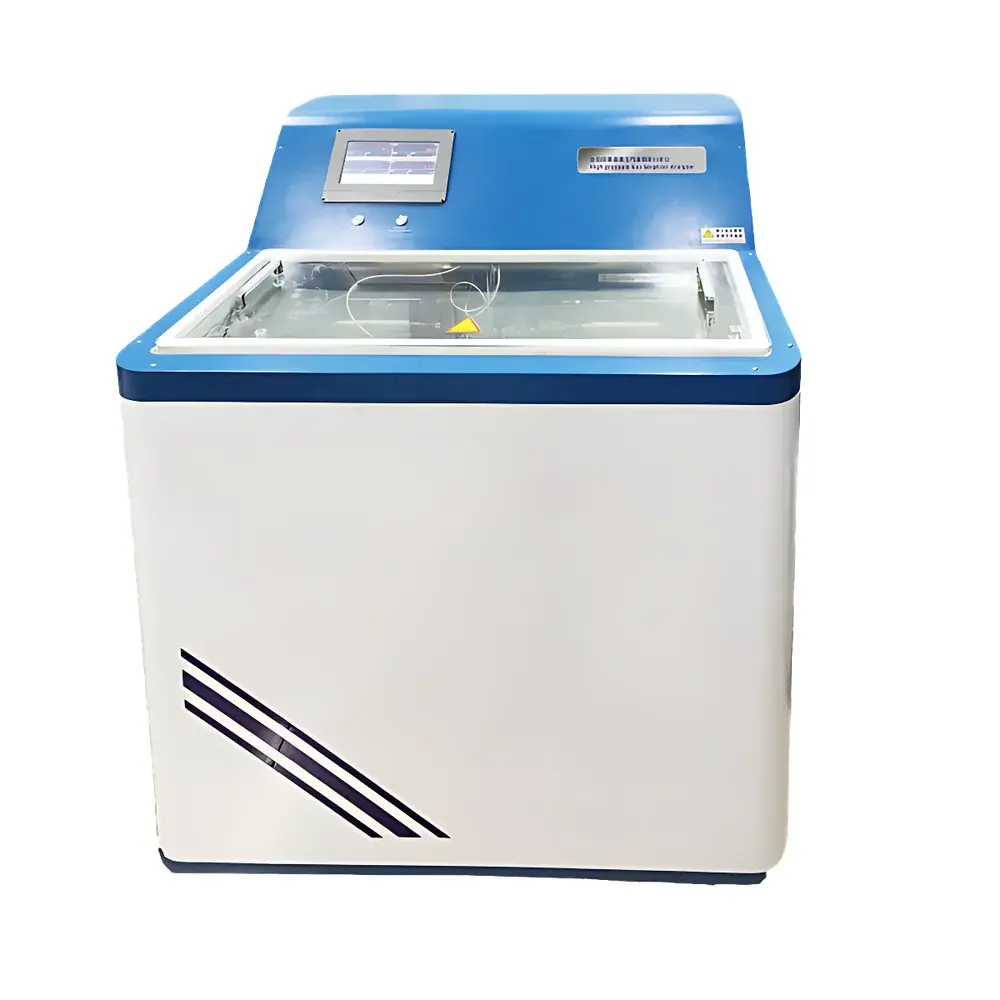
Grand GD-HPA Series Isothermal High-Pressure Adsorption Analyzer
| Brand | Grand |
|---|---|
| Origin | Jiangsu, China |
| Manufacturer Type | Manufacturer |
| Temperature Range | Ambient to 140 °C (oil bath) |
| Pressure Range | High vacuum to 69 MPa |
| Key Features | Constant-temperature gas manifold, sensor calibration protocol to eliminate non-zero adsorption artifacts, ultra-low leak rate design (<1×10⁻⁹ mbar·L/s) to prevent spurious adsorption signals |
Overview
The Grand GD-HPA Series Isothermal High-Pressure Adsorption Analyzer is an engineered platform for quantitative measurement of gas adsorption isotherms under precisely controlled temperature and pressure conditions—critical for characterizing porous materials used in energy storage, carbon capture, catalysis, and shale gas resource evaluation. It operates on the gravimetric or volumetric principle (configurable), with primary implementation based on high-precision magnetic suspension balance (MSB) or calibrated volumetric manometric methods compliant with ISO 15901-2 and ASTM D3663 standards. The system maintains thermal equilibrium across the entire gas delivery train—including valves, regulators, and sample cell—via active air/oil bath temperature control, minimizing thermal transients that induce measurement drift. Its dual-temperature architecture supports both low-temperature isotherm acquisition (e.g., CO₂ at 0 °C for CCS screening) and high-temperature desorption profiling (e.g., CH₄ at 80–120 °C for reservoir simulation), while the integrated heating furnace extends operational capability to 900 °C for irreversible desorption or thermal stability assessment of metal–organic frameworks (MOFs) and activated carbons.
Key Features
- Constant-temperature gas manifold with PID-controlled air/oil bath: temperature stability ±0.1 °C over full operating range, reducing thermal expansion-induced pressure drift and ensuring thermodynamic consistency across multi-point isotherm acquisition.
- Factory-calibrated pressure transducers and mass flow controllers traceable to NIST standards; onboard zero-point and span calibration routines mitigate baseline offset (“non-zero adsorption”) caused by sensor hysteresis or thermal zero-shift.
- Hermetically sealed stainless-steel gas circuit with metal-sealed VCR fittings and helium-leak-tested welds; validated leak rate <1×10⁻⁹ mbar·L/s, eliminating false uptake signals from ambient ingress—especially critical for low-pressure sub-1 bar measurements on microporous carbons.
- Dual-mode operation: switchable between static (manometric) and dynamic (flow-through) modes to accommodate both equilibrium isotherm mapping and kinetic adsorption/desorption profiling.
- Modular sample cell design supporting standard 0.5–5 g solid samples, with optional high-temperature ceramic crucibles and magnetic shielding for paramagnetic or reactive materials.
Sample Compatibility & Compliance
The GD-HPA accommodates powders, granules, monoliths, and thin-film composites—including zeolites, MOFs, silica gels, coal matrix, shale cores, and battery electrode materials. Sample holders comply with ASTM D4641 for coal and ASTM D7217 for shale gas sorption testing. All pressure components conform to ASME B31.3 process piping code and PED 2014/68/EU. Data acquisition meets FDA 21 CFR Part 11 requirements via audit-trail-enabled software, with electronic signatures, user role-based access control, and immutable raw data archiving—supporting GLP/GMP laboratory accreditation workflows.
Software & Data Management
GrandAdsorb v4.2 software provides ISO-compliant isotherm modeling (Langmuir, BET, Dubinin–Astakhov, Toth), pore size distribution analysis (NLDFT, QSDFT), and thermodynamic parameter derivation (isosteric heat of adsorption via Clausius–Clapeyron). Raw pressure–time–temperature datasets are stored in HDF5 format with embedded metadata (sample ID, operator, calibration timestamp, environmental logs). Export options include CSV, Excel, and XML for LIMS integration. Batch processing supports automated multi-isotherm comparison across temperature series, enabling Arrhenius-type activation energy estimation.
Applications
- Shale gas evaluation: CH₄, CO₂, and N₂ adsorption isotherms on core samples at reservoir-relevant temperatures (40–120 °C) and pressures (up to 30 MPa), supporting Langmuir volume and pressure modeling per USGS methodologies.
- Carbon capture material screening: CO₂ uptake capacity and selectivity (CO₂/N₂) at 0–40 °C and 0.1–1 MPa, with competitive adsorption modeling for flue gas conditions.
- Hydrogen storage R&D: H₂ isotherms at 77 K and up to 100 bar on MOFs and covalent organic frameworks (COFs), including enthalpy mapping via in-situ calorimetry coupling.
- Catalyst support characterization: Surface area and micropore volume determination of Pt/Al₂O₃, Ni/ZSM-5, and other supported catalysts under inert gas (Ar, N₂) at cryogenic and ambient temperatures.
FAQ
What temperature control methods are available, and how do they differ in application?
The system offers oil bath (ambient–140 °C) for high-stability isotherms requiring minimal thermal noise, and a combined air bath + resistive heating furnace (up to 900 °C) for high-temperature desorption or thermal regeneration studies.
Can the instrument perform competitive adsorption measurements?
Yes—via programmable gas switching and real-time composition monitoring using optional quadrupole mass spectrometry (QMS) or TCD-gas chromatography modules.
Is vacuum integrity verified automatically during startup?
Yes—the software initiates a 30-minute automated leak-check sequence upon initialization, logging pressure decay rate and flagging deviations exceeding ISO 27874 thresholds.
How is sensor drift compensated during long-duration isotherm runs?
Continuous background pressure monitoring and periodic zero-reference cycles are executed every 2 hours, with drift correction applied retroactively to raw uptake data using spline-interpolated baselines.
Does the system support ASTM D7217-compliant shale sorption testing?
Yes—preloaded test templates, certified reference materials (CRM) libraries, and reporting exports align directly with ASTM D7217 Annex A1 for moisture-corrected dry basis adsorption calculations.



