
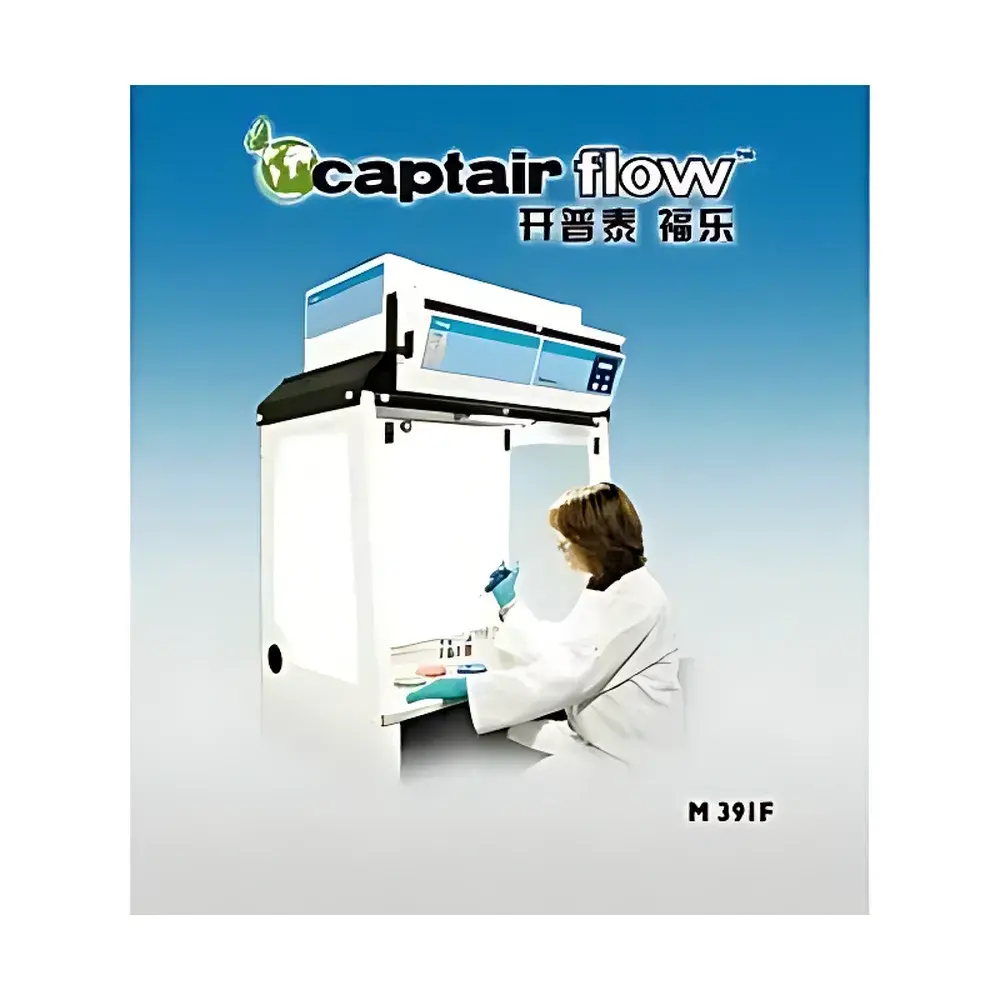
Erlab M391F Vertical Laminar Flow Clean Bench
| Brand | Erlab |
|---|---|
| Origin | France |
| Model | M391F |
| Construction | Double-sided stainless steel clean bench |
| Filter Class | EN 1822-1 H14 (≥99.995% @ 0.3 µm MPPS) |
| Airflow Velocity | >0.3 m/s |
| Airflow Volume | 230 m³/h |
| Noise Level | 52 dB(A) |
| Power Supply | 100–240 V / 50–60 Hz |
| Total Power Consumption | 58 W |
| Dimensions (L×W×H, mm) | 1000 × 620 × (1161–1246) external |
| Internal Working Area | 897 × 522 × 866 mm |
| Cleanliness Class | ISO 14644-1 Class 5 (equivalent to US FED STD 209E Class 100) |
| Compliance | EU GMP Annex 1 Class A/B environments |
| Pre-filter & HEPA monitoring | Integrated differential pressure gauge and fan failure alarm |
Overview
The Erlab M391F Vertical Laminar Flow Clean Bench is a precision-engineered, double-sided stainless steel laminar flow workstation designed for critical aseptic operations in regulated laboratory environments. Operating on the principle of unidirectional, downward vertical airflow—generated by a low-vibration, energy-efficient EC motor-driven centrifugal fan—the unit delivers particle-free air across the work surface at a controlled velocity exceeding 0.3 m/s. This airflow profile ensures consistent removal of airborne contaminants via high-efficiency filtration, maintaining an ISO 14644-1 Class 5 (US Class 100) environment within the working chamber. The system employs an EN 1822-1 certified H14 HEPA filter, validated to capture ≥99.995% of particles at the Most Penetrating Particle Size (MPPS) of 0.3 µm. Its structural integrity, corrosion-resistant 304 stainless steel enclosure, and ergonomic height-adjustable design support long-term reliability under daily operational stress in biology, pharmaceutical, microelectronics, and optics laboratories.
Key Features
- Double-sided access configuration enables collaborative or sequential workflow without compromising containment integrity.
- Single EC fan (LP44 series) with brushless motor technology ensures stable airflow, low power consumption (58 W), and acoustic performance ≤52 dB(A) at 1 m distance.
- Integrated real-time monitoring: visual/audible fan failure alarm and digital differential pressure gauge for predictive maintenance of both pre-filter and H14 HEPA filter.
- Height-adjustable stainless steel work surface (304 grade, 2 mm thickness, radius-edged front) supports ergonomic posture and facilitates decontamination.
- Optional GF4BE+ activated carbon filtration module available for concurrent particulate and gaseous contaminant control—validated for adsorption of organic and inorganic vapors encountered during weighing or chemical handling.
- Compliance-ready architecture: fully documented airflow validation pathways, filter certification traceability, and mechanical design aligned with EU GMP Annex 1 requirements for Class A/B environments.
Sample Compatibility & Compliance
The M391F is validated for non-pathogenic cell culture, microbiological isolation, sterile media preparation, optical component assembly, and precision weighing applications where ambient particulate load must be reduced to ≤100 particles ≥0.3 µm per cubic foot. Its ISO Class 5 internal environment meets the stringent spatial cleanliness criteria required for USP , EU GMP Annex 1 (Grade A/B), and ISO 14644-1:2015. All filtration components carry full EN 1822-1 test reports; the H14 filter’s service life—up to 4 years under typical ISO Class 7–8 ambient lab conditions—is tracked via differential pressure thresholds. The unit’s structural materials comply with REACH and RoHS directives, and its electrical design conforms to IEC 61010-1 for laboratory equipment safety.
Software & Data Management
While the M391F operates as a standalone hardware platform without embedded software, its monitoring subsystems generate analog and digital signals compatible with facility-wide Building Management Systems (BMS) and Laboratory Information Management Systems (LIMS). The fan status output and pressure differential signal can be interfaced via 0–10 V or 4–20 mA protocols for centralized logging. Audit trails—including filter replacement timestamps, fan runtime hours, and alarm event logs—are maintained manually per GLP/GMP documentation standards. Optional integration with Erlab’s SmartLink™ environmental monitoring suite enables remote parameter verification and calibration history tracking—supporting FDA 21 CFR Part 11 compliance when deployed with electronic signature workflows.
Applications
- Non-infectious mammalian and microbial cell culture setup and passaging
- Aseptic preparation of culture media, reagents, and buffers
- Pharmaceutical dosage form development requiring ISO Class 5 background
- Microelectronic wafer inspection and optical lens mounting
- Precision analytical weighing of reference standards and active pharmaceutical ingredients (APIs)
- Plant tissue culture and sterile seed germination protocols
- Calibration of particle counters and environmental sensors in cleanroom validation
FAQ
What is the recommended ambient environment for optimal M391F performance?
The unit is engineered for installation in ISO Class 7 (10,000) or cleaner ambient spaces. Operation in ISO Class 8 (100,000) environments may reduce HEPA filter lifespan and require more frequent pre-filter replacement.
Can the M391F be used for volatile organic compound (VOC) handling?
Yes—when equipped with the optional GF4BE+ activated carbon filter module, it provides dual-stage protection against both particulates and low-concentration VOCs. However, it is not rated for high-hazard or flammable vapor applications; dedicated ducted fume hoods remain required for such use cases.
Is the H14 filter certified to EN 1822-1 with full test documentation?
Yes—each filter is supplied with a manufacturer-issued EN 1822-1 Type Test Certificate specifying MPPS efficiency, leakage scan results, and initial pressure drop. Certificates are traceable by serial number and archived per quality system requirements.
How is airflow uniformity verified during commissioning?
Per ISO 14644-3, airflow uniformity is confirmed using calibrated thermal anemometers at 100 mm intervals across the work surface grid. Velocity deviation must remain within ±20% of the mean value (≥0.3 m/s) across all measurement points.
Does the M391F meet FDA or EMA requirements for Grade A environments?
It satisfies the engineering and performance criteria for Grade A (ISO 5) local protection zones when installed, qualified, and operated in accordance with EU GMP Annex 1 §4.37–4.42. Full qualification (IQ/OQ/PQ) must be performed on-site by the end user or authorized third-party provider.



