
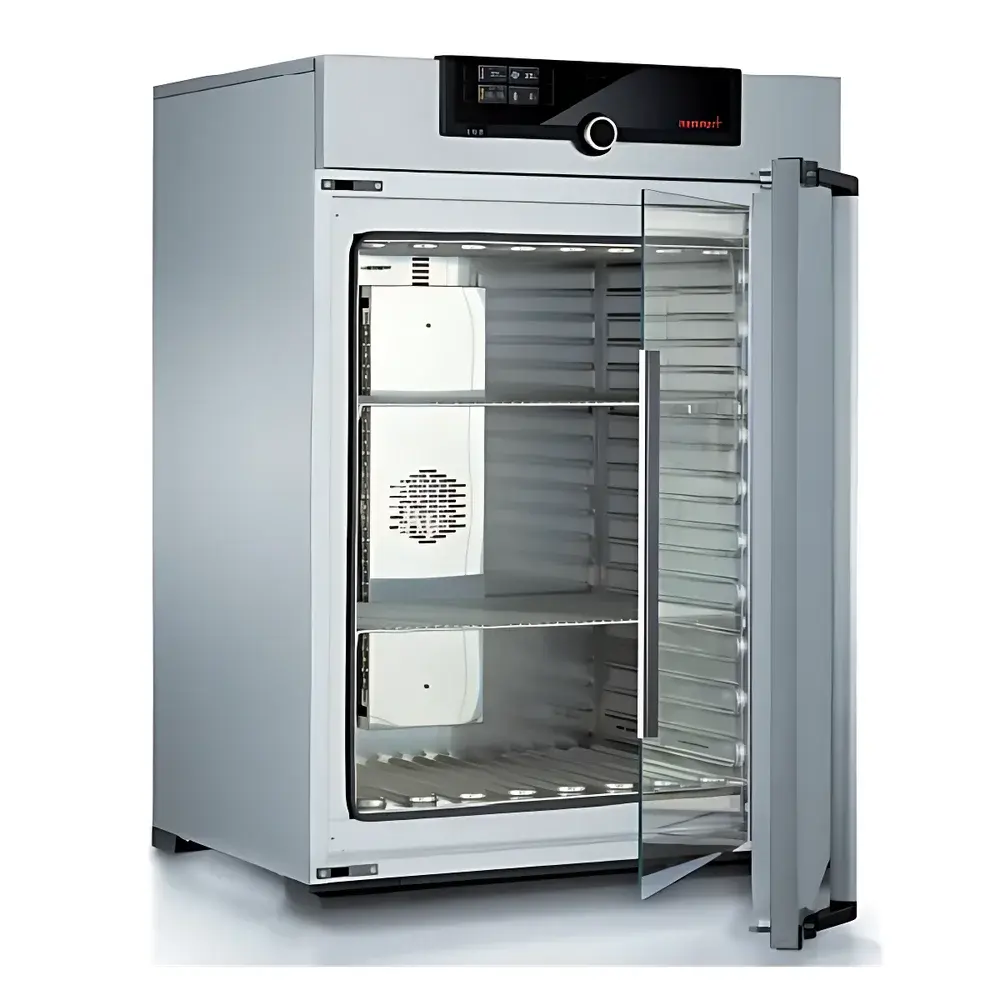
Memmert IN/IF Series Natural and Forced Convection Incubators
| Brand | Memmert (Germany) |
|---|---|
| Origin | Germany |
| Model | IN / IF Series |
| Temperature Range | Ambient +5°C to +80°C |
| Convection Type | Natural Convection (IN) / Adjustable-Speed Forced Convection (IF) |
| Sterilization Capability | 160°C for 4 h (INplus/IFplus models) |
| Fresh Air Preheating System | Integrated preheating chamber |
| Compliance | Designed for GLP/GMP environments, supports FDA 21 CFR Part 11–compliant software validation (with optional VarioControl software) |
Overview
The Memmert IN/IF Series incubators are precision-engineered laboratory instruments designed for stable, homogeneous thermal conditioning of biological, pharmaceutical, and food science samples. Based on the fundamental principle of convective heat transfer—either passive (natural convection) or active (fan-assisted forced convection)—these incubators deliver exceptional temperature uniformity and stability across their working chambers. Unlike general-purpose ovens, the IN/IF Series prioritizes sample integrity over rapid heating: temperature control is maintained within a narrow band (±0.3°C typical at 37°C), with minimal overshoot and drift. This performance is achieved through a combination of high-resolution Pt100 sensor feedback, adaptive PID algorithms, and a thermally optimized double-walled chamber design with low-thermal-mass insulation. The system is particularly suited for sensitive applications where surface desiccation, thermal shock, or moisture loss must be avoided—such as microbial growth studies, enzyme activity assays, cell culture pre-incubation, and stability testing of hygroscopic formulations.
Key Features
- Natural convection (IN models) eliminates mechanical air movement, preventing evaporation-induced surface drying of gels, agar plates, and aqueous cultures.
- Forced convection (IF models) incorporates a variable-speed centrifugal fan with 10% incremental speed adjustment (0–100%), enabling precise tuning of airflow intensity to match sample sensitivity and chamber loading.
- Integrated fresh-air preheating chamber ensures incoming ambient air is thermally equilibrated before entering the main chamber—eliminating localized cooling effects and reducing recovery time after door openings.
- High-temperature dry-heat sterilization cycle (160°C for 4 hours) available on INplus and IFplus variants, validated for microbial decontamination of chamber surfaces in accordance with ISO 14644-1 cleanroom-grade maintenance protocols.
- Dual-wall construction with vacuum-insulated glass door and low-conductivity mineral wool insulation minimizes thermal bridging and external heat emission.
- Calibration-ready architecture: factory-calibrated Pt100 sensors traceable to national standards; optional user-accessible calibration ports support in-house verification per ISO/IEC 17025 requirements.
Sample Compatibility & Compliance
The IN/IF Series accommodates standard microbiological vessels—including Petri dishes, multiwell plates, test tubes, flasks, and glass jars—without requiring custom racks. Chamber geometry and airflow management are optimized to avoid turbulence near sample surfaces, preserving humidity gradients critical for aerobic/anaerobic culture viability. All models comply with IEC 61010-1 (Safety Requirements for Electrical Equipment for Measurement, Control, and Laboratory Use) and meet electromagnetic compatibility (EMC) standards per EN 61326-1. When configured with VarioControl software and audit trail modules, systems support full 21 CFR Part 11 compliance—including electronic signatures, change tracking, and secure data archiving—making them suitable for regulated environments governed by USP , EU Annex 11, and GxP quality frameworks.
Software & Data Management
Standard models feature Memmert’s intuitive touchscreen interface with real-time graphing, setpoint ramping, and programmable multi-step profiles. Optional VarioControl software enables remote monitoring via Ethernet/Wi-Fi, automated data export (CSV, PDF), and integration into LIMS or MES platforms. Full audit trail functionality logs all parameter changes, user logins, alarm events, and sterilization cycles with timestamps and operator IDs—essential for FDA inspections and internal quality audits. Data integrity safeguards include write-protected storage, password-protected configuration modes, and encrypted backup archives.
Applications
- Microbiology: Bacterial and fungal cultivation under controlled aerobic conditions; colony isolation and enumeration.
- Pharmaceutical QA/QC: Stability testing of APIs and finished dosage forms per ICH Q1 guidelines; media fill simulation incubation.
- Food & Beverage: Shelf-life studies, pathogen enrichment (e.g., Salmonella, Listeria), and yeast propagation.
- Academic Research: Enzyme kinetics, protein denaturation profiling, and developmental biology assays requiring long-term thermal consistency.
- Diagnostic Laboratories: Reagent incubation for ELISA, PCR prep, and immunoassay workflows.
FAQ
What is the difference between IN and IF models?
The IN series relies solely on natural convection—ideal for moisture-sensitive samples where even minimal airflow could cause desiccation. The IF series adds a digitally controlled fan for enhanced temperature homogeneity in larger or densely loaded chambers.
Can the incubator maintain humidity?
No—these are dry incubators without active humidification. For humidity-controlled applications, consider Memmert’s HPP or IPP series.
Is sterilization cycle validated?
Yes—160°C for 4 h is a standardized dry-heat protocol for depyrogenation and microbial kill; users may perform additional verification using biological indicators per ISO 14937.
How often does calibration require verification?
Per ISO/IEC 17025, initial verification is recommended at installation; subsequent intervals depend on usage frequency and risk assessment—typically every 6–12 months in GMP settings.
Does the preheating chamber affect total air exchange rate?
No—the preheating function modifies only the temperature of incoming air; nominal air exchange remains constant and configurable (e.g., 0.5–2.0 volume changes per hour) based on application needs.



