
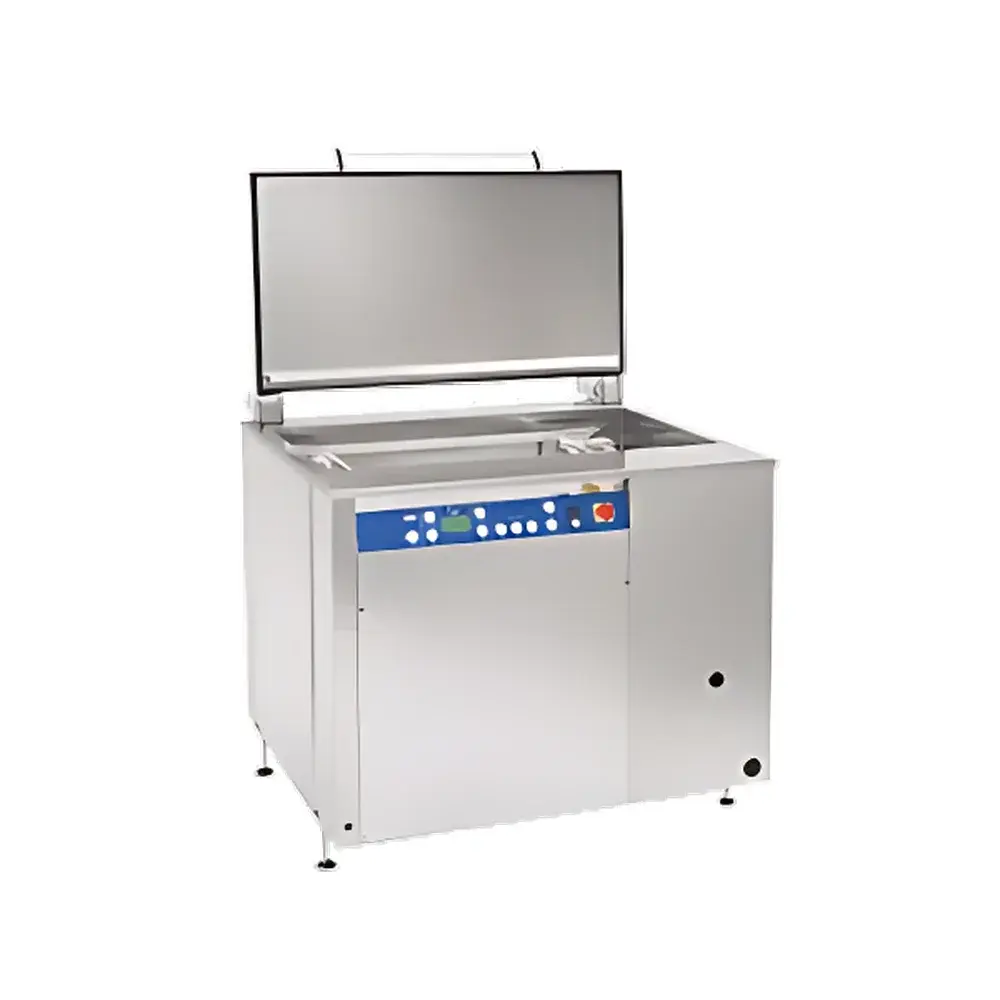
Elma XL Series Extra-Large Capacity Ultrasonic Cleaner
| Brand | Elma |
|---|---|
| Origin | Germany |
| Model | XL |
| Type | Industrial-Dedicated Ultrasonic Cleaner |
| Capacity Range | Up to 253 L (custom-configurable) |
| Ultrasonic Frequency | Multi-frequency options available (e.g., 37 kHz, 80 kHz, 130 kHz) |
| Ultrasonic Power Output | High-power transducer arrays (scalable per tank volume) |
| Power Adjustment | Yes, via BUS intelligent control system |
| Temperature Control | Yes, integrated heating with digital PID regulation (RT to 95 °C) |
| Timer Function | Programmable (1–999 min) |
| Lid | Hinged acoustic-damping cover with safety interlock |
| Drain & Fill | Optional automated inlet/outlet with level sensor |
| Degassing Mode | Yes, dedicated vacuum-assisted degas cycle |
| Sweep Mode | Yes, frequency modulation for uniform energy distribution |
| Pulse Mode | Yes, intermittent high-intensity bursts for challenging contaminants |
| Optional Accessories | Hoist-mounted sample suspension system, oil-skimming module, ultrasonic vibration booster modules, corrosion-resistant stainless-steel tanks (AISI 316L), integrated filtration recirculation |
Overview
The Elma XL Series Extra-Large Capacity Ultrasonic Cleaner represents the culmination of over six decades of German engineering expertise in ultrasonic cleaning technology. Designed for industrial-scale laboratory and production environments, the XL platform leverages proven piezoelectric transducer architecture coupled with Elma’s proprietary BUS intelligent control system to deliver reproducible, process-critical cleaning performance across volumes up to 253 liters. Unlike standard benchtop units, the XL series operates on the principle of controlled cavitation generation within a precisely tuned acoustic field—where ultrasonic energy (typically 37 kHz, 80 kHz, or 130 kHz) induces microbubble formation and implosive collapse in aqueous or solvent-based media, generating localized shear forces exceeding 10,000 g. This physical mechanism enables removal of particulate, organic, and thin-film residues from complex geometries—including blind holes, threaded components, and multi-material assemblies—without mechanical abrasion or thermal degradation. The system is engineered for integration into validated cleaning workflows compliant with ISO 13485, ASTM D2601, and USP for critical component preparation.
Key Features
- Modular tank construction with AISI 316L stainless-steel chamber and reinforced acoustic isolation for long-term resistance to cavitation erosion and chemical exposure
- BUS intelligent control architecture enabling synchronized operation of transducers, heaters, timers, and auxiliary modules via single-touch interface or Ethernet/IP protocol
- Sweep mode: Continuous ±1 kHz frequency modulation to eliminate standing-wave nodes and ensure homogeneous energy distribution across full tank volume
- Pulse mode: Programmable duty-cycle operation (e.g., 5 s ON / 2 s OFF) to maximize peak cavitation intensity while minimizing thermal load on heat-sensitive substrates
- Degassing mode: Integrated vacuum-assisted cycle (≤100 mbar) to remove dissolved gases prior to cleaning—critical for achieving repeatable cavitation thresholds in low-surface-tension solvents
- Hinged acoustic-damping lid with safety cut-off switch, reducing ambient noise to ≤65 dB(A) at 1 m distance
- Optional overhead hoist system with motorized lift (up to 50 kg capacity) and precision positioning for submersion of large or heavy components (e.g., turbine blades, hydraulic manifolds, PCB assemblies)
Sample Compatibility & Compliance
The XL series accommodates parts ranging from small precision optics to monolithic castings exceeding 1.5 m in length. Compatible substrates include aluminum alloys, titanium, stainless steels, ceramics, silicon wafers, and medical-grade polymers (e.g., PEEK, polyimide). Cleaning efficacy is validated per ASTM F2476 for residual soil quantification and ISO 14644-1 Class 5 cleanroom compatibility when equipped with HEPA-filtered recirculation. All electrical systems conform to IEC 61000-6-3 (EMC) and IEC 61010-1 (safety). Firmware supports audit-trail logging required under FDA 21 CFR Part 11 and EU Annex 11 for GMP-regulated environments.
Software & Data Management
The embedded Elma CleanControl™ software provides real-time monitoring of bath temperature, elapsed time, transducer current draw, and fault diagnostics. Process parameters are stored in non-volatile memory with timestamped versioning. Optional PC connectivity enables export of CSV-formatted logs for statistical process control (SPC) analysis and integration with MES/LIMS platforms via OPC UA. All user actions—including parameter changes and mode selection—are recorded with operator ID and electronic signature capability.
Applications
- Aerospace: Removal of machining coolants, EDM residue, and lubricants from turbine disks and structural airframe components
- Medical device manufacturing: Pre-sterilization cleaning of surgical instruments, orthopedic implants, and endoscope channels per ISO 15883
- Automotive R&D: Decontamination of fuel injectors, brake calipers, and EV battery cooling plates prior to leak testing
- Electronics: Post-reflow flux removal from high-density PCBAs without damaging BGA solder joints
- Research laboratories: Preparation of catalytic reactor substrates, MEMS devices, and optical diffraction gratings requiring sub-nanometer surface cleanliness
- Maintenance facilities: Restoration of precision measurement tools (e.g., CMM probes, laser interferometer optics) and calibration standards
FAQ
What tank capacities are available in the XL series?
Standard configurations range from 120 L to 253 L; custom-engineered tanks up to 500 L are available upon technical review.
Can the XL system be validated for regulated pharmaceutical cleaning processes?
Yes—when equipped with calibrated PT100 sensors, electronic signatures, and 21 CFR Part 11-compliant firmware, it meets qualification requirements for IQ/OQ/PQ protocols.
Is solvent-based cleaning supported?
The system supports flammable and chlorinated solvents when configured with explosion-proof transducers, intrinsically safe controls, and vapor recovery interfaces.
How does Sweep mode improve cleaning uniformity in large-volume tanks?
By continuously modulating the drive frequency, Sweep mode disrupts resonant node formation, ensuring consistent cavitation intensity across all zones—even at distances >600 mm from transducer surfaces.
What maintenance intervals are recommended for transducer arrays?
Under continuous operation, transducers require biannual inspection of bonding integrity and impedance drift; typical service life exceeds 10,000 operating hours with proper degas cycling.



