
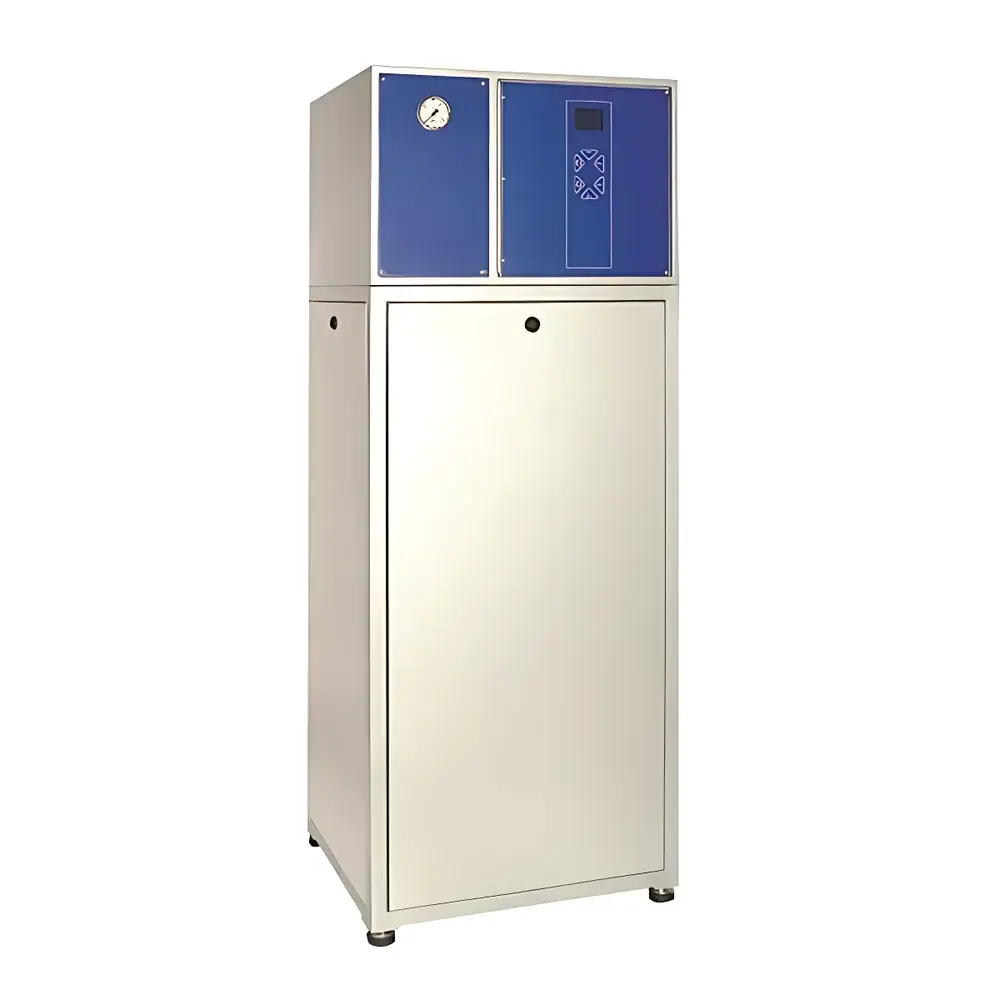
Think-lab Labonova Central RO Reverse Osmosis Pure Water System
| Brand | Think-lab |
|---|---|
| Origin | Germany |
| Model | Labonova Central RO |
| Purification Technology | Single-stage reverse osmosis (RO) |
| Feed Water Conductivity Range | Up to 1,000 µS/cm |
| Product Water Conductivity | <20 µS/cm (at 25 °C, dependent on feed water quality) |
| Salt Rejection Rate | ≥98% |
| Interface | RS232 serial communication port |
| System Architecture | Centralized, modular, closed-loop distribution-capable |
| Compliance | Designed for ISO 3696 Grade 3 and ASTM D1193 Type IV water production |
| Configuration | Customizable with external storage tanks, booster pumps, and recirculation loops |
Overview
The Think-lab Labonova Central RO is a centralized, single-stage reverse osmosis (RO) pure water system engineered for reliable, high-volume production of laboratory-grade purified water. It operates on the principle of cross-flow membrane filtration, where feed water under controlled hydraulic pressure passes through a semi-permeable polyamide thin-film composite (TFC) membrane. Dissolved ions, colloids, organic molecules (>100 Da), bacteria, and particulates are retained by the membrane, while purified permeate—meeting ISO 3696 Grade 3 and ASTM D1193 Type IV specifications—is collected for downstream use. Unlike distillation or deionization-only systems, the Labonova Central RO delivers consistent performance across variable municipal feed water conditions, with typical conductivity reduction from ≤1,000 µS/cm to <20 µS/cm at 25 °C. Its design prioritizes operational stability, energy efficiency, and integration readiness within multi-point distribution networks in research laboratories, clinical diagnostics facilities, pharmaceutical QC labs, and industrial R&D environments.
Key Features
- High-rejection TFC RO membrane with ≥98% salt rejection rate, validated per ASTM D4194 and ISO 9001 manufacturing standards
- Intelligent control unit with real-time monitoring of feed pressure, permeate conductivity, flow rate, and membrane differential pressure
- Modular architecture supporting scalable integration: compatible with stainless steel or PE storage tanks (50–2,000 L), variable-speed booster pumps, and UV sterilization modules (254 nm)
- Compact footprint optimized for mechanical room or basement installation; designed for vertical or horizontal piping layouts
- RS232 serial interface enabling direct connection to building management systems (BMS) or lab information systems (LIS) for audit-ready data logging
- Automated membrane flush cycle and programmable shutdown sequences to extend membrane service life and minimize fouling risk
Sample Compatibility & Compliance
The Labonova Central RO produces water suitable for non-critical laboratory applications requiring low ionic content and microbial control. Output water meets ISO 3696:2017 Grade 3 (conductivity ≤20 µS/cm at 25 °C, total oxidizable carbon ≤0.4 mg/L, bacteria ≤10² CFU/mL) and ASTM D1193-20 Type IV specifications. It serves as pre-treatment feed for downstream ultra-pure water systems (e.g., EDI or mixed-bed polishing units), rinse water for glassware washing, feed source for autoclaves and HVAC humidifiers, and diluent for reagent preparation in environmental testing and food safety analysis. The system complies with EU Machinery Directive 2006/42/EC and carries CE marking. While not certified to USP or EP 2.2.44, its architecture supports optional validation packages aligned with GLP and GMP Annex 15 requirements when integrated with qualified storage and distribution components.
Software & Data Management
The embedded controller records timestamped operational parameters—including feed and permeate conductivity, inlet pressure, cumulative volume, and alarm events—into non-volatile memory. Data export via RS232 enables periodic transfer to CSV-compatible databases or LIMS platforms. Though no proprietary software is bundled, the ASCII-based protocol supports integration with third-party SCADA systems using standard Modbus RTU mapping (available upon request). All system logs retain traceability for internal quality audits, and configurable event thresholds trigger visual and relay-based alerts for maintenance scheduling. No cloud connectivity or remote firmware updates are implemented, preserving network security and regulatory compliance in controlled environments.
Applications
- Centralized feed water supply for multiple benchtop ultra-pure water systems in academic core facilities
- Routine rinsing and cleaning of volumetric glassware, pipettes, and analytical instrumentation housings
- Feed source for steam generators in hospital sterilization departments and cleanroom humidification systems
- Preparation of buffers, standards, and mobile phases in HPLC, GC, and ICP-MS sample workflows (where Grade 3 water is specified)
- Supporting environmental testing protocols requiring low-conductivity rinse water per EPA Method 1664 and ISO 11885
- Industrial process water for electronics component cleaning and photovoltaic cell manufacturing pre-rinse stages
FAQ
What feed water quality is required for optimal Labonova Central RO performance?
The system is rated for municipal tap water with total dissolved solids (TDS) ≤600 ppm and free chlorine ≤0.5 mg/L. Pre-filtration (5 µm sediment + activated carbon) is mandatory to protect the RO membrane.
Can the Labonova Central RO be connected to an existing building loop?
Yes—it supports closed-loop recirculation configurations with optional circulation pump, sanitary fittings, and temperature-controlled piping per ASME BPE guidelines.
Is validation documentation available for GxP environments?
IQ/OQ templates and calibration certificates for integrated sensors are provided; PQ execution requires site-specific challenge testing with certified reference standards.
What is the expected membrane lifetime under typical lab usage?
With proper pretreatment and quarterly maintenance, the RO membrane maintains ≥95% rejection efficiency for 24–36 months, depending on feed water hardness and organic load.
Does the system meet FDA 21 CFR Part 11 requirements?
The base configuration does not include electronic signature or audit trail functionality; however, it can be interfaced with validated LIMS platforms that provide Part 11-compliant data handling.



