
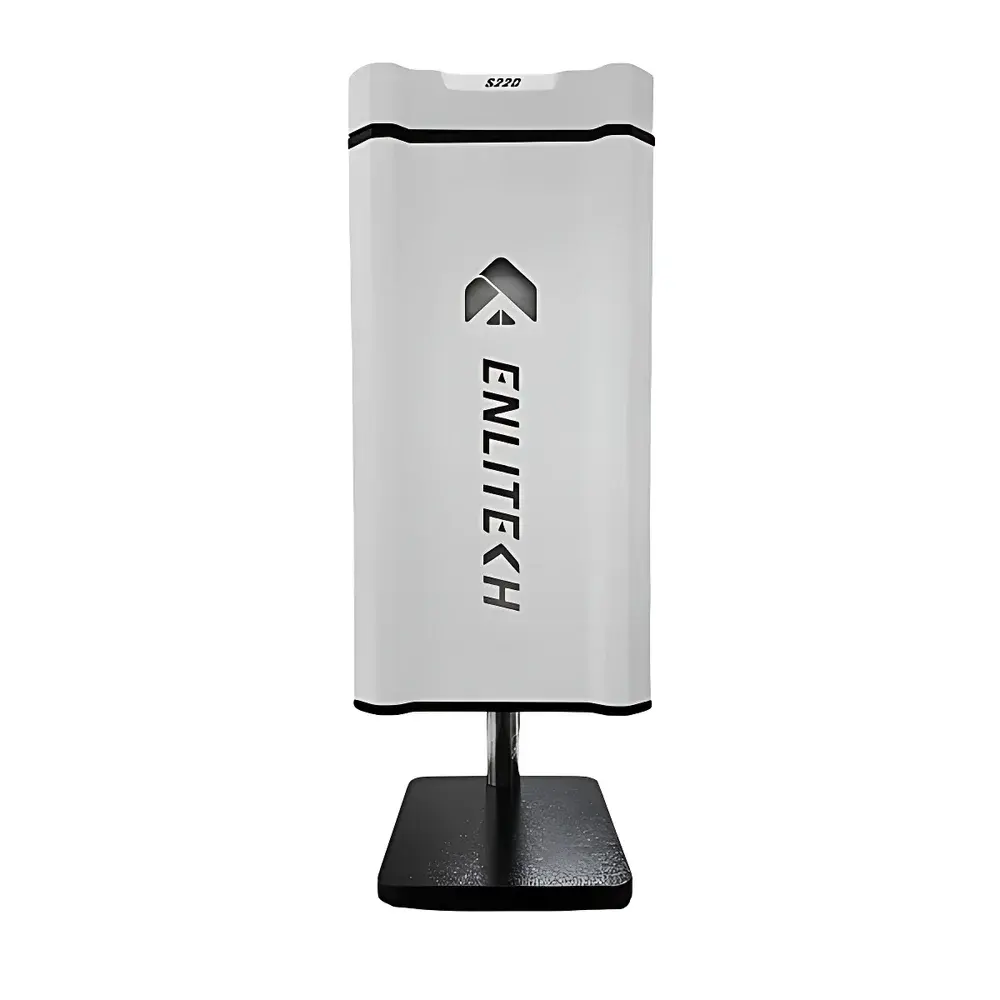
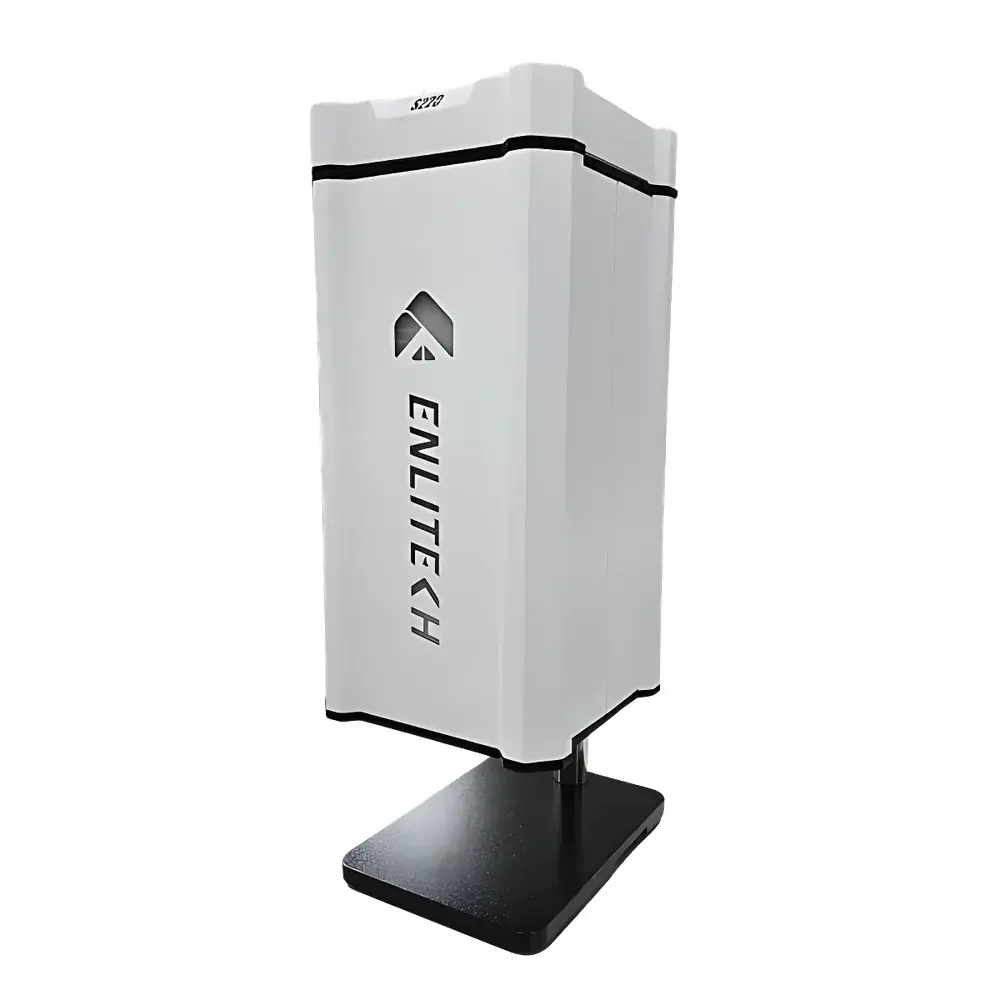
Enlitech SS-LED220 A++-Grade Large-Area LED Solar Simulator
| Brand | Enlitech |
|---|---|
| Origin | Taiwan |
| Model | SS-LED220 |
| Light Source Type | High-Stability Broad-Spectrum LED Array |
| Illumination Mode | External Illumination |
| Spectral Match (AM1.5G) | <6.25% (IEC Class A++) |
| Temporal Stability | <0.5% (IEC Class A++) |
| Irradiance Uniformity | <2% (IEC Class A) |
| Standard Compliance | IEC 60904-9, ASTM E927, JIS C8912 |
| Beam Area | 220 mm × 220 mm |
| Spectral Tunability | Customizable AM0 / AM1.5G and user-defined spectra |
| Intensity Control Range | 0–100% continuous, spectrum-invariant |
| Intensity Resolution | 1% step |
| Shutter | Programmable automated shutter with dark-current synchronization |
| LED Lifetime | >10,000 hours (L70) |
| Output Orientation | Up / Down / Left / Right (non-downward requires optional beam-direction adapter kit) |
Overview
The Enlitech SS-LED220 is an A++-grade large-area LED solar simulator engineered for high-fidelity photovoltaic (PV) device characterization under standardized and research-grade illumination conditions. Unlike conventional arc-lamp-based simulators, the SS-LED220 employs a precisely engineered array of spectrally stabilized LEDs to replicate the AM1.5G (1000 W/m²) and AM0 (1366 W/m²) reference solar spectra—without spectral drift across its full 0–100% irradiance range. Its core operational principle relies on digitally synchronized, current-controlled LED channels with narrowband phosphor-converted emitters and calibrated optical filtering, enabling true spectrum-invariant intensity modulation. This architecture eliminates the fundamental trade-off between irradiance control and spectral fidelity inherent in xenon or metal-halide systems. As a result, the SS-LED220 delivers metrologically traceable illumination compliant with IEC 60904-9 Edition 3 (2020) and ASTM E927-22 for spectral match, temporal stability, and spatial uniformity—making it suitable for GLP-compliant PV testing labs, NREL-accredited calibration facilities, and academic research groups developing next-generation optoelectronic materials.
Key Features
- A++-class spectral match (<6.25% deviation from AM1.5G reference) and temporal stability (<0.5% RMS variation over 30 minutes), certified per IEC 60904-9 Annex D and ASTM E927 Section 6.
- Large 220 mm × 220 mm uniform irradiance field (Class A uniformity, <2% spatial non-uniformity), enabling simultaneous testing of multi-cell modules, tandem stacks, or parallel small-area devices.
- Spectrum-invariant intensity control: continuous 0–100% irradiance adjustment with ≤1% resolution while maintaining fixed spectral power distribution—critical for light-intensity-dependent parameter extraction (e.g., Jsc linearity, recombination analysis).
- Programmable automated shutter integrated with dark-current acquisition logic, supporting automatic zero-bias dark I–V sweeps synchronized to illumination onset/offset.
- Four-axis beam orientation capability (up/down/left/right); downward illumination is standard; lateral or upward configurations require the optional SS-LED220 Beam Direction Adapter Kit.
- LED-based architecture ensures >10,000 hours of L70-rated operational lifetime, eliminating lamp replacement cycles, thermal stabilization delays, and spectral aging effects associated with plasma sources.
Sample Compatibility & Compliance
The SS-LED220 is validated for quantitative performance evaluation of photovoltaic devices exhibiting high sensitivity to spectral and temporal artifacts—including perovskite solar cells (PSCs), organic photovoltaics (OPVs), perovskite/silicon tandem cells, heterojunction (HJT), TOPCon, and PERC silicon devices. Its A++-level stability mitigates measurement hysteresis and scan-rate dependency commonly observed in ion-migration-prone absorbers. The system meets full compliance with IEC 60904-9:2020 (Class AAA requirements), ASTM E927-22 (Standard Specification for Solar Simulation for Photovoltaic Testing), and JIS C8912:2017. For regulatory submissions and interlaboratory round-robin studies, annual recalibration using an ISO/IEC 17025-accredited reference cell (e.g., KG5 or KG6) is recommended—Enlitech operates an in-house quantum efficiency calibration laboratory accredited to ISO/IEC 17025 for this purpose.
Software & Data Management
The SS-LED220 operates natively with Enlitech’s IVS-KA6000 control and analysis platform—a Windows-based software suite designed specifically for advanced PV metrology. IVS-KA6000 implements NREL-recommended asymptotic I–V acquisition protocols, bidirectional sweep correction, multi-channel sequential testing, and real-time light-intensity ramping with programmable dwell times. It supports full IEC 61215-compliant reporting templates, including Voc, Isc, FF, Pmax, η, Rs, Rsh, ideality factor (n), reverse saturation current density (J₀), temperature coefficient derivation (α, β), and fill-factor loss decomposition. KA Viewer provides post-acquisition visualization, batch statistical analysis, and export to CSV, MATLAB (.mat), or HDF5 formats. Both applications enforce audit-trail logging per FDA 21 CFR Part 11 requirements when configured with electronic signature modules.
Applications
- Stability-critical efficiency mapping of perovskite and organic solar cells under controlled illumination history.
- Multi-junction device characterization requiring precise spectral weighting (e.g., AM0 for space PV, AM1.5G for terrestrial).
- Light-intensity-dependent recombination analysis via Sun-Voc, Sun-Jsc, and ideality factor extraction.
- Accelerated aging studies with programmable irradiance cycling and thermal coupling.
- Calibration transfer between reference cells and test devices in primary standards laboratories.
- Development of spectral-response-matched filters and luminescent down-shifting layers.
FAQ
What international standards does the SS-LED220 comply with?
The SS-LED220 meets IEC 60904-9:2020 (Class A++ for spectral match and temporal stability; Class A for uniformity), ASTM E927-22, and JIS C8912:2017.
Is the spectral output truly invariant during intensity modulation?
Yes—the LED driver architecture maintains constant relative channel currents across the full 0–100% range, preserving spectral shape within ±0.2% normalized spectral deviation (verified by onboard spectroradiometer traceable to NIST SRM 2020).
Can the SS-LED220 simulate non-standard spectra such as AM0 or custom bandgap-matched profiles?
Yes—via IVS-KA6000’s spectral editor, users can define arbitrary spectral power distributions and calibrate corresponding LED channel weights using a calibrated spectroradiometer.
What is the recommended calibration interval and method?
Annual recalibration using an ISO/IEC 17025-accredited reference cell is advised; Enlitech provides on-site or return-to-factory calibration services with full uncertainty budget documentation.
Does the system support automated dark-current subtraction during I–V measurement?
Yes—the integrated programmable shutter triggers synchronized dark sweeps immediately before and after illumination, enabling robust series/shunt resistance deconvolution without manual intervention.




