
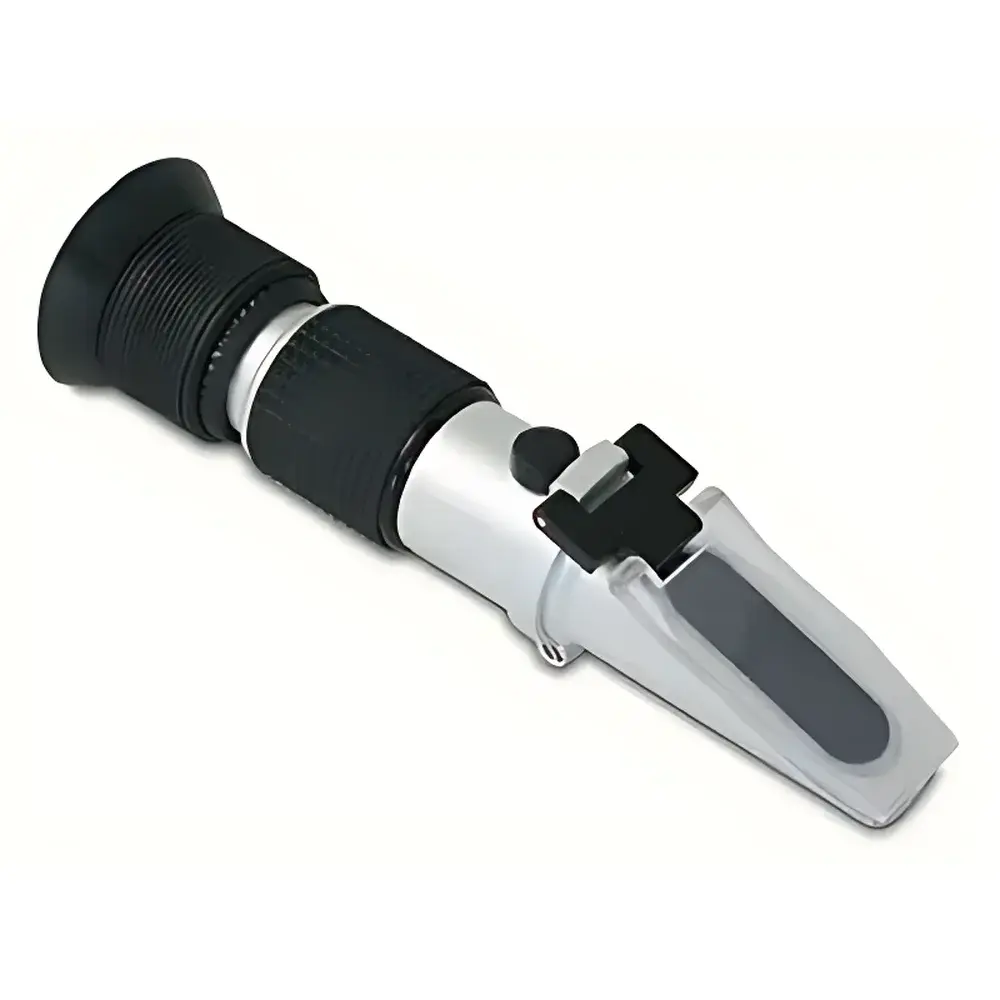
Bellingham + Stanley E-Line Series Portable Refractometer
| Brand | Bellingham + Stanley |
|---|---|
| Country of Origin | United Kingdom |
| Model | E-Line |
| Compliance | BS EN ISO 9001, UKAS Accredited, CE Marked |
| Optical Principle | Critical Angle Refraction (Abbe-type) |
| Temperature Compensation | Automatic Temperature Compensation (ATC) |
| Construction | All-metal body with thermal-insulating rubber grip |
| Ergonomics | Optimized hand-held geometry for single-handed operation |
| Scale Resolution | 0.1–0.5 °Brix depending on model |
| Measurement Range | 0–90 °Brix (multi-range variants available) |
| Prism Type | High-grade optical glass with spring-loaded flip cover |
Overview
The Bellingham + Stanley E-Line Series Portable Refractometer is a precision optical instrument engineered for rapid, field-deployable refractive index measurement in liquid samples. Based on the Abbe principle of critical angle refraction, the E-Line delivers reliable °Brix readings across a broad range of concentrations — from low-sugar beverages to high-concentration industrial syrups and brines. Designed and manufactured in the United Kingdom by one of the world’s oldest dedicated refractometry specialists (established 1920), each unit undergoes rigorous calibration against NIST-traceable standards and conforms to BS EN ISO 9001 quality management requirements. Its robust all-metal housing, integrated ATC mechanism (typically ±0.3 °C compensation accuracy), and ergonomic thermal-insulated grip ensure consistent performance under variable ambient conditions — whether in agricultural field testing, food processing line checks, or HVAC coolant verification.
Key Features
- All-metal construction with corrosion-resistant anodized aluminum chassis and hardened optical prism assembly
- Thermally insulated rubber overmold grip minimizes heat transfer from operator’s hand, reducing measurement drift during extended use
- Spring-assisted prism flip cover ensures repeatable sample contact pressure and protects optical surfaces during transport
- High-contrast engraved scale with anti-glare matte finish enables accurate visual interpolation under natural or artificial lighting
- Automatic Temperature Compensation (ATC) built into the prism block using bimetallic expansion elements — no external power or software required
- Field-serviceable design: prism cleaning, recalibration, and battery replacement (if equipped with LED illumination) can be performed without specialized tools
Sample Compatibility & Compliance
The E-Line series accommodates aqueous solutions, sugar-based liquids (e.g., fruit juices, soft drinks, honey), glycol-water mixtures, saline solutions, and certain organic solvents — provided they do not etch optical glass or leave persistent residue. Samples must be free of suspended solids and air bubbles; filtration or centrifugation is recommended prior to analysis. Each model is supplied with a UKAS-accredited calibration certificate traceable to the National Physical Laboratory (NPL). The instruments comply with BS EN ISO 9001:2015 for manufacturing quality assurance and carry full CE marking per EU Directive 2014/30/EU (EMC) and 2014/35/EU (LVD). While not intended for regulated GMP environments requiring electronic audit trails, the mechanical design supports GLP-aligned manual recordkeeping protocols.
Software & Data Management
As a fully analog, optical-mechanical instrument, the E-Line requires no firmware, drivers, or proprietary software. Readings are interpreted visually via the calibrated scale — eliminating cybersecurity vulnerabilities, software obsolescence, and validation overhead associated with digital interfaces. For laboratories maintaining electronic lab notebooks (ELNs), users may log observed values alongside environmental notes (e.g., ambient temperature, sample ID, operator initials) using standard LIMS-compatible templates. Optional accessories include a certified reference standard set (0–80 °Brix, ±0.02 °Brix uncertainty) for daily verification and a portable LED illuminator (model EL-LED) for low-light conditions — both compatible across the entire E-Line range.
Applications
- Agriculture & Horticulture: Field assessment of fruit ripeness, sap concentration in maple syrup production, and irrigation solution salinity
- Food & Beverage QA/QC: Incoming raw material screening (e.g., fruit concentrate, corn syrup), in-process blending verification, and final product consistency checks
- Automotive & Industrial Fluids: Glycol concentration monitoring in engine coolants and heat transfer fluids per ASTM D1120 and ISO 2987
- Pharmaceutical Excipients: Semi-quantitative verification of sucrose or dextrose solutions used in oral suspensions and syrups (USP compliant when used within validated ranges)
- Education & Training: Demonstrating fundamental optical principles including Snell’s law, dispersion, and temperature-dependent refractive index behavior
FAQ
What does “ATC” mean in the E-Line model designation?
ATC stands for Automatic Temperature Compensation. The E-Line incorporates a bimetallic compensation system embedded in the prism block that adjusts the optical path length in real time to offset refractive index changes caused by sample temperature deviation from 20 °C.
Can the E-Line measure non-aqueous samples such as ethanol or acetone?
Yes — but only if the refractive index falls within the calibrated scale range and the solvent does not attack optical glass. Pure ethanol (nD ≈ 1.361) is measurable on select models; however, prolonged exposure to aggressive solvents may degrade prism coatings. Consult B+S Technical Bulletin TB-REF-04 for solvent compatibility guidance.
Is recalibration possible in the field?
Yes. Using distilled water (0 °Brix) and a certified sucrose standard, users can verify and adjust zero and span points via the rear calibration screw — procedure detailed in Instruction Manual IM-Eline-Rev7.
Does the E-Line meet FDA 21 CFR Part 11 requirements?
No — as a purely analog instrument with no electronic data capture, it falls outside the scope of Part 11. However, its mechanical traceability, UKAS-certified calibration, and documented user procedures support ALCOA+ data integrity principles in hybrid paper-electronic workflows.




