
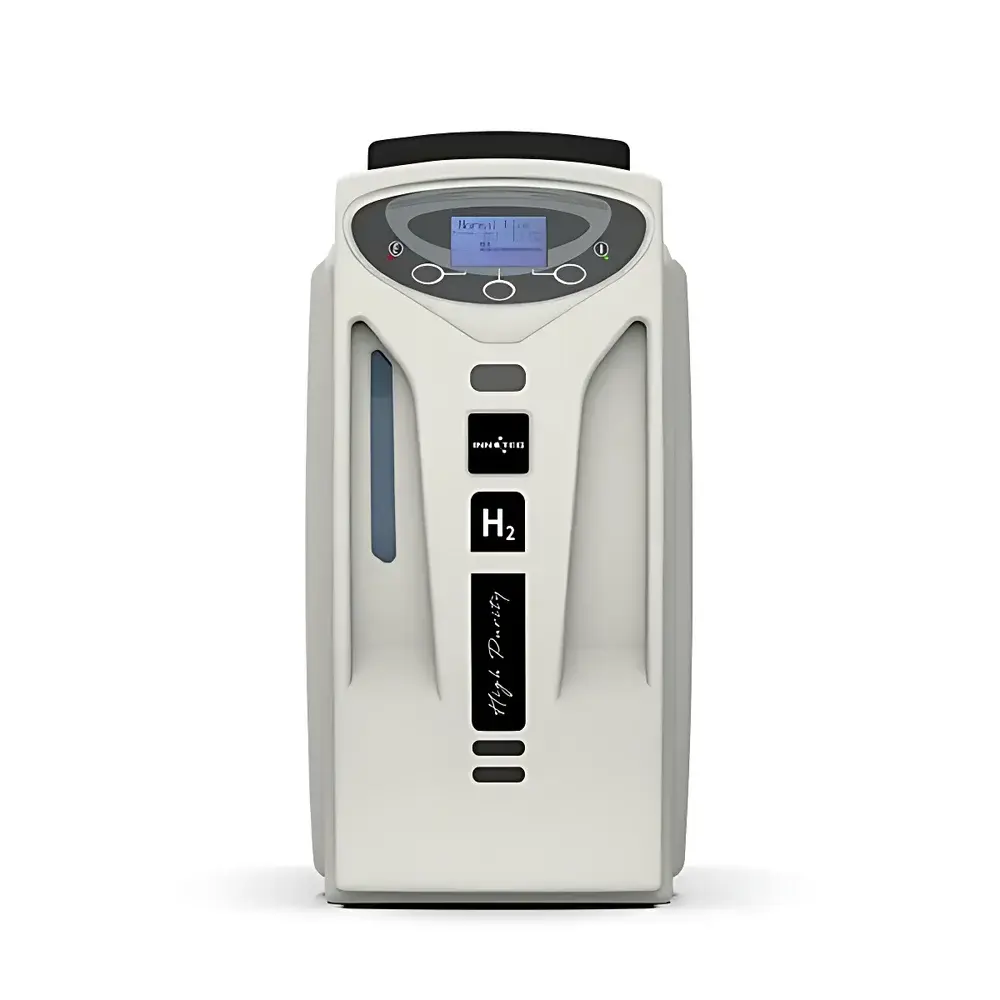
INNOTEG HP-HG250 High-Purity Hydrogen Generator
| Brand | INNOTEG |
|---|---|
| Origin | Italy |
| Model | HP-HG250 |
| Hydrogen Generation Principle | PEM Electrolysis of Deionized Water |
| Output Flow Rate | 250 mL/min |
| Output Pressure | 11 bar |
| Hydrogen Purity | >99.9996% |
| Power Consumption | 200 W |
| Certifications | CE, FCC, MET (UL/CSA) |
| Continuous Operation | 24/7, 365 days/year |
| Safety Features | Dual Internal/External H₂ Leak Detection with Auto-Shutdown, Liquid Level Monitoring, Conductivity-Based Water Quality Monitoring |
| Optional Functions | Automatic Refill, Cascade Operation |
Overview
The INNOTEG HP-HG250 High-Purity Hydrogen Generator is an engineered solution for laboratories requiring a continuous, on-demand supply of ultra-high-purity hydrogen gas (>99.9996%) without reliance on high-pressure cylinders. It employs proton exchange membrane (PEM) electrolysis technology—electrolyzing deionized water to generate hydrogen and oxygen in a fully separated, catalytic reaction chamber. Unlike alkaline electrolyzers, the PEM architecture eliminates caustic electrolytes, enables rapid response to flow demand changes, and ensures intrinsic gas purity by preventing crossover contamination. Designed for integration into analytical systems—including gas chromatography (GC), hydrogenation reactors, fuel cell test stations, and residual gas analyzers—the HP-HG250 delivers stable 250 mL/min output at up to 11 bar backpressure, meeting stringent requirements for trace-level analysis and process-critical applications.
Key Features
- Proton exchange membrane stack with platinum and platinum-iridium alloy catalysts on both anode and cathode sides, ensuring high electrochemical efficiency and long-term stability under continuous operation.
- Titanium-coated electrolytic cell housing—resistant to oxidation and corrosion in humid, high-potential environments—extends service life beyond 10,000 operational hours.
- Real-time monitoring via high-resolution LCD interface displaying instantaneous flow rate, system pressure, water level, and feedwater conductivity.
- Dual-stage hydrogen leak detection: internal sensor network monitors membrane integrity and gas path integrity; external sensors detect ambient H₂ concentration exceeding 10 ppm, triggering audible/visual alarms and immediate shutdown per IEC 61508 SIL-2 functional safety guidelines.
- Integrated water quality management: inline conductivity sensor continuously verifies deionized water resistivity (>15 MΩ·cm), halting production if conductivity exceeds 0.1 µS/cm—ensuring compliance with ASTM D1193 Type I water specifications.
- Zero consumables design: no desiccants, filters, or catalyst replacements required during normal operation; maintenance limited to periodic visual inspection and annual calibration verification.
Sample Compatibility & Compliance
The HP-HG250 is compatible with all laboratory-grade deionized water sources meeting ISO 3696 Grade 1 or ASTM D1193 Type I specifications. Its output gas meets or exceeds purity requirements for GC carrier gas (per ASTM D6299 and ISO 10156), hydrogenation catalysis (USP ), and semiconductor process gas standards (SEMI F57). The unit complies with CE marking directives (2014/30/EU EMC, 2014/35/EU LVD), FCC Part 15 Class B emissions limits, and MET-accredited safety standards aligned with UL 61010-1 and CSA C22.2 No. 61010-1 for laboratory equipment. Full audit trails, user-access logs, and configurable password protection support GLP/GMP workflows and FDA 21 CFR Part 11 readiness when paired with optional remote control firmware.
Software & Data Management
The HP-HG250 supports RS-232 and optional Ethernet connectivity for integration into centralized lab infrastructure. Firmware includes embedded event logging (start/stop cycles, alarm triggers, parameter deviations) with timestamped records exportable via USB or network transfer. Remote control capability allows for start/stop command issuance, setpoint adjustment, and diagnostic status retrieval through secure HTTP API or SCADA-compatible Modbus TCP protocol. All configuration changes are logged with operator ID and timestamp—enabling full traceability for regulatory audits. Optional cascade mode permits synchronized operation of multiple units to scale output while maintaining identical pressure and purity profiles across parallel systems.
Applications
- Gas Chromatography: As carrier and detector fuel gas for FID, TCD, and HID systems—eliminating baseline drift associated with cylinder batch variability.
- Pharmaceutical Development: Supporting catalytic hydrogenation reactions under controlled stoichiometry and inert atmosphere generation for lyophilization chambers.
- Environmental Testing: Providing calibrated H₂ source for calibrating electrochemical sensors and zero-gas generation in air quality monitoring networks.
- Petrochemical QA/QC: Enabling sulfur chemiluminescence detection (SCD) and thermal conductivity analysis of hydrocarbon streams.
- Fuel Cell R&D: Delivering consistent, moisture-controlled hydrogen for membrane electrode assembly (MEA) testing and durability validation under dynamic load cycling.
FAQ
What water quality is required for optimal performance?
Deionized water with resistivity ≥15 MΩ·cm (conductivity ≤0.067 µS/cm) and total organic carbon (TOC) <10 ppb is mandatory. Tap or distilled water will cause irreversible membrane fouling.
Can the HP-HG250 operate unattended for extended periods?
Yes—it is rated for uninterrupted 24/7 operation with automated safety interlocks, including low-water shutoff, over-pressure relief, and thermal runaway prevention.
Is remote monitoring supported out-of-the-box?
The base model includes RS-232; Ethernet and Modbus TCP require optional firmware activation and hardware module installation.
Does the unit meet regulatory requirements for GxP environments?
With enabled audit trail logging, user authentication, and electronic signature support (via optional software package), it satisfies core elements of FDA 21 CFR Part 11 and EU Annex 11 for computerized system validation.
How often does the PEM stack require replacement?
Under proper water quality and operating conditions, the stack maintains ≥95% initial efficiency after 10,000 hours—equivalent to >3 years of continuous use. Replacement is only necessary upon diagnostic confirmation of irreversible performance decay.



