
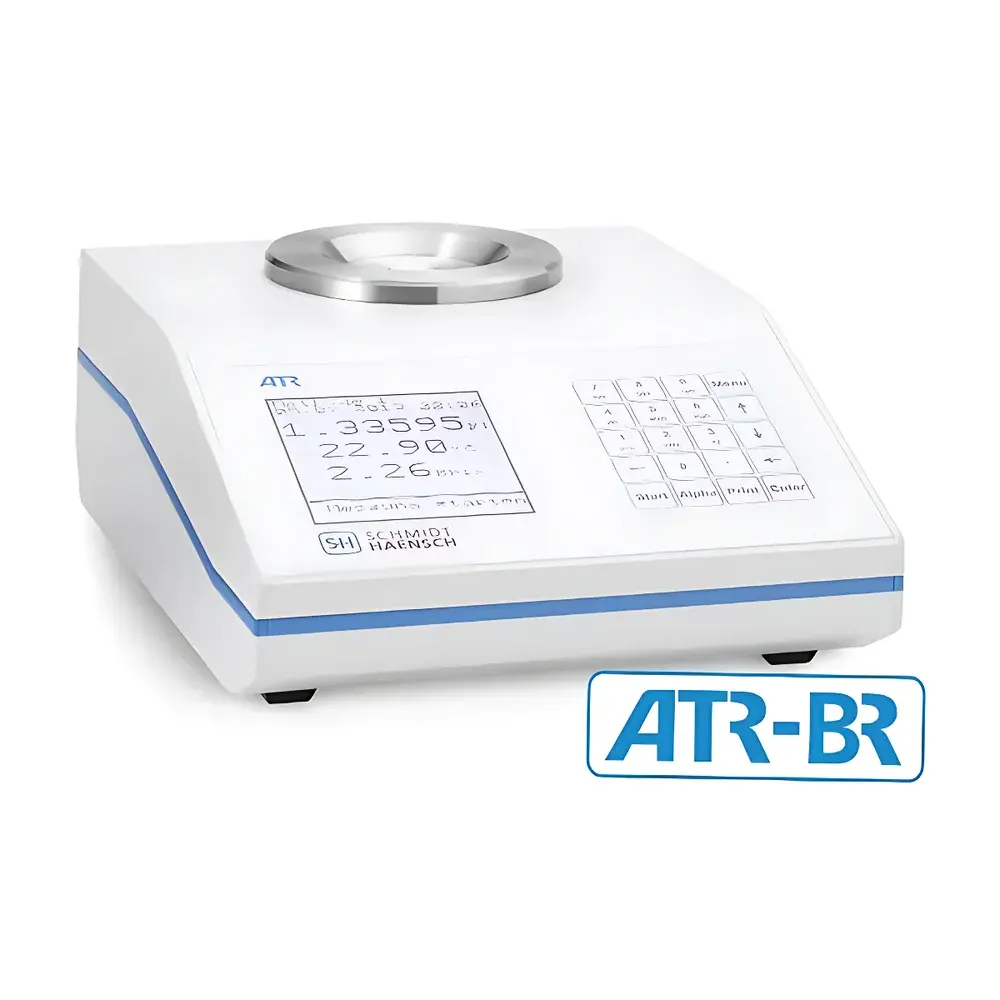
Schmidt + Haensch ATR-BR Automatic Digital Refractometer
| Brand | Schmidt + Haensch (S+H) |
|---|---|
| Origin | Germany |
| Model | ATR-BR |
| Product Type | In-line / Laboratory Refractometer |
| Temperature Control | Integrated Peltier-free prism temperature sensing |
| Digital Display | Backlit LCD (16×16 characters) |
| Measurement Range | 1.32000–1.54000 RI / 0–100 %Brix |
| Resolution | 0.00001 RI / 0.01 %Brix |
| Accuracy | ±0.00002 RI / ±0.01 %Brix (1.32–1.44), ±0.00003 RI / ±0.01 %Brix (1.44–1.54) |
| Repeatability | 0.00001 RI / 0.01 %Brix |
| Temperature Sensing | NTC sensor embedded in sapphire prism, accuracy ±0.03 °C, repeatability ±0.02 °C |
| Sample Volume | 0.3 mL |
| Prism Material | Sapphire |
| Light Source | LED with integrated interference filter, λ = 589 nm |
| Interfaces | RS-232C (bidirectional), Centronics parallel port, USB (optional) |
| Compliance | ASTM D1218, DIN 51757, ISO 21542, USP <781>, ICUMSA Method GS2/3-13, AOAC 932.12, FDA 21 CFR Part 11 (with optional audit trail software) |
Overview
The Schmidt + Haensch ATR-BR Automatic Digital Refractometer is a high-precision, critical-angle-based instrument engineered for laboratory and process-integrated refractive index (RI) and Brix measurements across demanding industrial and regulatory environments. Unlike traditional Abbe-type refractometers, the ATR-BR employs total internal reflection (ATR) at a sapphire prism interface—enabling accurate, contact-based measurement independent of sample turbidity, color, or optical clarity. Its solid-state optical architecture eliminates moving parts and calibration drift associated with mechanical prisms or manual focusing. The device operates on the principle that the critical angle of total internal reflection varies predictably with the refractive index of the adjacent medium; this relationship is converted into digital RI and concentration values using factory-traceable algorithms calibrated against NIST-certified sucrose standards. Designed for continuous operation in QC labs, pilot plants, and GMP-compliant production lines, the ATR-BR delivers metrological stability under ambient conditions (10–40 °C), with real-time temperature compensation referenced to the prism surface—not ambient air—ensuring thermodynamic fidelity in volatile or viscous samples.
Key Features
- Sapphire prism construction: Chemically inert, scratch-resistant, and compatible with aggressive solvents, acids, alkalis, and high-viscosity media (e.g., syrups, resins, emulsions).
- Minimal sample requirement: Only 0.3 mL required per measurement—ideal for precious, hazardous, or low-yield samples.
- Integrated high-resolution temperature sensing: Precision NTC sensor embedded directly into the prism body provides real-time thermal feedback with ±0.03 °C accuracy and ±0.02 °C repeatability—critical for temperature-sensitive applications such as pharmaceutical excipient analysis or fermentation monitoring.
- Multi-parameter output: Simultaneous display of RI, %Brix, %w/w, g/mL, g/L, and moisture content (user-configurable via 10 programmable scales, including preloaded Brix calibration).
- Dual-interface connectivity: Standard RS-232C and Centronics parallel port support direct integration with LIMS, SCADA, or PLC systems; USB adapter available for modern PC compatibility.
- Robust human-machine interface: Splash-proof keypad with 20 dedicated function keys and backlit 16×16 character LCD—designed for gloved operation in cleanrooms or production floors.
- No active temperature control: Eliminates thermal lag and condensation risks inherent in Peltier-cooled units—optimized for rapid turnaround in batch release testing.
Sample Compatibility & Compliance
The ATR-BR accommodates a broad physicochemical spectrum—from low-viscosity solvents (e.g., ethanol, acetone) to highly viscous materials (e.g., honey, molasses, polymer melts) without dilution or filtration. Its sapphire/PTFE sample chamber resists corrosion from halogenated compounds, strong acids (e.g., HNO₃, H₂SO₄), and caustic solutions (e.g., NaOH up to 40%). The instrument meets essential regulatory requirements for method validation and data integrity: it supports ASTM D1218 (petroleum products), DIN 51757 (lubricants), ISO 21542 (food and beverages), USP (pharmaceuticals), and ICUMSA GS2/3-13 (sugar industry). When paired with optional audit-trail-enabled software, the system complies with FDA 21 CFR Part 11 for electronic records and signatures—enabling full traceability of operator actions, measurement history, and calibration events in GLP/GMP audits.
Software & Data Management
Embedded firmware enables statistical processing—including mean calculation, standard deviation, and pass/fail threshold evaluation—directly on-device. Up to four user-defined measurement protocols (e.g., “Fermentation Broth”, “Pharma Excipient”, “Beverage QC”) can be stored with unique temperature compensation curves and unit mappings. All results—including timestamp, operator ID (manually entered), batch number, and environmental conditions—are exportable via serial link in ASCII format for seamless ingestion into Excel, LabWare LIMS, or custom MES platforms. Optional Windows-based remote control software permits full instrument configuration, real-time data streaming, and automated report generation (PDF/CSV) with customizable headers and footers—eliminating transcription errors in regulated documentation workflows.
Applications
- Pharmaceuticals: Quantification of active pharmaceutical ingredients (APIs) in liquid formulations, excipient concentration verification (e.g., glycerol, propylene glycol), and osmolality estimation in parenteral solutions.
- Food & Beverage: Real-time Brix monitoring in juice concentration, syrup blending, dairy product standardization (milk solids non-fat), and fermentation endpoint detection (beer, wine, kombucha).
- Chemicals & Petrochemicals: Solvent purity assessment (e.g., IPA, THF), hydrocarbon blend verification (gasoline, biodiesel), and polymer solution concentration (e.g., PVC in cyclohexanone).
- Cosmetics & Fragrances: Essential oil dilution control, surfactant concentration in emulsions, and alcohol content verification in toners and sprays.
- Clinical Diagnostics: Serum protein estimation (via RI correlation), urine specific gravity screening, and quality control of reagent kits.
FAQ
Does the ATR-BR require solvent rinsing between measurements?
No—its sapphire prism and PTFE sample chamber resist residue buildup; a single dry wipe with lint-free tissue is typically sufficient for non-viscous samples. For high-sugar or polymer-laden matrices, a brief rinse with ethanol or water followed by air-drying is recommended.
Can the ATR-BR measure opaque or fluorescent samples?
Yes—because it relies on total internal reflection rather than transmission optics, sample opacity, particulate content, or native fluorescence does not affect measurement integrity.
Is temperature calibration traceable to national standards?
Yes—the integrated NTC sensor is factory-calibrated against PT100 reference standards traceable to DKD/DAkkS-accredited laboratories, with full calibration certificate provided upon request.
What is the typical warm-up time before first measurement?
Less than 60 seconds—no pre-heating or stabilization period is required due to the absence of active thermal regulation.
How is compliance with 21 CFR Part 11 achieved?
Through optional validated software that enforces electronic signatures, role-based access control, immutable audit trails, and secure data export—fully documented in the system validation package (IQ/OQ/PQ protocols available).




