
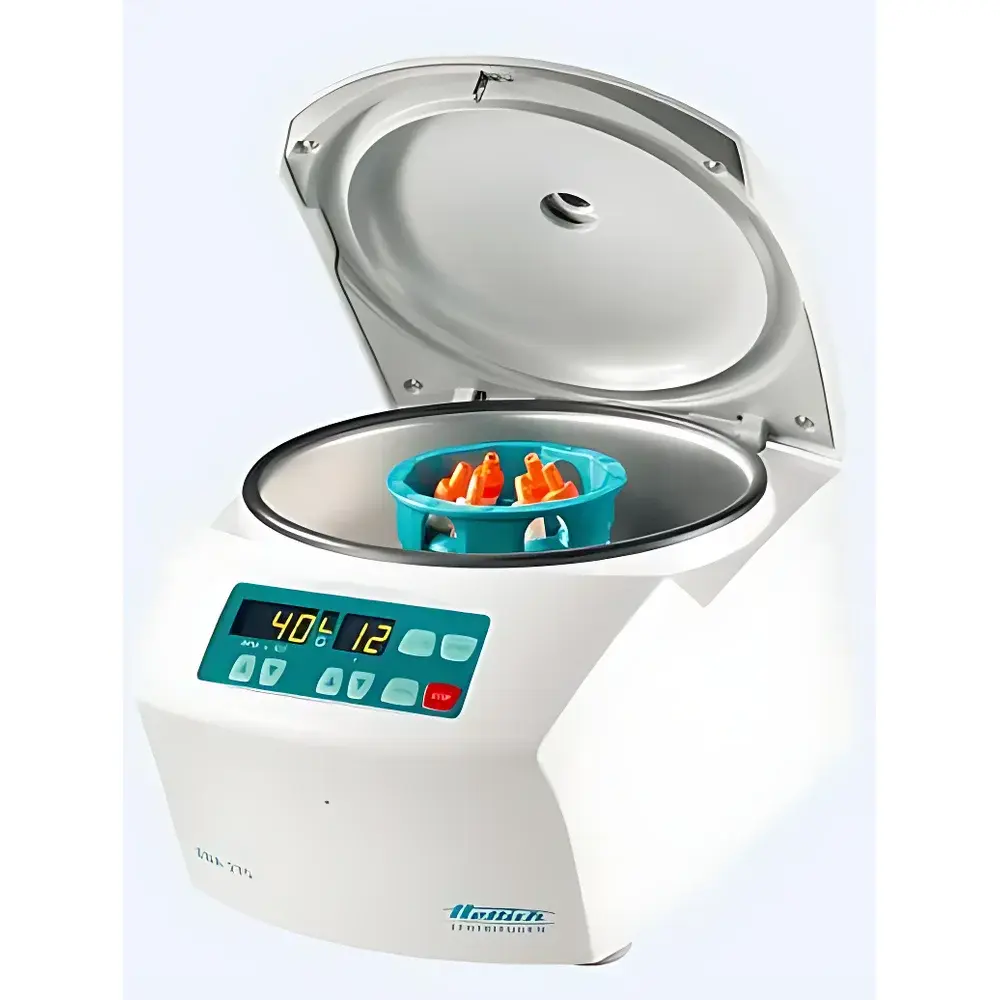
Hettich EBA 270 Benchtop Centrifuge
| Brand | Hettich |
|---|---|
| Origin | Germany |
| Model | EBA 270 |
| Instrument Type | Benchtop Centrifuge |
| Speed Range | 0–4,000 rpm |
| Max RCF | 2,254 × g |
| Max Capacity | 6 × 15 mL |
| Dimensions (H×W×D) | 239 × 326 × 389 mm |
| Weight | 14 kg |
| Power Supply | 200–240 V, 50–60 Hz |
| Power Consumption | 130 VA |
| Electromagnetic Compatibility | EN/IEC 61326-1 Class B |
| Timer Range | 1–99 min, ∞ (continuous), and short-spin mode |
| Safety Certification | Compliant with IEC 61010-1 for laboratory equipment |
Overview
The Hettich EBA 270 is a compact, high-reliability benchtop centrifuge engineered for routine separation tasks in clinical diagnostics, blood banking, quality control laboratories, and academic research settings. Operating on the principle of sedimentation under controlled rotational force, the EBA 270 delivers reproducible separation performance across diverse sample types—including whole blood, serum, plasma, urine sediments, and cell suspensions—without requiring refrigeration or complex rotor interchange systems. Its fixed-angle rotor design ensures rapid pelleting of particles with densities greater than the surrounding medium, leveraging predictable RCF (Relative Centrifugal Force) profiles at speeds up to 4,000 rpm. The unit’s mechanical architecture prioritizes operational safety and long-term stability: a robust brushless motor, precision-balanced rotor assembly, and integrated lid interlock system prevent operation unless the lid is fully closed and locked. Designed and manufactured in Germany, the EBA 270 conforms to stringent European safety standards (IEC 61010-1) and electromagnetic compatibility requirements (EN/IEC 61326-1 Class B), making it suitable for regulated environments where instrument traceability and functional integrity are essential.
Key Features
- Fixed-angle 6-position rotor accommodating standard 15 mL conical tubes—optimized for high-yield pellet formation and minimal sample cross-contamination.
- Intuitive rotary dial interface with LED display for precise time (1–99 min), speed (0–4,000 rpm), and mode selection (continuous, timed, or short-spin).
- Automatic lid lock mechanism that engages during operation and disengages only after full deceleration—ensuring operator safety per ISO 13485-aligned lab workflows.
- Emergency lid release lever accessible from the front panel, enabling manual override in power failure or mechanical stall scenarios.
- Low-noise operation (<55 dB[A]) and vibration-dampened base, facilitating placement on shared benchtops without disrupting adjacent instrumentation.
- Energy-efficient brushless DC motor with thermal protection circuitry, supporting >10,000 hours of service life under typical usage conditions.
Sample Compatibility & Compliance
The EBA 270 is validated for use with polypropylene and polycarbonate 15 mL centrifuge tubes meeting ISO 8536-5 specifications. It supports common anticoagulant-treated blood samples (EDTA, heparin, citrate) and non-viscous biological fluids within defined density and viscosity limits (≤1.2 g/mL, ≤10 mPa·s). While not classified as a Class II medical device under EU MDR, its construction and performance align with CLSI GP45-A4 guidelines for centrifuge validation in clinical laboratories. The unit meets essential requirements of the EU Machinery Directive 2006/42/EC and carries the CE marking for safe deployment in GLP-compliant facilities. Routine maintenance—limited to rotor inspection, cleaning, and periodic calibration verification—is documented in accordance with ISO/IEC 17025 clause 6.4.10.
Software & Data Management
The EBA 270 operates as a standalone instrument without embedded software or digital connectivity. All parameter settings are retained locally via non-volatile memory and do not require firmware updates or network configuration. For laboratories implementing electronic recordkeeping, the device supports manual entry into LIMS or ELN platforms via standardized metadata fields (e.g., timestamp, rpm, duration, operator ID). Though lacking FDA 21 CFR Part 11-compliant audit trails natively, its deterministic mechanical behavior—combined with physical logbook entries—meets minimum documentation thresholds for ISO 15189-accredited clinical labs performing low-risk separations.
Applications
- Routine serum/plasma separation from whole blood in hospital core labs and blood donor centers.
- Pelleting of urinary sediments for microscopic analysis in nephrology and urology diagnostics.
- Clarification of bacterial cultures and yeast suspensions prior to downstream assays (e.g., ELISA, PCR sample prep).
- Preparative isolation of extracellular vesicles and micro-particles in exploratory biomarker studies.
- Quality assurance testing of reagent stability and particulate contamination in pharmaceutical manufacturing support labs.
FAQ
Is the EBA 270 suitable for centrifuging infectious or biohazardous samples?
Yes—when used with sealed, certified biosafety tubes and operated inside a certified biosafety cabinet, provided local institutional biosafety protocols are followed.
Can the rotor be autoclaved?
No—the aluminum rotor is not autoclavable; cleaning is recommended with 70% ethanol or mild detergent and air-drying. Sterilization via dry heat (160°C, 2 h) is permissible per Hettich technical bulletin TB-EBA270-Rotor-02.
Does the EBA 270 support variable acceleration/deceleration rates?
No—it features fixed ramp profiles optimized for tube integrity and reproducible pelleting; no programmable gradient control is available.
What is the expected service interval for preventive maintenance?
Hettich recommends rotor inspection every 12 months or after 500 operating hours, whichever occurs first, with full service advised every 3 years by an authorized technician.
Is replacement rotor certification required after purchase?
Each rotor ships with a factory-issued serial-numbered conformity statement referencing DIN EN ISO 15197 and IEC 61010-2-020; no additional user-side certification is mandated for standard applications.



