
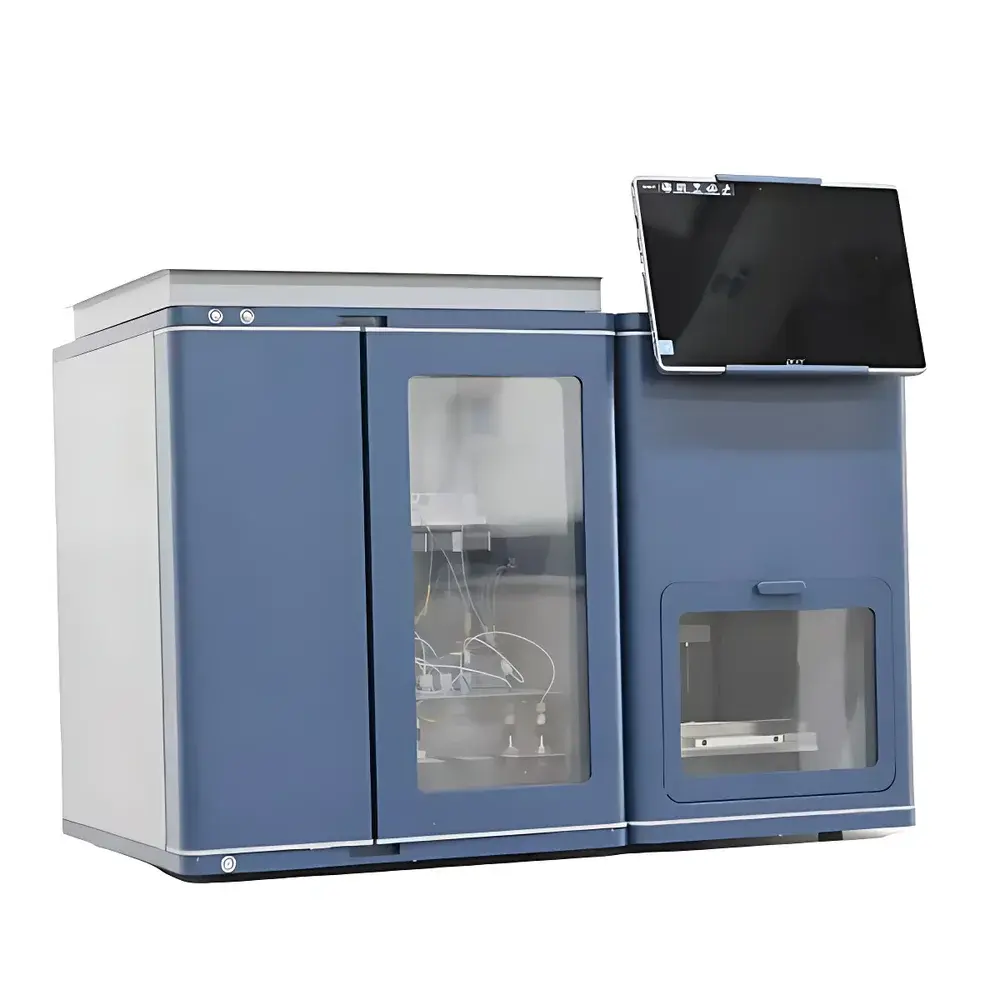
Orienda SARAlyzer Elite Automated Four-Fraction Analyzer for Heavy Oils
| Brand | Orienda |
|---|---|
| Origin | Beijing, China |
| Manufacturer Type | Authorized Distributor |
| Regional Classification | Domestic (China) |
| Model | SARAlyzer Elite |
| Pricing | Available Upon Request |
Overview
The Orienda SARAlyzer Elite is an automated, benchtop four-fraction analyzer engineered specifically for the quantitative separation and characterization of heavy petroleum fractions—namely saturates, aromatics, resins, and asphaltenes (SARA)—using medium-pressure liquid chromatography (MPLC) principles. It implements a standardized, gravity- and pressure-assisted column chromatographic workflow that adheres to the thermodynamic partitioning behavior of hydrocarbon classes in defined solvent systems. Unlike manual or semi-automated SARA methods, the SARAlyzer Elite integrates precise solvent delivery, fraction-specific elution control, real-time flow monitoring, and inert-atmosphere sample handling to ensure analytical reproducibility across diverse heavy feedstocks—including vacuum residues, deasphalted oils, bitumens, and upgraded heavy crudes. Its design aligns with the physical chemistry foundations of ASTM D4124 (Standard Test Method for Separation of Asphalt into Four Fractions), while fully complying with the updated Chinese national standard NB/SH/T 6087–2024, which specifies MPLC-based methodology, column conditioning protocols, and fraction quantification criteria for heavy distillates and residua.
Key Features
- Full automation from sample loading to dry fraction recovery: integrated auto-sampler, inline filtration, programmable gradient elution, fraction-triggered collection, and nitrogen-purged rotary evaporation modules eliminate manual intervention during analysis.
- Parallel processing capability: accommodates up to four samples per batch with synchronized, independent fraction collection—reducing turnaround time to ≤120 minutes per batch without compromising resolution or recovery yield.
- Sealed, ventilated enclosure with active exhaust and solvent vapor condensation: maintains operator safety and lab air quality by preventing fugitive emissions of chlorinated solvents (e.g., n-heptane, toluene, dichloromethane) commonly used in SARA protocols.
- Modular hardware architecture: critical subassemblies—including the MPLC column manifold, solvent reservoir rack, and fraction collector tray—are designed as slide-in drawer units, enabling rapid maintenance and calibration verification without disassembly or specialized tools.
- Gradient elution programming: supports customizable multi-step solvent polarity transitions (e.g., n-heptane → toluene → dichloromethane), facilitating method development for non-standard feedstocks or research-grade fractionation beyond conventional SARA definitions.
- Premounted, pre-equilibrated silica gel columns and disposable polypropylene fraction vials: supplied with certified mass balance validation data, ensuring inter-laboratory comparability and minimizing operator-induced variability in column packing or transfer losses.
Sample Compatibility & Compliance
The SARAlyzer Elite accepts liquid or semi-solid petroleum samples with kinematic viscosity up to 5000 mm²/s at 100 °C (ASTM D445), including vacuum gas oils, atmospheric and vacuum residues, oxidized and polymer-modified bitumens, and synthetic crude fractions. All operational parameters—including column temperature (ambient to 60 °C), eluent flow rate (0.5–5.0 mL/min), and fraction cut thresholds—are configurable to meet the procedural requirements of NB/SH/T 6087–2024, ASTM D4124–2022, NB/SH/T 0509–2010, SY/T 5119–2016, and SY/T 7550–2019. System validation reports include traceable calibration certificates for volumetric dispensing, gravimetric recovery checks, and chromatographic resolution metrics (Rs ≥ 1.5 between adjacent fractions), supporting GLP-compliant documentation and internal audit readiness.
Software & Data Management
The embedded control software provides ISO/IEC 17025-aligned audit trails, including user login logs, method version history, raw chromatogram archives (in .cdf format), and electronic signatures compliant with FDA 21 CFR Part 11 Annex 11 requirements. Fraction mass percentages are calculated using pre-loaded density correction tables and calibrated gravimetric endpoints; all results export directly to CSV, PDF, or LIMS-compatible XML formats. Optional integration with enterprise laboratory information management systems (LIMS) is supported via HL7 or ASTM E1384 interfaces. Software updates are delivered through secure, authenticated firmware channels with SHA-256 checksum verification.
Applications
- Catalytic cracking feedstock evaluation: quantifying saturate-to-asphaltene ratio and resin content to predict coke yield, catalyst deactivation rates, and slurry phase stability.
- Crude assay and blending optimization: correlating SARA profiles with distillation curves, sulfur speciation, and metal (Ni/V) distribution for refinery planning models.
- Needle coke precursor qualification: assessing aromaticity index and resin/asphaltene balance to forecast graphitizability and thermal expansion behavior.
- Bitumen performance grading: linking asphaltene colloidal instability index (CII) and saturate crystallinity to rutting resistance, fatigue life, and low-temperature cracking thresholds per AASHTO MP19 and EN 13108.
- R&D on alternative heavy feedstocks: characterizing bio-oils, coal liquefaction residues, and plastic pyrolysis oils for compatibility with existing upgrading infrastructure.
FAQ
Does the SARAlyzer Elite support method validation per ISO/IEC 17025?
Yes—the system includes built-in repeatability testing routines, certified reference material (CRM) workflows, and full documentation templates aligned with ISO/IEC 17025:2017 clause 7.7.
Can it analyze samples containing particulates or high metal content?
Samples must be pre-filtered to ≤0.45 µm; optional inline guard cartridges are available for feeds with >50 ppm total metals to protect column integrity.
Is column regeneration possible, or are columns strictly single-use?
Pre-packed columns are validated for single-batch use per NB/SH/T 6087–2024; however, custom reusable stainless-steel columns with replaceable frits are offered for method development labs.
What solvent disposal protocols does the system accommodate?
Integrated condensate recovery ports enable connection to centralized solvent recycling units or secondary containment trays meeting EPA 40 CFR 264.173 standards.
How is instrument qualification performed after installation?
Oriented Factory Acceptance Testing (FAT) and Site Acceptance Testing (SAT) packages include system suitability tests using NIST-traceable SARA reference oils, with full IQ/OQ documentation provided.





