
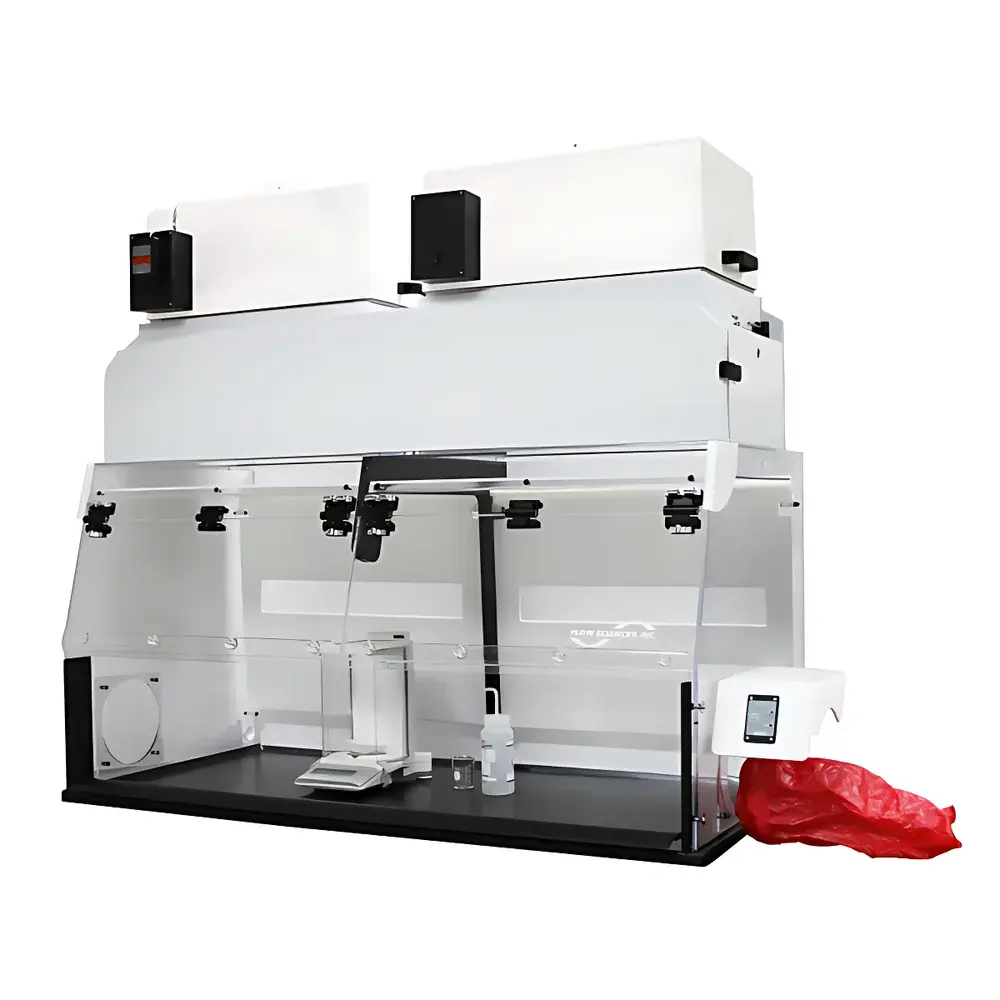
FSI ETA-AAC Negative-Pressure Balance Enclosure
| Brand | FSI (Flow Sciences, Inc.) |
|---|---|
| Origin | USA |
| Model | ETA-AAC |
| Airflow Velocity Range | 0.3–0.5 m/s (adjustable) |
| Sound Pressure Level | <60 dBA at 0.4 m/s |
| Filtration | Dual-stage HEPA (H14, EN 1822), BIBO lower filter |
| Filter Lifetime | ≥3 years under typical use |
| Inlet Configuration | Four-sided (top/bottom/left/right) aerodynamic arc-shaped baffles |
| Internal Flow Control | Rear laminar flow baffle + removable non-screw ceiling panel |
| Safety Compliance | OEB 3–5 validated per ISO 14644-1 Class 5 background |
| Alarm System | Thermal-anemometer-based face velocity monitor with audible/visual alert at <0.3 m/s |
| Accessories | Integrated waste bagging system, pass-through port interface, chemical-resistant phenolic resin work surface base |
Overview
The FSI ETA-AAC Negative-Pressure Balance Enclosure is an engineered containment solution designed for high-integrity gravimetric operations involving potent, low-dose, or nanoscale active pharmaceutical ingredients (APIs), cytotoxic compounds, and other hazardous particulates. Built upon Flow Sciences’ proprietary negative-pressure laminar airflow architecture, the ETA-AAC operates on the principle of inward-directed, unidirectional airflow—maintaining a consistent inward face velocity across the entire sash opening to prevent operator exposure and cross-contamination. Unlike conventional fume hoods or balance enclosures relying on turbulent displacement, the ETA-AAC employs empirically validated aerodynamic design elements—including four-sided arc-shaped inlet baffles, a rear-mounted laminar flow baffle, and a seamless, tool-free removable ceiling panel—to enforce stable, low-turbulence airflow profiles. Third-party OEB (Occupational Exposure Band) validation confirms containment efficacy down to ≤1 µg/m³ airborne concentration—meeting requirements for OEB 3 through OEB 5 handling per ICH S9 and ISPE baseline guidance.
Key Features
- Negative-pressure containment with real-time thermal-anemometer-based face velocity monitoring (0.3–0.5 m/s range); visual and audible alarm triggers when velocity falls below 0.3 m/s
- Dual-stage H14 HEPA filtration (EN 1822 compliant), with bottom-in/bottom-out (BIBO) configuration for safe, leak-tight filter changeout without exposure risk
- Quiet operation enabled by ebm-papst EC centrifugal fan—sound pressure level <60 dBA at nominal 0.4 m/s face velocity
- Four-sided aerodynamic arc baffles at all intake edges eliminate corner turbulence and ensure uniform inflow distribution
- Removable, screw-free ceiling panel and rear laminar flow baffle facilitate rapid decontamination and routine maintenance without tools
- Integrated waste bagging system with sealed liner retention and dedicated pass-through port interface for secure material transfer
- Base constructed from 25 mm phenolic resin laminate—resistant to acids, bases, solvents, and thermal shock per ASTM D5420 and NEMA LE-1 standards
Sample Compatibility & Compliance
The ETA-AAC accommodates both benchtop analytical balances (up to 350 mm depth × 500 mm width) and larger microbalance or semi-microbalance platforms. Its internal geometry supports open-vessel weighing, powder dispensing, dilution series preparation, and lyophilized API handling—all under ISO 14644-1 Class 5 (or cleaner) local environment conditions. The enclosure has undergone independent third-party testing using surrogate powders (e.g., lactose, micronized acetaminophen) per ISO 14644-3 Annex B and USP . It complies with FDA 21 CFR Part 11 requirements for electronic records when paired with validated data logging software, and meets GLP/GMP environmental control expectations for API handling in preclinical and clinical manufacturing support labs.
Software & Data Management
While the ETA-AAC operates as a standalone mechanical containment device, its thermal-anemometer sensor outputs analog 4–20 mA signals compatible with building management systems (BMS) or centralized lab monitoring platforms (e.g., Siemens Desigo, Honeywell Experion). Optional digital interface modules enable timestamped velocity logging, alarm event capture, and audit-trail generation aligned with 21 CFR Part 11 Annex 11 principles. Factory-supplied IQ/OQ protocols include test scripts for airflow mapping, filter integrity verification (via DOP/PAO challenge), and alarm response validation—fully traceable to NIST-traceable calibration standards.
Applications
- Weighing of highly potent compounds (HPAPIs) during formulation development and stability studies
- Nanoparticle dispersion and characterization sample preparation under controlled particulate isolation
- Reference standard preparation for LC-MS/MS quantitation where mass accuracy depends on contamination-free handling
- QC release testing of sterile APIs requiring OEB-aligned containment per EMA CHMP Q5C guidelines
- Early-phase toxicology dosing material preparation in compliance with OECD 417 and 422 study requirements
FAQ
What OEB levels does the ETA-AAC validate against?
The ETA-AAC has been independently tested and certified for OEB 3–5 containment per ISO 14644-1 Class 5 background environments using surrogate powder challenges.
Is the HEPA filter truly maintenance-free for three years?
Yes—under continuous operation at ≤0.45 m/s face velocity and typical laboratory particulate loading (≤1 mg/m³ average), the dual H14 filters maintain >99.995% efficiency for ≥36 months, verified via upstream/downstream photometer scanning per EN 1822-5.
Can the enclosure be integrated into a facility’s HVAC monitoring network?
Yes—the analog velocity output and optional digital module support integration with BMS or LIMS via Modbus RTU or BACnet MS/TP protocols.
Does the unit include validation documentation for GMP environments?
Yes—factory-provided IQ/OQ packages meet EU Annex 15 and ASTM E2500-13 requirements and are pre-audited for use in FDA- and EMA-inspected facilities.
How is filter replacement performed safely?
The BIBO lower filter housing allows full-seal removal using glovebag techniques; upper HEPA is accessed externally without breaching containment integrity.



