
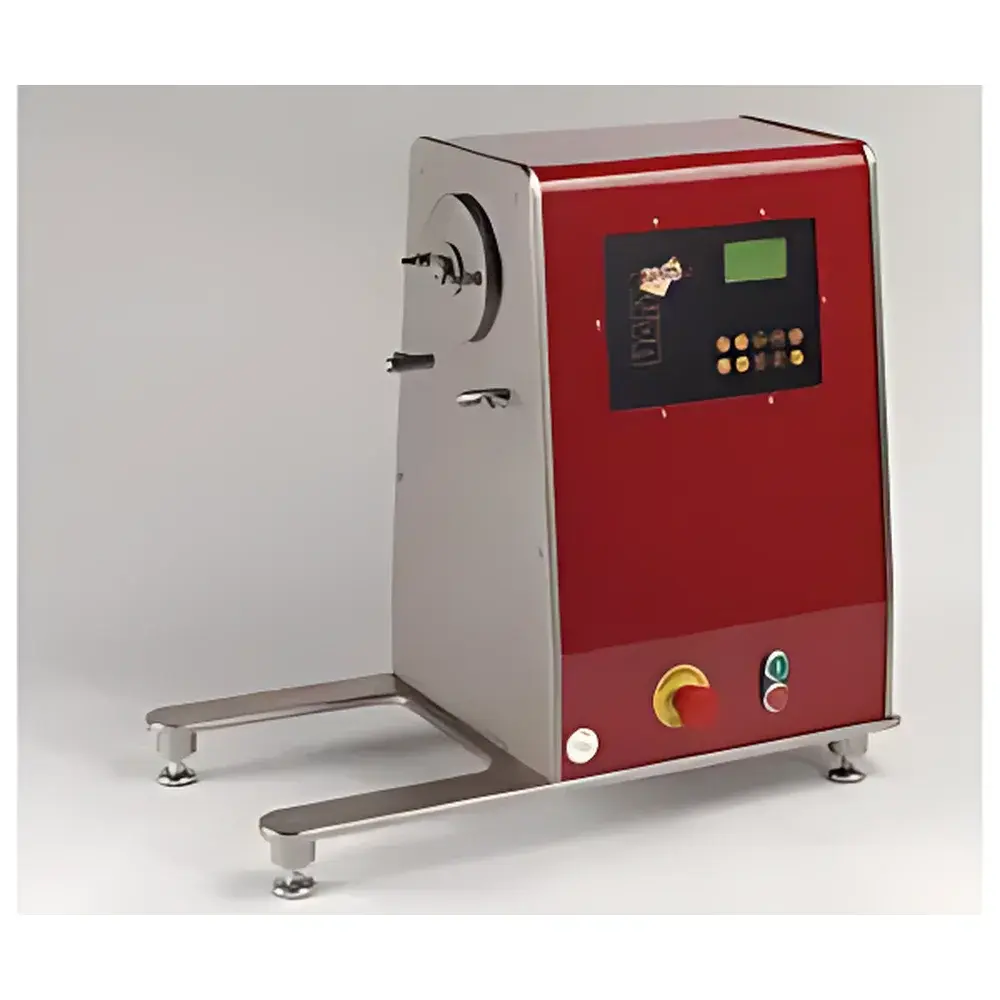
Pharmag UAM Drive Unit
| Brand | Pharmag |
|---|---|
| Origin | Germany |
| Model | UAM |
| Speed Range | 40–400 rpm (continuously adjustable) |
| Gear Ratio | 1:3.42 |
| Power Rating | 700 W |
| Input Voltage | 100–240 V AC, 50/60 Hz |
| Control Interface | Touchscreen panel with 10 programmable protocols |
| Design | Modular, tool-agnostic drive platform for pharmaceutical process equipment |
Overview
The Pharmag UAM Drive Unit is a precision-engineered, modular motorized drive system designed specifically for pharmaceutical intermediate-scale (pilot-scale) processing applications. Operating on the principle of controlled rotational torque transmission via a fixed-ratio planetary gearhead, the UAM serves as the central mechanical power source within Pharmag’s integrated suite of solid-dose and liquid formulation equipment. Its architecture enables seamless mechanical coupling to a wide range of interchangeable process tools—including high-shear granulators, fluid-bed processors, paddle mixers, powder blenders, and volumetric fillers—without requiring hardware reconfiguration or recalibration. This functional universality supports flexible batch manufacturing workflows compliant with ICH Q5A and Q7 guidelines, while its robust thermal management and electromagnetic compatibility (EMC) design meet EN 61000-6-2 and EN 61000-6-4 requirements for laboratory and cleanroom environments.
Key Features
- Modular mechanical interface: Standardized ISO 9409-1-150-B flange mounting allows rapid tool attachment/detachment without alignment fixtures or torque wrenches—reducing changeover time by >60% compared to fixed-drive systems.
- Intuitive touchscreen HMI: 7-inch capacitive display with multi-language support (English, German, Spanish, Chinese), real-time RPM feedback, and non-volatile memory for up to 10 user-defined operational protocols—including speed ramp profiles, dwell times, and torque limit thresholds.
- Wide-speed continuous control: Digital servo regulation maintains ±0.5% speed accuracy across the full 40–400 rpm range, enabling reproducible shear history in wet granulation and consistent mixing intensity in low-viscosity suspensions.
- Thermally optimized 700 W brushless DC motor: Integrated temperature sensors and forced-air cooling ensure stable output under sustained load conditions typical of 2–10 kg batch processing; rated IP54 for dust and splash resistance.
- Universal power input: Auto-ranging 100–240 V AC, 50/60 Hz supply eliminates need for external voltage converters during global deployment; meets UL 61010-1 and CE safety directives.
Sample Compatibility & Compliance
The UAM Drive Unit is not a standalone analytical instrument but a critical actuation subsystem validated for use with Pharmag’s GMP-compliant pilot-scale equipment portfolio. It interfaces exclusively with Pharmag-certified process tools bearing CE marking and conforming to ISO 13485:2016 (for medical device-related formulations) and FDA 21 CFR Part 11-ready firmware when paired with Pharmag’s optional data acquisition module. While the drive itself does not perform direct material analysis, its repeatable torque delivery and speed fidelity are essential for generating process data suitable for Quality-by-Design (QbD) documentation per ICH Q8(R2). All mechanical couplings comply with ISO 286-1 tolerance class h7/g6 to prevent misalignment-induced vibration during extended operation.
Software & Data Management
When integrated with Pharmag’s optional UAM-Link data logger (sold separately), the drive unit supports timestamped export of RPM, current draw, and runtime data in CSV format. Firmware version 2.3+ includes audit trail functionality compliant with ALCOA+ principles: each protocol modification is logged with operator ID, timestamp, and reason-for-change metadata. Data files are digitally signed and encrypted (AES-128) to satisfy FDA 21 CFR Part 11 requirements for electronic records. No cloud connectivity is embedded; all data remains on-device or exports via USB 2.0 port to secure local networks—ensuring adherence to EU GDPR and HIPAA-aligned data sovereignty policies.
Applications
- Wet granulation process development: Precise control over impeller speed enables systematic study of binder distribution kinetics and granule growth mechanisms at 3–8 kg scale.
- High-shear dry mixing optimization: Reproducible torque application supports DoE-based evaluation of API-excipient homogeneity under varying shear rates.
- Fluid-bed coating parameter screening: Synchronized drum rotation control facilitates correlation between air velocity, spray rate, and particle motion dynamics.
- Viscosity-sensitive suspension blending: Low-end speed stability (40 rpm ±0.2 rpm) ensures gentle incorporation of fragile biologics or micronized APIs without degradation.
- GMP pilot batch replication: Preloaded protocols enable identical mechanical energy input across multiple batches—critical for tech transfer to commercial manufacturing lines.
FAQ
Is the UAM Drive Unit suitable for sterile manufacturing environments?
No—the UAM is rated IP54 and intended for use upstream of final sterilization steps (e.g., in granulation or blending suites). It is not autoclavable or compatible with vaporized hydrogen peroxide (VHP) decontamination cycles.
Can third-party equipment be mechanically coupled to the UAM?
Only Pharmag-certified tools with matching ISO 9409-1-150-B flanges and torque-rated couplings are supported. Non-Pharmag adapters void warranty and compromise GMP traceability.
Does the UAM require routine calibration?
Speed calibration is factory-performed and traceable to PTB (Physikalisch-Technische Bundesanstalt); no user calibration is required. Annual verification using an NIST-traceable tachometer is recommended for audit readiness.
What is the expected service life under continuous operation?
Rated for ≥20,000 hours MTBF at 75% load; bearing replacement intervals are specified at 15,000 hours under ISO 281 L10 life criteria.
Is firmware update capability available remotely?
Firmware updates must be performed locally via USB stick using Pharmag-signed binaries; no remote access, OTA, or network connectivity is implemented for cybersecurity compliance.




