
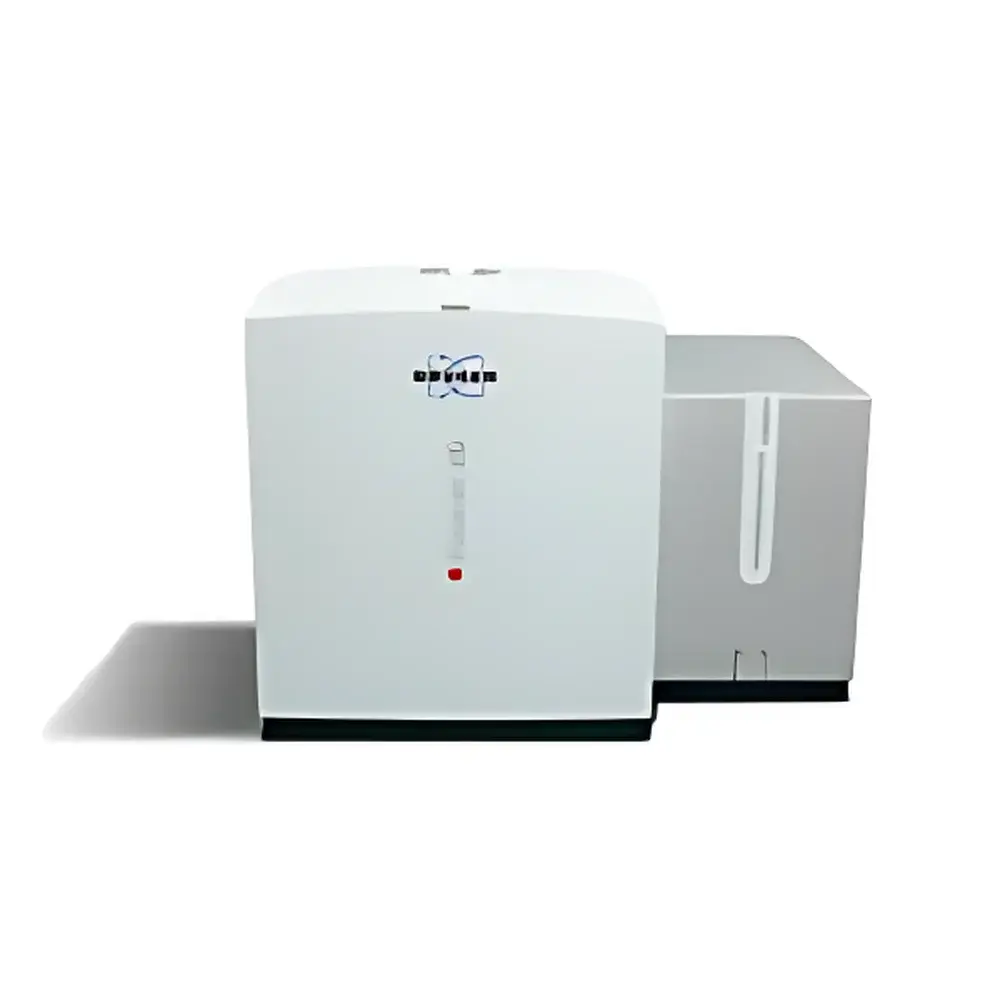
Bruker Fourier 80 Benchtop Nuclear Magnetic Resonance Spectrometer
| Brand | Bruker |
|---|---|
| Origin | Germany |
| Manufacturer Type | Authorized Distributor |
| Origin Category | Imported |
| Model | Fourier 80 |
| Instrument Type | High-Field Benchtop NMR Spectrometer |
| Operating Frequency | 80 MHz (¹H) |
| Sensitivity | ≥240:1 (¹H single-channel, 1% ethylbenzene, standard) |
| ≥220 | 1 (¹H single-channel with pulsed field gradient) |
| ≥160 | 1 (¹H/X dual-channel with pulsed field gradient) |
| Resolution | Standard configuration: ≤0.4/15/30 Hz (at 50%/0.55%/0.11% peak height) |
| HD configuration | ≤0.3/10/15 Hz (at 50%/0.55%/0.11% peak height) |
Overview
The Bruker Fourier 80 is a high-field, compact benchtop nuclear magnetic resonance (NMR) spectrometer engineered for routine and research-grade ¹H and multinuclear (¹³C, ¹⁹F, ³¹P, etc.) spectroscopy in academic, industrial, and teaching laboratories. Operating at a fixed 80 MHz proton frequency, the system leverages permanent magnet technology with active shimming to deliver high spectral fidelity without cryogenic cooling or dedicated infrastructure. Its design adheres to fundamental NMR principles—based on pulsed Fourier-transform detection under controlled static magnetic fields—and enables quantitative, non-destructive molecular characterization via chemical shift, J-coupling, relaxation times, and diffusion coefficients. Unlike conventional superconducting NMR systems requiring liquid helium and nitrogen, the Fourier 80 eliminates cryogen dependency, reducing total cost of ownership while maintaining robust signal-to-noise ratio (SNR) and reproducibility across daily operation.
Key Features
- Compact footprint (ca. 60 × 60 × 75 cm) — installs directly on laboratory benches or inside fume hoods without structural modification
- Integrated pulsed field gradient (PFG) unit enabling solvent suppression (e.g., H₂O, CHCl₃), diffusion-ordered spectroscopy (DOSY), and coherence selection in 2D experiments
- Dual-channel (¹H/X) capability supporting heteronuclear experiments such as HSQC, HMBC, and DEPT with standardized probe tuning
- Active shim system with real-time field homogeneity optimization, delivering linewidths ≤0.3 Hz (50% height) in HD configuration
- GoScan™ software for rapid one-click acquisition and basic processing; fully compatible with TopSpin™ 4.x for advanced pulse programming, data fitting, and publication-ready analysis
- Optional autosampler (up to 132 positions) with temperature-controlled sample handling (4–60 °C), supporting unattended overnight acquisition and statistical batch analysis
Sample Compatibility & Compliance
The Fourier 80 accepts standard 5 mm NMR tubes (including Wilmad and Bruker-certified variants) and supports both solution-state and semi-solid samples. It complies with ISO/IEC 17025:2017 requirements for analytical instrument validation when operated under documented SOPs. Data integrity is ensured through audit-trail-enabled TopSpin software compliant with FDA 21 CFR Part 11 (electronic records and signatures) when deployed in regulated environments. All spectral acquisitions meet ASTM E2982-21 guidelines for benchtop NMR performance verification, including line shape assessment, SNR calibration, and resolution benchmarking using certified reference standards (e.g., 1% ethylbenzene in CDCl₃).
Software & Data Management
Data acquisition, processing, and reporting are unified within Bruker’s software ecosystem. GoScan provides intuitive workflows for routine ¹H screening, peak integration, and purity assessment — ideal for QC/QA labs and undergraduate instruction. TopSpin offers full command-line and graphical interface access to pulse sequence libraries (including DOSY, NOESY, TOCSY, and qNMR modules), phase correction algorithms, baseline fitting, and export to common formats (JCAMP-DX, MNova, CSV, PDF). Raw FID and processed spectra are stored in Bruker’s proprietary fid/1r directory structure, ensuring traceability and compatibility with LIMS integration via API or file-based ingestion protocols. All software updates follow GLP-compliant release documentation and version control practices.
Applications
- Academic & Fundamental Research: Structural elucidation of synthetic intermediates, reaction monitoring under variable temperature/pressure conditions, conformational analysis of small organic molecules and organometallic complexes
- Teaching & Training: Hands-on NMR pedagogy for undergraduate chemistry curricula; real-time demonstration of chemical shift anisotropy, spin-spin coupling, and dynamic exchange phenomena
- Process Chemistry & Quality Control: Rapid identity confirmation of APIs and excipients; quantification of residual solvents per ICH Q3C guidelines; batch-to-batch consistency evaluation via fingerprint spectral comparison
- Forensic & Materials Analysis: Non-invasive identification of unknown compounds in seized materials; polymer microstructure determination (e.g., tacticity, branching) via ¹³C NMR
- In Situ Reaction Monitoring: Integration with flow cells or pressure-rated sample holders for kinetic profiling of catalytic transformations, hydrolysis, or polymerization reactions
FAQ
Is the Fourier 80 suitable for quantitative NMR (qNMR) applications?
Yes — its high stability, calibrated RF power delivery, and validated pulse sequences support qNMR per USP General Chapter <711> and EP 2.2.33, with typical RSD <1.5% for internal standard assays.
Does the system require external cooling or ventilation?
No — the permanent magnet operates at ambient temperature; only standard lab-grade electrical supply (100–240 VAC, 50/60 Hz) and passive air convection are required.
Can I upgrade from single-channel to dual-channel configuration post-purchase?
Yes — hardware and software licensing upgrades are available through Bruker service contracts, including X-channel amplifier, preamplifier, and probe retuning.
What maintenance is required beyond routine calibration?
Annual field homogeneity verification and RF coil inspection are recommended; no cryogen refills, vacuum pump servicing, or magnet quench management are necessary.
Is remote operation supported?
Yes — secure SSH and VNC access to TopSpin is enabled by default; instrument status, queue management, and real-time FID visualization are accessible via institutional network or VPN.





