
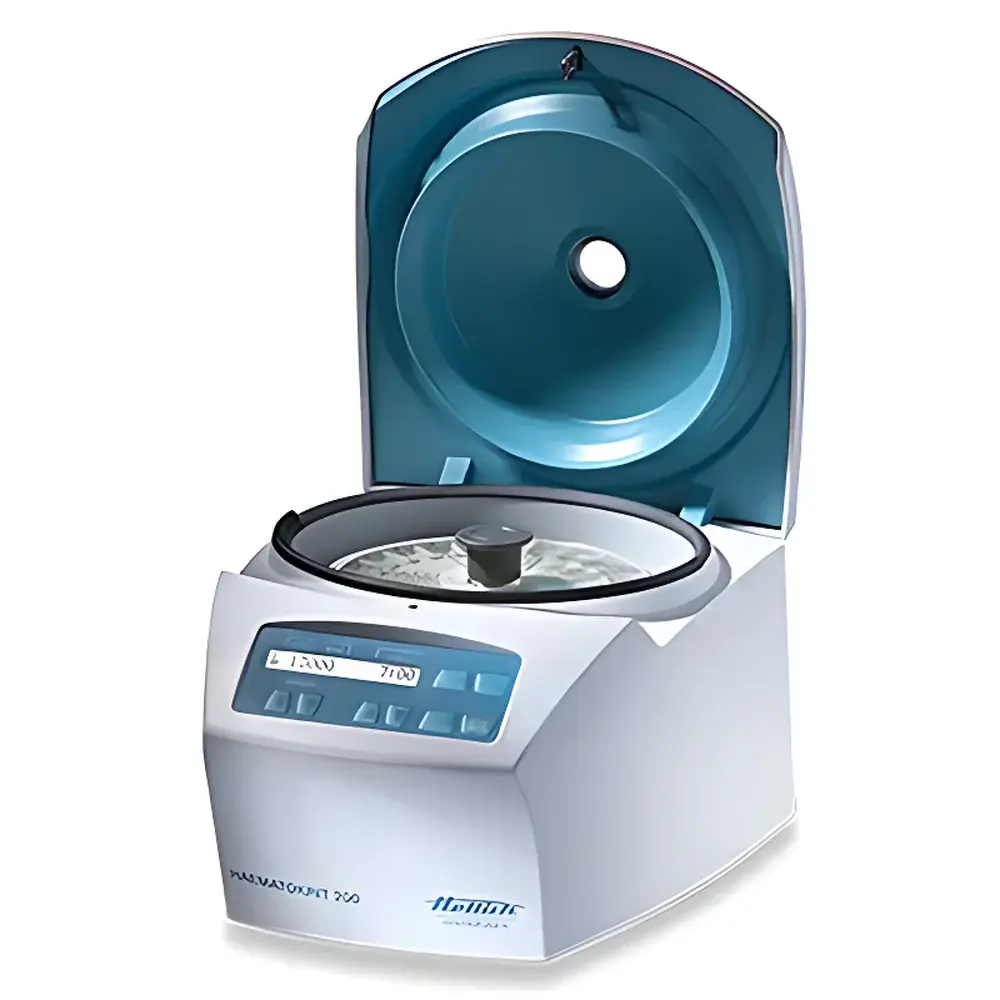
Hettich HAEMATOKRIT 200 Capillary Centrifuge
| Brand | Hettich |
|---|---|
| Country of Origin | Germany |
| Model | HAEMATOKRIT 200 |
| Instrument Type | Benchtop Centrifuge |
| Speed Range | 13,000 rpm (max) |
| RCF | 16,060 × g |
| Capacity | 24 × capillaries |
| Dimensions (H×W×D) | 228 × 261 × 353 mm |
| Weight | 10 kg |
| Rotor Configuration | Horizontal swing-out rotor with integrated hematocrit reader |
| Safety Design | Segmented chamber rotor with individual capillary compartments |
| Compliance | CE, IEC 61010-1, ISO 13485 (medical device manufacturing environment) |
Overview
The Hettich HAEMATOKRIT 200 Capillary Centrifuge is a purpose-engineered benchtop instrument designed specifically for rapid, standardized hematocrit (Hct) determination in clinical and diagnostic laboratories. Operating on the principle of sedimentation under controlled centrifugal force, it separates whole blood components—erythrocytes, leukocytes, platelets, and plasma—within calibrated capillary tubes according to density and particle size. The device achieves precise stratification at 13,000 rpm, generating a maximum relative centrifugal force (RCF) of 16,060 × g, ensuring reproducible separation within 5 minutes. Its compact footprint (228 × 261 × 353 mm) and lightweight construction (10 kg) enable seamless integration into hematology workstations, point-of-care testing environments, and mobile laboratory units without compromising mechanical stability or thermal management.
Key Features
- Integrated hematocrit scale on the rotor lid enables direct visual reading of packed cell volume (PCV) without requiring additional calipers or digital readers—reducing operator variability and transcription errors.
- Segmented horizontal swing-out rotor accommodates either 24 capillaries (for routine hematocrit analysis) or 20 capillaries (optimized for buffy coat quantification), with physically isolated chambers that prevent cross-contamination in case of tube rupture.
- Robust aluminum rotor construction and precision-balanced drive system ensure long-term rotational stability and minimal vibration—even at maximum speed—supporting GLP-compliant daily operation.
- Microprocessor-controlled acceleration/deceleration profiles minimize shear-induced hemolysis and preserve sample integrity during spin-down.
- Automatic rotor recognition and speed/RCF interlock prevent unauthorized or unsafe operating conditions; motor braking is electronically regulated to avoid overshoot and thermal stress on bearings.
- Front-accessible control panel with LED display provides real-time monitoring of time, speed, and elapsed run duration—no software interface required for basic operation.
Sample Compatibility & Compliance
The HAEMATOKRIT 200 accepts standard 75 mm or 100 mm heparinized or EDTA-coated capillary tubes (internal diameter: 1.0–1.2 mm), compliant with CLSI H20-A3 and ISO 15189 hematology preanalytical requirements. Its segmented rotor design meets IEC 61010-1 safety standards for protection against mechanical hazards and liquid ingress. As a Class IIa medical device manufactured under ISO 13485-certified processes, the instrument supports traceability in clinical diagnostics environments subject to FDA 21 CFR Part 820 and EU MDR 2017/745. Routine calibration verification can be performed using NIST-traceable tachometers and certified reference capillaries per ASTM E2917-22 guidelines.
Software & Data Management
The HAEMATOKRIT 200 operates as a standalone, non-networked device with no embedded data logging or USB export capability—consistent with its role as a dedicated, low-complexity analytical tool in high-throughput hematology labs. All operational parameters are set manually via tactile rotary controls, eliminating software validation burdens under 21 CFR Part 11. For laboratories requiring audit trails, manual entry into LIMS or electronic health record (EHR) systems is supported by printed run logs generated from external timers or integrated lab workflow software. Optional third-party barcode scanners may be used to associate capillary IDs with patient records prior to centrifugation.
Applications
- Routine hematocrit measurement in hospital core labs, blood banks, and outpatient clinics per CLIA-waived protocols.
- Buffy coat layer thickness quantification for leukocyte enumeration in oncology and transplant monitoring workflows.
- Quality control of anticoagulated whole blood specimens prior to automated hematology analyzer input.
- Field-deployable hematocrit assessment in resource-limited settings where refrigerated storage or high-speed centrifugation is unavailable.
- Educational use in biomedical science curricula for teaching sedimentation kinetics and erythrocyte aggregation behavior.
FAQ
What capillary tube specifications are compatible with the HAEMATOKRIT 200?
Standard 75 mm or 100 mm microhematocrit tubes with internal diameters of 1.0–1.2 mm and heparin or EDTA coatings are recommended. Tubes must be sealed with clay or plastic sealant prior to loading.
Does the instrument require routine calibration?
Yes—annual speed verification using a certified handheld tachometer is advised. Rotor balance checks should be performed before each shift if used continuously.
Can the HAEMATOKRIT 200 be used for non-blood applications?
It is not validated for non-hematological samples. Its rotor geometry, acceleration profile, and RCF output are optimized exclusively for capillary-based blood separation per ISO 15189 Annex A.3.
Is the rotor autoclavable?
No—the aluminum rotor is not autoclave-compatible. Cleaning is performed with 70% ethanol and lint-free wipes; immersion or ultrasonic cleaning is prohibited.
What safety certifications does this model hold?
CE marking under Directive 2014/30/EU (EMC) and 2014/35/EU (LVD); compliance with IEC 61010-1:2010 for laboratory electrical equipment; ISO 13485:2016 certification applies to Hettich’s manufacturing quality system—not the end-user installation.



