
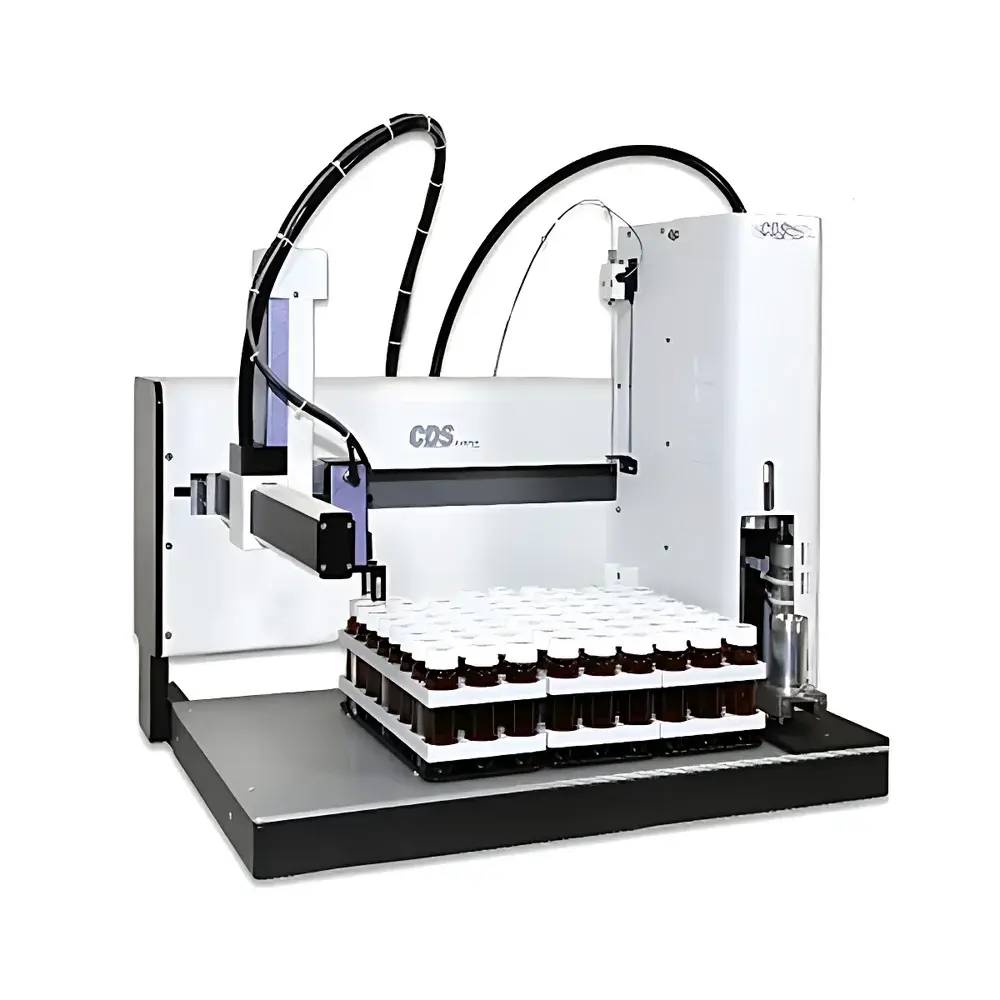
CDS 7450 Automated Solid/Liquid Purge and Trap Concentrator
| Brand | CDS Analytical |
|---|---|
| Origin | USA |
| Model | 7450 |
| Instrument Type | Water & Soil VOC Analyzer |
| Sample Capacity | 72-position |
| Trap Temperature | Ambient (Room-Temperature Capture) |
| Purge Heater Temperature | Up to 100 °C |
| Sample Chilling Temperature | 4 °C |
| Internal Standard Delivery | 2 µL Quantitative Loop |
| Moisture Removal | Integrated On-line Dual-Path Dehumidification |
| System Inertness | Entire Fluid Path Constructed of SilcoNert®-Treated Stainless Steel and Fused Silica |
| Foam Detection | Real-time Optical Foam Sensor |
| Sample Compatibility | Aqueous Matrices, Soil/Sediment Slurries (via Methanol Extraction), and Solid Samples with Spiking Protocol |
Overview
The CDS 7450 Automated Solid/Liquid Purge and Trap Concentrator is a high-reliability, fully automated sample introduction system engineered for the quantitative enrichment and transfer of volatile organic compounds (VOCs) from aqueous and solid environmental matrices. It operates on the principle of dynamic headspace purging—where an inert carrier gas (typically helium or nitrogen) continuously sweeps VOCs from a heated, agitated sample into a sorbent trap. Following purge completion, the trap undergoes rapid thermal desorption, delivering a sharp, focused analyte band directly into the injection port of any GC or GC/MS system. Unlike cryogenic trapping systems, the 7450 employs ambient-temperature capture using proprietary hydrophobic, high-capacity sorbents—eliminating liquid nitrogen or mechanical refrigeration while minimizing co-trapping of water and methanol. This design significantly reduces baseline interference, improves chromatographic peak shape, and extends trap lifetime under routine environmental monitoring workloads.
Key Features
- Ambient-temperature trap architecture eliminates cryogens and associated operational complexity, lowering maintenance burden and improving long-term reproducibility.
- 72-position autosampler accommodates standard 40-mL VOA vials and 40-mL EPA-compliant soil extraction vials—enabling unattended batch processing of both water and soil samples without hardware reconfiguration.
- Real-time optical foam detection prevents carryover and cross-contamination by halting purge cycles upon foam formation in high-solids or surfactant-rich samples.
- Quantitative internal standard delivery via a fixed 2 µL stainless steel loop ensures sub-microliter precision and minimizes variability across injections.
- Dual-path moisture management: dedicated dehumidification flow path operates independently from the analytical desorption stream, achieving >95% water removal efficiency without compromising VOC recovery or column integrity.
- Entire fluid path—including purge lines, trap housing, transfer lines, and valves—is passivated with SilcoNert® or equivalent deactivated surface treatment, ensuring minimal adsorption of polar VOCs (e.g., chloromethanes, acetaldehyde, vinyl chloride).
Sample Compatibility & Compliance
The CDS 7450 supports method-compliant operation per U.S. EPA Methods 502.2, 524.2, 524.4, 8260D, and 8270E, as well as ASTM D3699 and ISO 15681-2. It accepts direct aqueous injection and accommodates soil/sediment analysis through validated methanol-assisted extraction protocols (e.g., EPA Method 5035A). The system’s independent water and soil preparation pathways prevent cross-sample contamination—a critical requirement for regulated environmental laboratories undergoing GLP audits or state-certified testing programs. All firmware and control logic are designed to support audit-ready electronic records in accordance with FDA 21 CFR Part 11 when integrated with compliant LIMS or data systems.
Software & Data Management
Instrument control and sequence management are handled via CDS’s Windows-based 7450 Control Software, which provides full parameter logging, method versioning, and user-access-level permissions. Each run generates timestamped metadata—including trap temperature history, purge gas flow calibration status, foam event logs, and internal standard delivery verification—exportable in CSV or XML format for traceability. The software supports seamless integration with major GC and GC/MS platforms (Agilent, Thermo Fisher, Shimadzu, PerkinElmer) via RS-232, Ethernet, or contact-closure triggers. Audit trail functionality includes operator ID, method modification timestamps, and system error flags—all retained for ≥36 months unless purged under documented retention policy.
Applications
The CDS 7450 serves laboratories performing regulatory compliance testing for drinking water, wastewater, groundwater, landfill leachate, and contaminated soils. Its robust handling of heterogeneous matrices makes it particularly suited for Superfund site investigations, municipal utility monitoring, and third-party environmental testing facilities. Routine applications include quantitation of BTEX (benzene, toluene, ethylbenzene, xylenes), trihalomethanes (chloroform, bromodichloromethane), haloacetonitriles, and other priority pollutants listed under the Safe Drinking Water Act (SDWA) and Clean Water Act (CWA). The system also supports research-grade VOC profiling in atmospheric condensates, bioreactor off-gas streams, and pharmaceutical residual solvent analysis where low-level sensitivity and matrix resilience are essential.
FAQ
Does the CDS 7450 require liquid nitrogen or mechanical cooling for trap operation?
No. It utilizes room-temperature sorbent trapping with hydrophobic polymer-based media optimized for VOC retention without water co-condensation.
Can the same trap be used for both water and soil extracts without cleaning between runs?
Yes—the dual-path design and inert surface chemistry enable consecutive analysis of aqueous and methanolic extracts without measurable carryover, provided method-defined bake-out parameters are applied post-run.
How is internal standard precision verified during routine operation?
The 2 µL quantitative loop is calibrated gravimetrically at factory acceptance; software logs each IS delivery event with pressure and timing diagnostics to flag deviations exceeding ±2% of nominal volume.
Is the system compatible with GC/MS systems requiring splitless or cold-on-column injection?
Yes—desorption parameters (trap heat rate, transfer line temperature, vent timing) are fully programmable to match inlet requirements across all major GC/MS configurations.
What maintenance intervals are recommended for routine EPA compliance work?
Trap replacement every 200–300 injections; quarterly valve inspection; annual full-system performance verification using EPA Method 8260D surrogate spiking protocol.




