
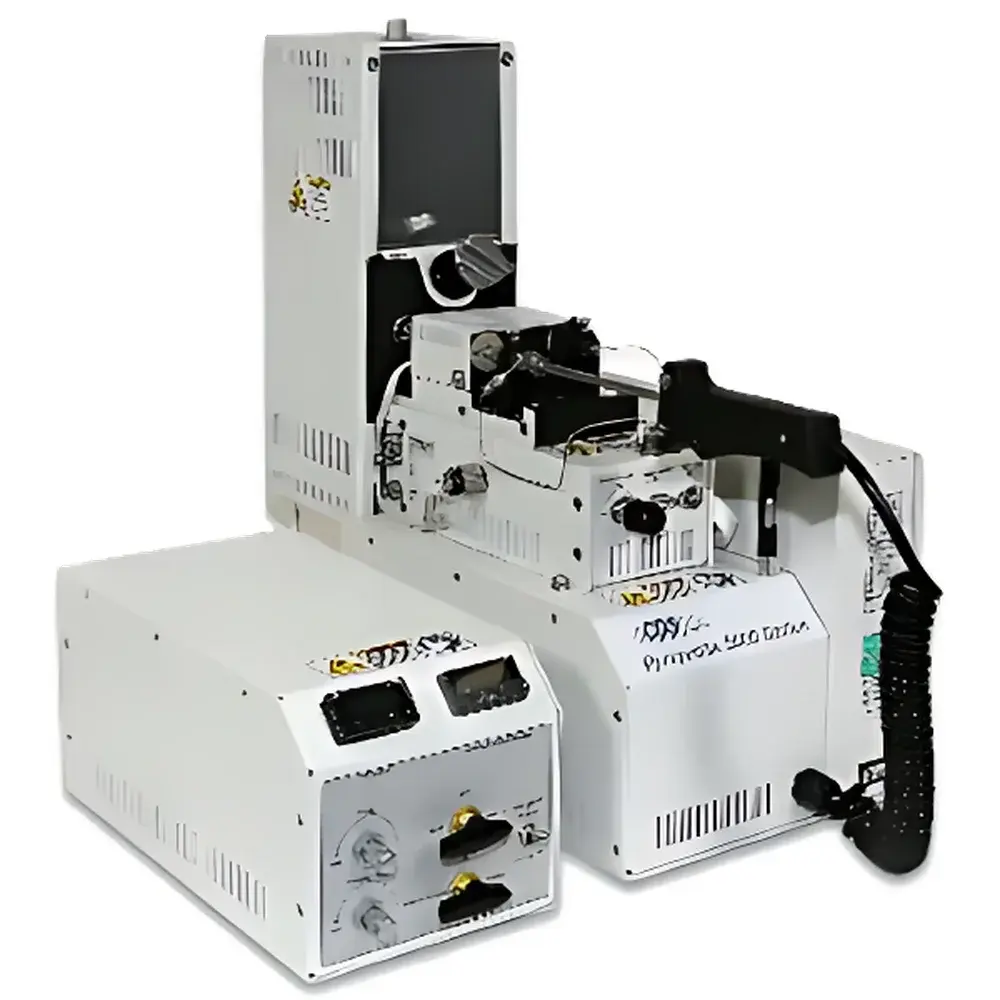
LabTech CDS 5200 Automated Pyrolyzer
| Brand | LabTech |
|---|---|
| Origin | Beijing, China |
| Manufacturer Type | Direct Manufacturer |
| Model | CDS 5200 |
| Price | Upon Request |
| Pyrolysis Temperature Range | Ambient to 1400 °C (adjustable in 0.1 °C increments) |
| Temperature Accuracy | ±0.1 °C |
| Maximum Pressure Rating | 500 PSI (3400 kPa) |
| Heating Rate (Pulse Mode) | 10–20,000 °C/sec |
| Heating Rate (Programmed Mode) | 0.01–999.9 °C/sec or 0.01–999.9 °C/min |
| Programmable Steps per Run | Up to 8 steps with independent GC trigger per step |
| Transfer Line Max Temp | 350 °C |
| Interface Temp | ≥350 °C |
| Sample Path Material | Inert (e.g., SilcoNert®-treated stainless steel or fused silica) |
| Optional In-line Cold Trap | Integrated cryo-focusing with thermal desorption |
| Atmosphere Control | N₂, air, O₂, He, or custom gas (via external mass flow controller) |
| Catalytic Reactor | 3″ × 1/4″ OD 316 stainless steel, rated to 800 °C, user-replaceable catalyst bed |
Overview
The LabTech CDS 5200 Automated Pyrolyzer is a high-precision, research-grade thermal decomposition system engineered for seamless hyphenation with gas chromatography (GC) and gas chromatography–mass spectrometry (GC/MS) platforms. It operates on the principle of controlled, rapid thermal degradation—either via pulse-heating (microsecond-scale thermal shock) or programmed ramping—to volatilize thermally labile and non-volatile macromolecules—including polymers, copolymers, additives, crosslinkers, and complex organic matrices—into characteristic low-molecular-weight fragments suitable for chromatographic separation and identification. Designed for reproducible method transfer across laboratories, the CDS 5200 delivers trace-level sensitivity, exceptional thermal stability, and full operational autonomy without requiring instrument-specific firmware integration. Its modular architecture supports both routine QC workflows and advanced mechanistic studies in polymer science, forensic chemistry, and sustainable materials characterization.
Key Features
- Ultra-wide pyrolysis temperature range: ambient to 1400 °C, with digital resolution of 0.1 °C and long-term stability better than ±0.1 °C over 24 h.
- Dual-mode heating control: selectable pulse mode (10–20,000 °C/sec) for instantaneous thermal shock analysis, or programmable multi-step ramping (0.01–999.9 °C/sec or /min), supporting up to eight independently triggered temperature segments per run.
- High-pressure pyrolysis chamber rated to 500 PSI (3400 kPa), enabling controlled decomposition under pressurized inert or reactive atmospheres—critical for studying volatile retention, secondary reactions, or catalytic cracking kinetics.
- Heated transfer line (up to 350 °C) with inert surface finish (SilcoNert® or equivalent), ensuring quantitative delivery of thermally sensitive pyrolysates without condensation or adsorption losses.
- Integrated cryogenic trapping and thermal desorption module, allowing pre-concentration of trace analytes prior to GC injection—enhancing detection limits by up to two orders of magnitude for low-abundance markers.
- Modular catalytic reactor (3″ × 1/4″ OD, 316 SS) operable up to 800 °C, compatible with heterogeneous catalysts (e.g., Pt/Al₂O₃, zeolites, Ni-based systems) for studying depolymerization pathways, hydrogenation, or deoxygenation mechanisms.
Sample Compatibility & Compliance
The CDS 5200 accommodates solid, liquid, and viscous samples—including raw rubber, cured elastomers, composite resins, lignocellulosic biomass, electronic encapsulants, tobacco particulates, and archaeological residues—loaded into standard quartz or ceramic sample cups (10–50 µL capacity). All wetted surfaces are chemically inert and certified compliant with ASTM D7203 (pyrolysis-GC for polymer identification) and ISO 17201-3 (forensic pyrolysis analysis). The system supports GLP/GMP-aligned operation through optional audit-trail logging, user access controls, and electronic signature capability—fully compatible with FDA 21 CFR Part 11 requirements when paired with validated chromatography data systems (CDS).
Software & Data Management
Controlled via LabTech’s PyroVision™ software (Windows-based), the CDS 5200 enables method development, sequence scheduling, real-time temperature profiling, and synchronized GC trigger logic—including per-step acquisition initiation and hardware handshake protocols (TTL or RS-232). Raw thermal event logs, GC start timestamps, and pressure/temperature diagnostics are stored in vendor-neutral CSV and XML formats. Software supports automated calibration verification using NIST-traceable reference standards (e.g., poly(methyl methacrylate), polystyrene, cellulose), with built-in drift compensation algorithms for long-duration batch runs.
Applications
- Quantitative additive screening in automotive tires and industrial rubber compounds (e.g., antioxidants, plasticizers, vulcanizing agents).
- Feedstock characterization in thermochemical biomass conversion—identifying levoglucosan, furans, phenolics, and syringyl/guaiacyl ratios.
- Forensic differentiation of synthetic fibers, adhesives, and paint binders based on pyrolytic fingerprinting.
- Failure analysis of printed circuit board laminates and conformal coatings under thermal stress conditions.
- Archaeometric sourcing of historical resins, varnishes, and binding media via evolved gas analysis.
- Catalyst evaluation in plastic waste valorization studies—monitoring monomer recovery yields and side-product formation during catalytic pyrolysis.
FAQ
Can the CDS 5200 be interfaced with third-party GC/MS systems from Agilent, Thermo Fisher, or Shimadzu?
Yes—the system uses standardized analog/digital I/O (TTL triggers, 0–10 V signals) and requires no proprietary drivers; hardware integration is performed via GC auxiliary port or external relay box.
Is method validation support available for regulated environments (e.g., pharmaceutical or environmental testing labs)?
LabTech provides IQ/OQ documentation templates, performance qualification protocols, and on-site installation qualification services aligned with ISO/IEC 17025 and USP <851>.
What maintenance intervals are recommended for the pyrolysis furnace and transfer line?
Furnace calibration verification is advised every 6 months; quartz liner replacement is typically required after ~500–1000 runs depending on sample matrix corrosivity; transfer line cleaning is recommended quarterly or after high-residue samples.
Does the system support unattended overnight operation?
Yes—fully automated sequences (including auto-cup loading/unloading via optional robotic sampler) can execute >100 samples with integrated GC re-equilibration and system self-diagnostics between runs.




