
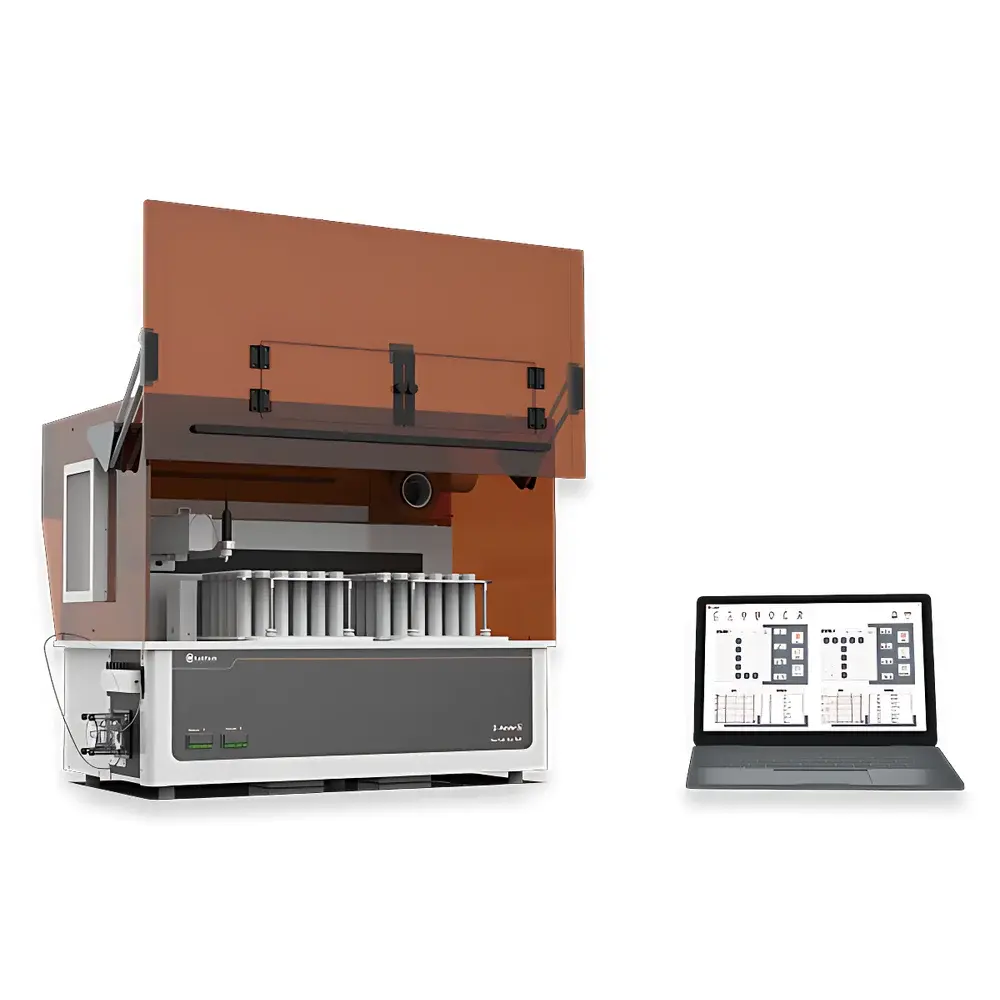
LabTech D-MASTER Fully Automated Graphite Block Digestion System
| Brand | LabTech |
|---|---|
| Origin | Beijing, China |
| Manufacturer Type | Direct Manufacturer |
| Instrument Type | Graphite Block Digestion System |
| Automation Level | Fully Automated |
| Sample Capacity | 60 Positions |
| Max Heating Temperature | 230 °C |
| Temperature Control Accuracy | ±0.1 °C |
| Heating Principle | Electric Resistance Heating |
| Reagent Channels | 9 |
Overview
The LabTech D-MASTER Fully Automated Graphite Block Digestion System is an engineered solution for high-throughput, trace-metal–grade sample preparation in environmental, food, clinical, and regulatory laboratories. It operates on the principle of controlled electric-resistance heating within a thermally uniform graphite block, enabling precise, reproducible acid digestion under open-vessel conditions. Unlike conventional hot plates or manual block digesters, the D-MASTER integrates robotic liquid handling, closed-loop thermal regulation, and real-time process monitoring to eliminate operator-dependent variability. Its design adheres to core principles of analytical pre-treatment integrity—minimizing contamination risk, ensuring complete matrix decomposition, and maintaining analyte stability throughout multi-step digestion protocols (e.g., HNO₃–HCl–HF sequences for silicate-rich soils or seafood tissues). The system is intended for use in laboratories compliant with ISO/IEC 17025, EPA Methods 3050B/3051A/3052, and USP , where method traceability and procedural consistency are mandatory.
Key Features
- Fully automated digestion workflow: Integrated robotic arm performs reagent dispensing (9 independent channels), sample homogenization via orbital shaking, programmable lift-and-lower motion for vessel immersion control, gradient temperature ramping, reflux-assisted acid evaporation (“赶酸”), and final volumetric定容 to 10–50 mL with precision syringe pumps.
- 360° rotating robotic arm with sealed mechanical architecture: Eliminates exposure of drive components to corrosive fumes; all motion axes are housed within a fully enclosed chamber with integrated PTFE-coated guide rails and ceramic-reinforced bearings for long-term reliability in aggressive HNO₃/HF environments.
- Multi-platform remote operation: Web-based interface accessible via desktop, tablet, or smartphone; supports concurrent login from multiple users with role-based permissions (e.g., operator, supervisor, QA auditor); includes time-stamped audit trail for all method executions and parameter changes.
- Real-time safety interlocks: Dual optical sensors monitor reagent volume levels; infrared thermal mapping detects abnormal surface temperatures; capacitive proximity switches verify vessel presence prior to reagent addition; audible voice alerts notify operators upon method completion or critical fault events.
- Dedicated ventilation module: Self-contained exhaust unit with activated carbon + HEPA filtration (optional acid gas scrubber upgrade), decoupled from electronics via isolated airflow pathways—ensuring stable operation at ambient lab temperatures up to 35 °C without derating.
Sample Compatibility & Compliance
The D-MASTER accommodates standard 50 mL and 100 mL quartz or PTFE digestion tubes (including EPA-compliant borosilicate glass variants) across its 60-position heated block. It supports digestion of heterogeneous matrices including soil, sediment, plant tissue, dairy products, infant formula, cosmetics, and biological fluids. All firmware and software modules comply with FDA 21 CFR Part 11 requirements for electronic records and signatures—including user authentication, audit trail generation, and data integrity controls (ALCOA+ principles). Preloaded method libraries align with ASTM D3682-22 (trace metals in water), ISO 11466 (heavy metals in soils), and GB/T 5009 series (Chinese national food safety standards).
Software & Data Management
The proprietary LabTech DigestControl™ v4.2 software provides intuitive drag-and-drop method builder, real-time video feed overlay (1080p resolution with timestamp watermark), and automated report generation in PDF/XLSX formats. Each run logs metadata including ambient humidity/temperature, reagent lot numbers, operator ID, calibration status of temperature sensors (NIST-traceable), and deviation flags against setpoint profiles. Exported datasets include raw thermal curves, reagent consumption logs, and alarm event chronologies—all structured for direct import into LIMS platforms via ASTM E1384-compliant XML schema.
Applications
- Preparation of certified reference materials (CRMs) for ICP-MS and AAS quantification
- Routine heavy metal screening in wastewater sludge per EPA Method 6010D
- Digestion of high-fat food samples prior to Cd/Pb determination by GF-AAS
- Leachate analysis from landfill monitoring wells using TCLP protocols
- QC/QA validation of digestion efficiency via recovery spikes (e.g., Sc, Y, In internal standards)
FAQ
Does the D-MASTER support HF-based digestion protocols?
Yes—the system’s fluidic pathways employ chemically inert PFA tubing and sapphire-tipped valves; all wetted surfaces are rated for continuous exposure to ≤40% hydrofluoric acid at temperatures up to 200 °C.
Can digestion methods be validated for GLP compliance?
Absolutely—the software generates IQ/OQ documentation templates, stores calibration certificates for temperature probes and dispensing pumps, and maintains immutable execution logs required for FDA or OECD GLP audits.
What maintenance intervals are recommended for sustained accuracy?
Temperature sensor verification every 6 months (using external reference thermometer), robotic arm lubrication annually, and reagent line priming before first use of each new acid batch.
Is third-party LIMS integration supported?
Yes—via RESTful API endpoints and configurable CSV/XML export schedules; tested integrations include Thermo Fisher SampleManager, LabVantage, and STARLIMS.
How is carryover contamination prevented between runs?
Each reagent channel features automatic air-gap aspiration and post-dispense purge cycles; the robotic arm undergoes UV-C sterilization during idle periods, and tube racks are indexed to prevent cross-position residue transfer.
Related Products



