
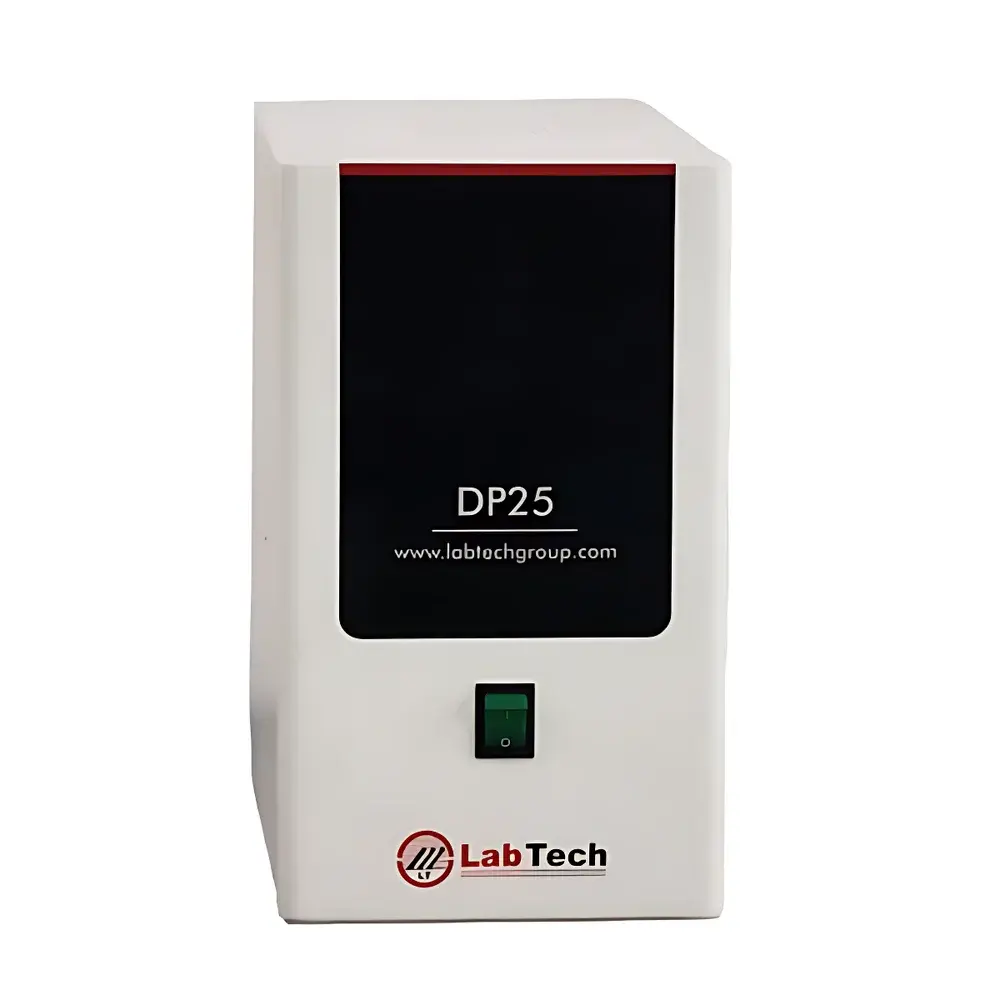
LabTech DP25 / DP36 / VP2C Corrosion-Resistant Diaphragm Vacuum Pump
| Brand | LabTech |
|---|---|
| Origin | Beijing, China |
| Manufacturer Type | Direct Manufacturer |
| Product Type | Oil-Free Diaphragm Pump |
| Pump Category | Chemical-Resistant Dual-Stage Vacuum Pump |
| Diaphragm Material | PTFE-Laminated Composite Membrane |
| Construction | Fluoropolymer-Wetted Components (PTFE, FFKM, PVDF) |
| Compliance Context | Designed for GLP/GMP-adjacent laboratory environments requiring solvent and aggressive chemical compatibility |
Overview
The LabTech DP25, DP36, and VP2C series corrosion-resistant diaphragm vacuum pumps are engineered for continuous, oil-free operation in chemically demanding laboratory applications. Utilizing a dual-stage positive displacement mechanism, these pumps generate vacuum through the reciprocating motion of a fluoropolymer-reinforced diaphragm—eliminating the need for lubricating oil and preventing cross-contamination of sensitive samples or vacuum lines. Unlike rotary vane or piston pumps, diaphragm-based systems inherently avoid hydrocarbon vapor backstreaming and particulate generation, making them ideal for applications where sample integrity, operator safety, and regulatory traceability are critical. The core architecture integrates chemically inert wetted materials—including PTFE-laminated diaphragms, FFKM valve assemblies, and PVDF pump housings—to ensure long-term stability when exposed to halogenated solvents (e.g., chloroform, DCM), strong acids (e.g., HNO₃, H₂SO₄), caustic bases (e.g., NaOH, KOH), and oxidizing agents (e.g., H₂O₂, ozone). This design aligns with ISO 8573-1 purity class 0 requirements for oil-free compressed air/vacuum systems and supports compliance-driven workflows in pharmaceutical QC, environmental analysis, and academic synthesis labs.
Key Features
- Oil-free, dry-running operation—no lubrication required, zero risk of oil vapor contamination or maintenance-related downtime
- Dual-stage compression architecture enabling deeper ultimate vacuum performance compared to single-stage equivalents
- PTFE-laminated composite diaphragm offering enhanced fatigue resistance, reduced hysteresis, and extended service life under cyclic load
- Full fluoropolymer wetted path: pump head, valves, gaskets, and internal tubing constructed from PTFE, FFKM, and PVDF to resist degradation from organic solvents and corrosive vapors
- Thermally stable motor housing with integrated thermal cut-off protection for sustained operation at ambient temperatures up to 40 °C
- Low-vibration, brushless DC motor design minimizing mechanical noise (<52 dB(A)) and structural resonance in shared lab spaces
- Modular construction allowing field-replaceable diaphragm kits and valve assemblies without specialized tools
Sample Compatibility & Compliance
These pumps are validated for use with volatile organic compounds (VOCs), acidic and alkaline digestates, and reactive gas streams commonly encountered in sample preparation workflows—including but not limited to rotary evaporation, vacuum filtration, solid-phase extraction (SPE), freeze drying pre-evacuation, and vacuum desiccation. All wetted components meet USP Class VI biocompatibility standards and comply with RoHS Directive 2011/65/EU for hazardous substance restriction. While not certified to ATEX or IECEx for explosive atmospheres, their non-sparking motor and static-dissipative housing meet general laboratory electrical safety guidelines per IEC 61010-1. For regulated environments, the absence of oil-based lubricants simplifies audit readiness for FDA 21 CFR Part 11–aligned data integrity frameworks where vacuum system maintenance logs and component replacement records are subject to review.
Software & Data Management
The DP25, DP36, and VP2C models operate as standalone analog devices without embedded firmware or digital interfaces. However, they are fully compatible with third-party vacuum monitoring systems via standard 0–10 V or 4–20 mA analog output signals (optional accessory module). Integration with LabVantage, STARLIMS, or Thermo Fisher SampleManager is achievable through programmable logic controllers (PLCs) or industrial I/O gateways. Maintenance tracking—including diaphragm cycle count estimation and scheduled replacement intervals—is supported via external logbooks aligned with ISO/IEC 17025 Clause 6.4.2 (Equipment Management) and GLP Principle 5.1 (Facility and Equipment Records).
Applications
- Vacuum concentration of acid-digested environmental samples (EPA Method 3050B, 3052)
- Rotary evaporation of reaction mixtures containing THF, DMF, or pyridine without pump degradation
- Membrane filtration of aggressive cell culture media or protein purification buffers
- Pre-vacuum conditioning of X-ray diffraction sample holders exposed to HF-based etchants
- Supporting glovebox inert atmosphere purging where hydrocarbon-free vacuum is mandatory
- High-purity vacuum backing for mass spectrometry ion sources handling halogenated analytes
FAQ
What vacuum level can the DP36 achieve under typical lab conditions?
Ultimate vacuum performance depends on ambient temperature, gas composition, and connected system volume; typical values range between 5–15 mbar (absolute) for clean air at 23 °C. For precise specifications under defined test conditions, consult the manufacturer’s ISO 21809-2–compliant performance report.
Is the VP2C suitable for continuous 24/7 operation?
Yes—the VP2C is rated for continuous duty with a maximum recommended duty cycle of 100% at ≤35 °C ambient, provided adequate ventilation and periodic diaphragm inspection per the maintenance schedule.
Can I replace the diaphragm myself without voiding warranty?
Yes—LabTech supplies OEM-certified diaphragm replacement kits with step-by-step technical documentation compliant with ISO/IEC 17025 Annex A.3 (Competence of Personnel). No proprietary tools are required.
Does this pump meet FDA requirements for pharmaceutical manufacturing?
While not FDA-cleared as a medical device, its material certifications (USP Class VI, FDA 21 CFR 177.1550 for PTFE), absence of extractables, and oil-free design support qualification in GMP-compliant processes per ICH Q5C and Annex 15.
Related Products



